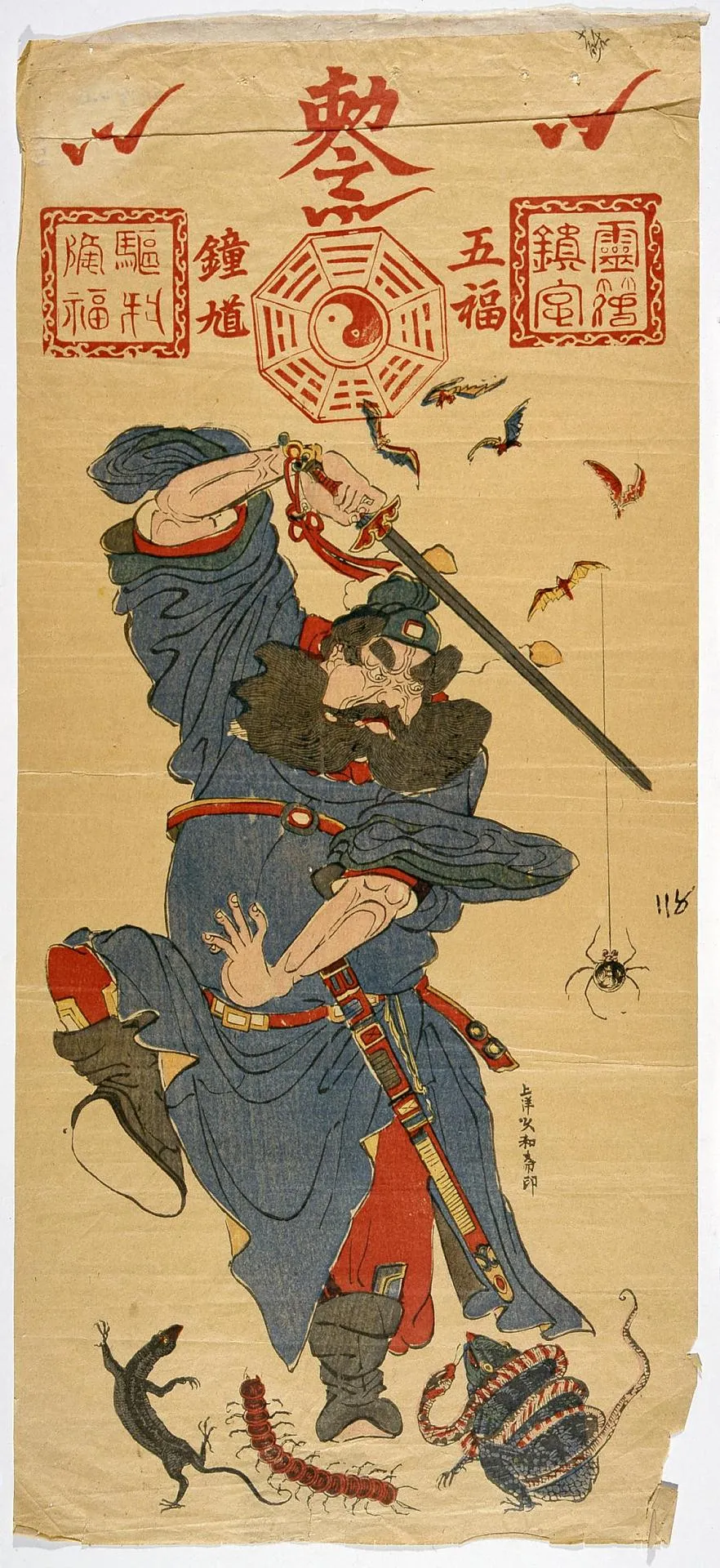
Among all deities in the Chinese pantheon, Zhong Kui boasts perhaps the most instantly recognizable visual identity. If Guanyin is defined by compassion and Guan Yu by loyalty, then Zhong Kui is defined by a paradoxical duality — ugliness combined with fearsome power. This visual system was not the invention of any single painter. It is a collective achievement, refined over a millennium by imperial court artists, literati painters, and anonymous folk artisans alike.
Viewed through the lens of semiotics, every element of Zhong Kui's depiction — his facial features, garments, held objects, mounts, and attendants — functions as a legible cultural sign. These signs appear in stable combinations, forming a visual grammar so consistent that Zhong Kui can be identified immediately regardless of medium, style, or era.
The Canonical Face: Leopard Head, Ring Eyes, Iron Skin, and Dragon Beard
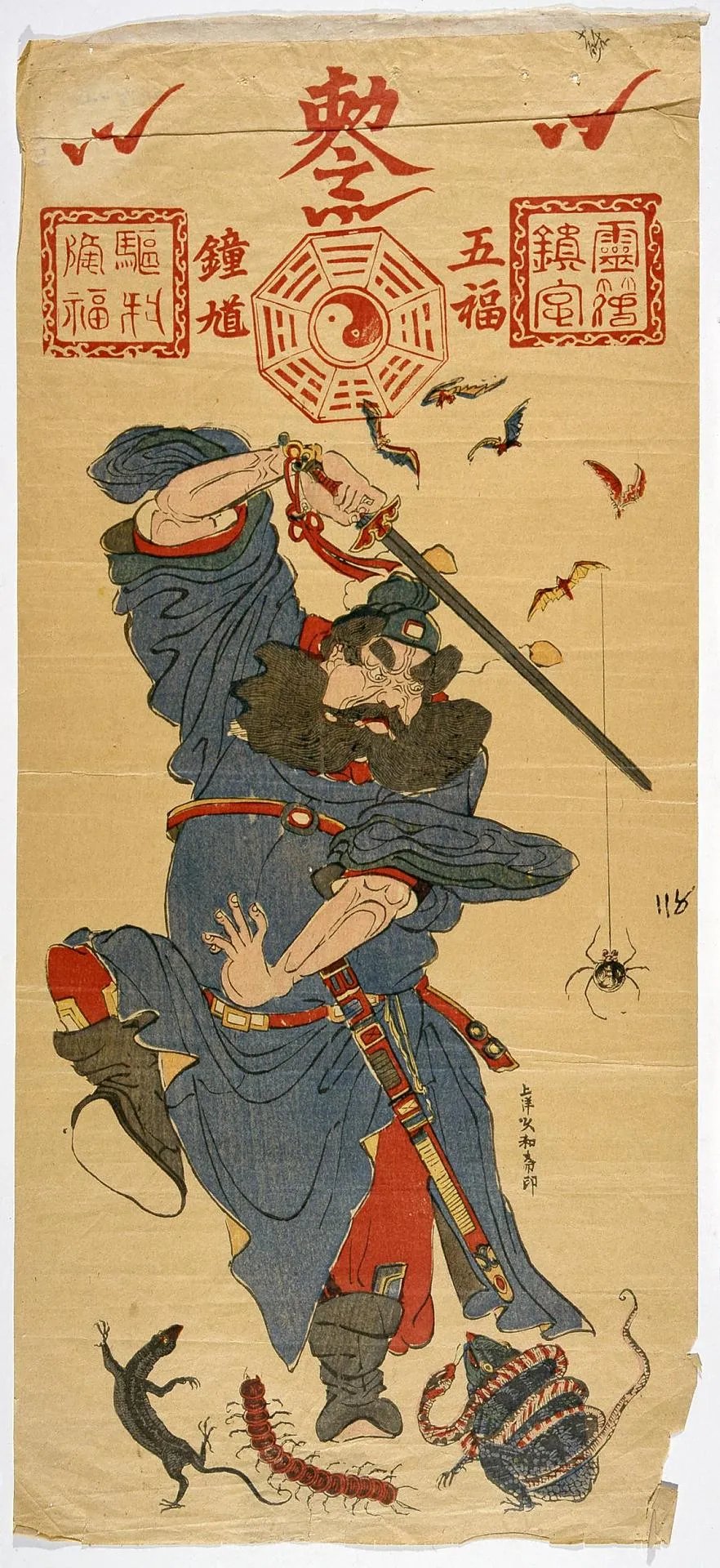
Zhong Kui's standard portrait solidified during the Tang dynasty. The earliest textual anchor appears in Emperor Xuanzong's dream account, relayed to the painter Wu Daozi — he described seeing a "great ghost with a bristling beard covering his entire face" (Su E, Duyang Zabian 杜阳杂编). Over centuries of artistic iteration, these facial traits were codified into a four-part formula: leopard head, ring eyes, iron face, and dragon beard.
Leopard Head describes a broad skull with a prominent, jutting brow — a visual shorthand for raw martial power. In folk New Year prints (nianhua 年画), this feature was often exaggerated into an almost square-jawed physiognomy, maximizing visual impact at a glance.
Ring Eyes refers to wide, glaring eyes. The word "ring" (huan 环) is surgically precise: not merely "large eyes," but eyes that bulge like bronze rings, with an inescapable, piercing gaze. In Zhong Kui paintings, the eyes carry the greatest semiotic weight. His glare is the visual embodiment of exorcistic authority — according to popular belief, demons are most terrified of being seen. Zhong Kui's ring eyes represent an all-seeing stare from which no evil spirit can hide.
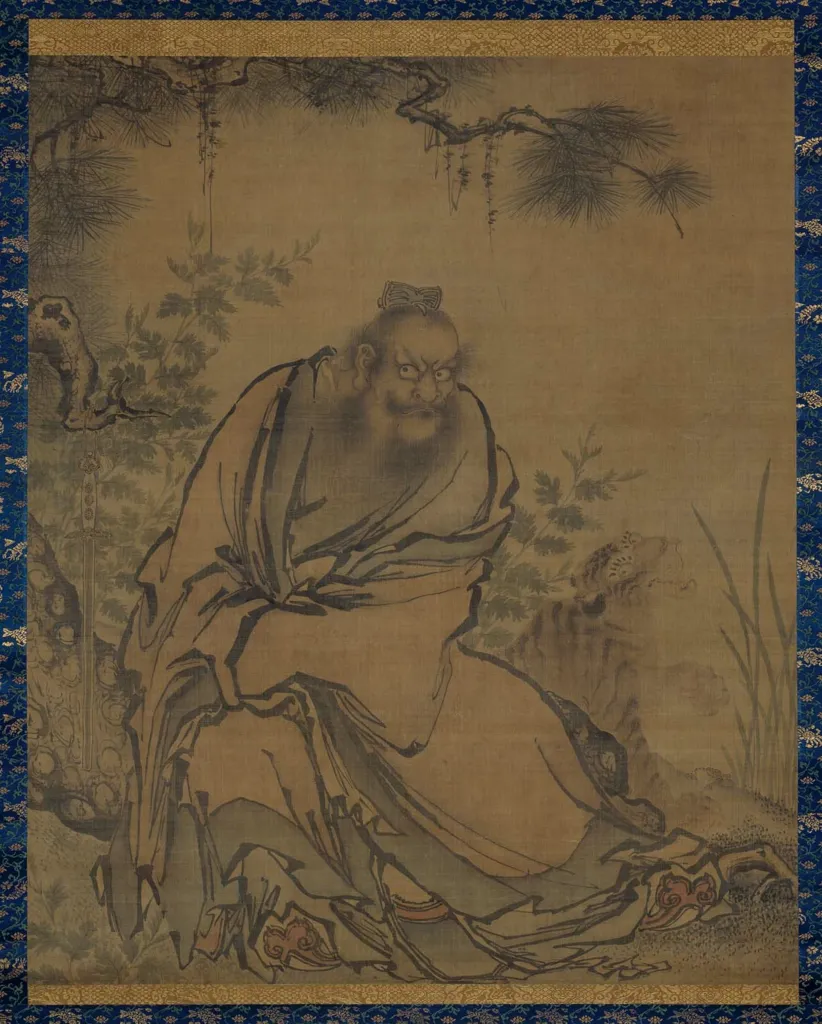
Iron Face carries a deliberate double meaning: skin as dark as iron, and a reputation for absolute impartiality. The color treatment varies by artistic tradition. Literati paintings favor a restrained approach, using diluted ochre and ink washes for subtlety. Folk prints, by contrast, deploy heavy blacks and dark reds, emphasizing the metallic toughness and raw energy implied by "iron."
Dragon Beard describes a thick, curling mass of facial hair. The word "dragon" (qiu 虬) originally denotes a coiled serpent, and when applied to Zhong Kui's beard, it implies that even in human form, he commands the authority of a dragon. The brushwork differs by school: literati painters use a dry, split-tip brush for a wispy, windswept quality, while folk artisans favor bold, hooked arcs of dense ink to convey coiled energy.
Together, these four traits compose an unmistakable visual signature — a face pushed to the extreme of ugliness and, simultaneously, to the extreme of martial grandeur. Importantly, this canonical formula is remarkably elastic across media and periods. Under a literatus's brush, Zhong Kui's face might betray melancholy or philosophical withdrawal; in folk art, it amplifies the raw shock value of the glare and the beard.
The Sword and Demon-Slaying: Evolution of a Weapon Sign
Zhong Kui is almost never depicted empty-handed — his most iconic attribute is the demon-slaying sword.
The sword underwent a fascinating semiotic evolution in Zhong Kui's iconography. In the earliest Tang dynasty legends, Zhong Kui "catches" ghosts rather than "slays" them — in the emperor's dream, he gouged out a demon's eyes and swallowed them bare-handed. Wu Daozi's original painting, according to historical records, likewise depicted Zhong Kui grasping a demon with his bare hands.
The sword appeared and became standardized roughly between the Five Dynasties and Song periods. In the works of Shi Ge and Gong Kai, the sword was already an indispensable fixture. This transformation is closely tied to Daoism's absorption of Zhong Kui into its pantheon. Within the Daoist system, the sword is the paramount ritual instrument — Celestial Masters Zhang Daoling, Xu Jingyang, and the immortal Lü Dongbin are all sword-bearing figures. Once Zhong Kui was enshrined as a "True Lord of Demon Quelling" (qu mo zhen jun 驱魔真君), he naturally required a sword to match his elevated theological status.
Zhong Kui's sword appears in several canonical compositional modes:
Held Point-Down (Dao Ti Bao Jian 倒提宝剑): The blade points downward with the hilt in hand. This is the most common pose, suggesting Zhong Kui has just finished slaying a demon and has not yet sheathed his weapon — ready to strike again at any moment. It is the most dynamic of the standard poses.
Raised Mid-Strike (Hui Jian Zhan Gui 挥剑斩鬼): The sword is held high, about to descend upon a cowering demon. This is the most dramatic composition, prevalent in New Year prints and temple murals.
Slung Across the Back (Fu Jian 负剑): The sword is carried behind the shoulders, with only the hilt visible. This more restrained pose suggests Zhong Kui is not currently in combat, but his power remains on standby. It appears primarily in literati scroll paintings.
In folk belief, Zhong Kui's sword itself became an independent apotropaic object. In some regions, New Year prints depicted only the sword without Zhong Kui, or the sword motif was printed on yellow paper and used as a talisman — the weapon evolved from an attribute of the deity into a free-standing exorcistic sign.
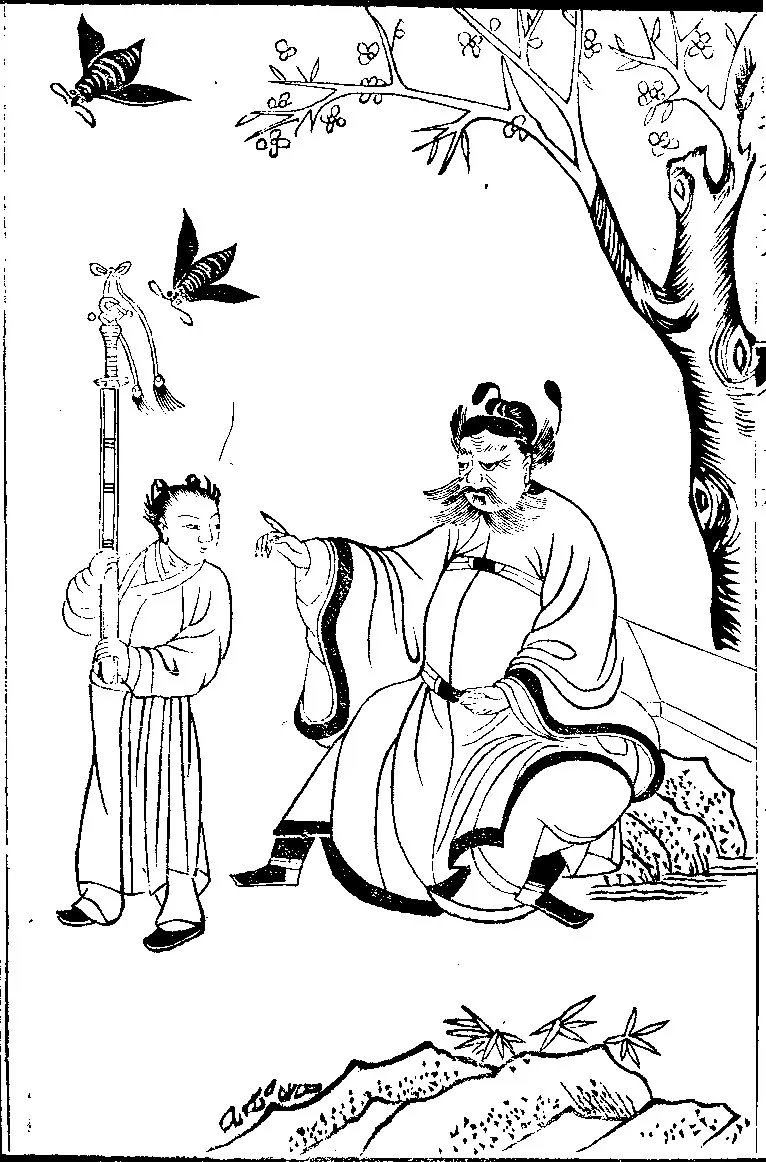
16th-century Zhong Kui Illustration
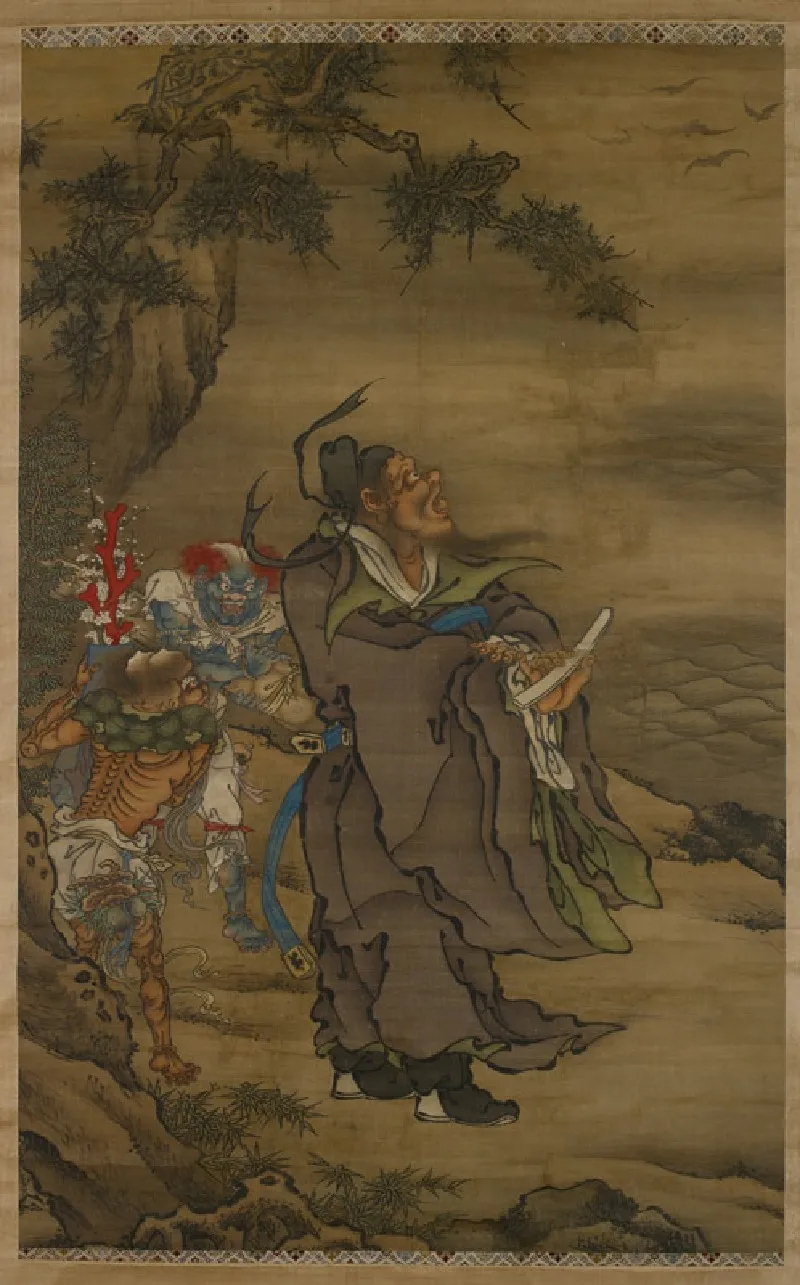
Zhong Kui and the Five Bats
Bats and Fortune: The Homophonic Symbol System
The most ingenious symbolic device in Zhong Kui's iconography is the bat.
The union of Zhong Kui and bats rests on a concise linguistic pun: the word for bat (fu 蝠) is a homophone for fortune (fu 福). Zhong Kui is the god who drives away evil; the bat represents incoming blessings. Together, they encode the message "exorcise evil and bestow fortune" (qu xie jiang fu 驱邪降福). This homophonic symbol system matured during the Ming and Qing dynasties and became the most ubiquitous accessory motif in Zhong Kui imagery.
The most classic formula is the "Five-Bat Zhong Kui" (Wu Fu Zhong Kui 五蝠钟馗) — five bats circling the deity in flight, representing the "Five Blessings Arriving at the Door" (wu fu lin men 五福临门). The Five Blessings originate in the Book of Documents (Shangshu 尚书), specifically the "Great Plan" (Hongfan 洪范) chapter: "The first is longevity, the second is prosperity, the third is health and peace, the fourth is love of virtue, and the fifth is a natural death at the end of one's allotted span." A celebrated Ming dynasty painting, Zhong Kui Driving Out Evil and Bringing Blessings, exemplifies this schema perfectly: a commanding Zhong Kui occupies the center while five bats flutter around him, accompanied by attendant demons carrying auspicious objects — a vase (ping 瓶, homophone for "peace" 平), red coral (hong 红, homophone for "good fortune" 红), and lingzhi fungus (a symbol of longevity).
The directional placement of bats also carries meaning: flying upward signifies "fortune descending from heaven," flying downward means "fortune rising from the earth," and circling Zhong Kui represents "fortune revolving around you." In some prints, a bat flies directly toward Zhong Kui's face as though delivering a report — a composition interpreted as "guiding fortune into the home" (yin fu gui tang 引福归堂).
The brilliance of the bat symbol lies in how it expands Zhong Kui's function from pure exorcism to active blessing. A Zhong Kui who only slays demons has limited practical appeal; a Zhong Kui who both repels evil and attracts fortune satisfies the full spectrum of popular religious needs. This functional expansion was achieved entirely through visual addition, without requiring any textual explanation — a testament to the sophistication of China's visual culture of meaning-making through images.
The Aesthetics of Ugliness: Beauty in the Grotesque
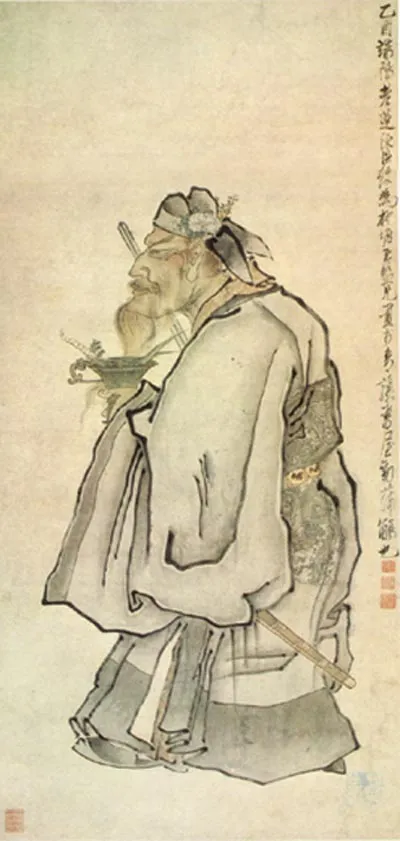
Perhaps the most thought-provoking semiotic question in Zhong Kui's iconography is his deliberate ugliness.
Traditional Chinese aesthetics never treated beauty and ugliness as absolute opposites. The philosophy of Zhuangzi (庄子) had already established the aesthetic potential of the grotesque — Zhili Shu in the chapter "Human World" (Ren Jian Shi 人间世) and Ai Tai Tuo in "Signs of Complete Virtue" (De Chong Fu 德充符) are both paragons of hideous exterior concealing inner spiritual abundance. In Zhong Kui's visual tradition, ugliness is precisely the outward manifestation of power: because he is ugly, the mortal world rejects him; because the mortal world rejects him, he transcends it and becomes divine.
Zhong Kui's ugliness is fundamentally functional ugliness. It does not serve aesthetic negation but rather religious intensification. In the logic of folk belief, demons terrify because of their horrifying appearance. Zhong Kui's ugliness enables him to fight fire with fire — uglier and fiercer than any demon, he alone can master them.
Literati painters handled Zhong Kui's ugliness with greater nuance. In the works of Gong Kai, Chen Hongshou, and Jin Nong, the grotesquerie carries an undercurrent of defiance and pathos — not mere ugliness, but the posture of someone wounded by fate who still refuses to bow. The Qing dynasty painter Gao Qipei was renowned for his finger paintings of Zhong Kui, pressing his ink-covered fingers directly onto paper. The resulting visage has a raw, improvised roughness, as though Zhong Kui has just risen from the mud. This technique, perhaps more than any polished polychrome rendering, captures the spiritual core of a man who died unjustly.
Official Robes and Identity: From Scholar to Ghost King
Zhong Kui's garments constitute the most narratively rich element in his visual vocabulary.
The core of Zhong Kui's identity is his status as the "Scholar of Zhongnan" (Zhongnan Jinshi 终南进士) — a man who passed the imperial examinations yet was stripped of his appointment because of his hideous face. In the Tang dynasty legend, Zhong Kui was buried in a green robe bestowed by the emperor (green being the official dress color for officials below the sixth rank in the Tang). This robe is the material proof of his earned scholarly status. Over time, however, the color of his robe in visual tradition shifted from green to red.
The red official robe became standard in Ming and Qing iconography for several reasons. Red is an apotropaic color in Chinese culture — ideal for a demon-quelling deity. Red is also the color of celebration, making Zhong Kui more auspicious in New Year print contexts. Additionally, popular memory over the centuries likely conflated the emperor's gift of a burial robe with the most prestigious color possible — red.
The style of Zhong Kui's official dress also varies. In literati paintings, he typically wears a round-collared, wide-sleeved official gown with a jade belt and a futou headpiece — standard Tang dynasty scholar-official attire. In folk prints, his wardrobe is more diverse: sometimes a python robe (mang pao 蟒袍), implying his elevated rank as King of Ghosts; sometimes armor, emphasizing his martial function; occasionally even a plain cloth shirt, returning him to his humble origins.
The futou (幞头) headpiece is a constant across almost all depictions. This was the formal headwear of Tang and Song dynasty officials. Zhong Kui wearing a futou asserts his identity as a jinshi degree-holder — even in the afterlife, he has never removed this symbol of academic achievement. The detail carries a profound irony: a man denied office because of his appearance spends eternity dressed in official robes.
Mounts and Mobility: The Tiger, the Donkey, and the Baize Beast
Zhong Kui's mode of travel constitutes an often-overlooked but symbolically rich dimension of his iconography.
In early images, Zhong Kui is typically on foot — a demon-queller who walks among the living, requiring no mount. But as his visual identity grew more elaborate, several mounts became standardized.
The Tiger is the most common. In Chinese culture, the tiger is king of all beasts and possesses innate demonifuge properties. Zhong Kui mounted on a tiger combines the two most powerful exorcistic symbols into a single image, effectively doubling the apotropaic force. Tiger-riding Zhong Kui images are especially prevalent in southern Chinese New Year prints, possibly linked to regional traditions of tiger worship.
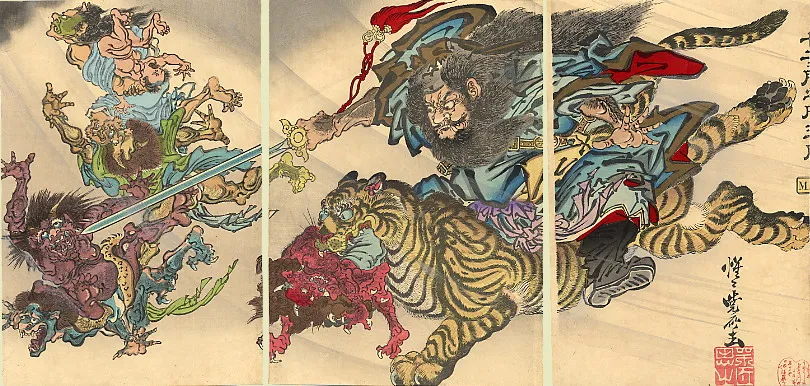
The Donkey belongs specifically to the "Zhong Kui Marries Off His Sister" (Zhong Kui Jia Mei 钟馗嫁妹) composition. Zhong Kui riding a donkey to escort his sister to her wedding carries a dual significance: the donkey is the humble mount of a poor scholar, suggesting that even after apotheosis, Zhong Kui retains his modest roots. The donkey's gentle temperament also contrasts with the tiger's ferocity, befitting the tenderness of a brother's wedding escort.
The Baize is the rarest and most intellectually layered mount. The Baize is a mythical beast from ancient Chinese cosmology, said to possess knowledge of every demon and ghost in existence. According to legend, when the Yellow Emperor traveled to the eastern sea, the Baize recited the forms and names of 11,520 types of supernatural creatures, which the emperor's scribes recorded in the Baize Tu (白泽图, "Diagrams of the Baize"). Zhong Kui riding the Baize implies that he commands the ability to identify every type of evil spirit — a perfect match with the Baize's "knower of demons" function, forming an exquisitely precise symbolic union.
Modern Decodings: The Living Sign System
In the modern era, Zhong Kui's symbol system has not faded with the decline of popular religion. Instead, contemporary artists and designers have reinterpreted these signs for new contexts.
In modern ink painting, Zhong Kui's sword is sometimes replaced by a fountain pen or calligraphy brush — demon-slaying becomes social satire, and Zhong Kui transforms from an exorcist into a critic of corruption and injustice. In comics and animation, his ring eyes and dragon beard are streamlined into geometric shapes, but the core identity of "ugly yet fierce" survives intact. In commercial design, the five-bat motif has been extracted as an independent auspicious pattern, widely used without any reference to Zhong Kui himself.
These contemporary adaptations prove that Zhong Kui's visual language possesses remarkable vitality and adaptability. Its core mechanisms — expressing beauty through ugliness, righteousness through ferocity, and humanity through the supernatural — continue to resonate with modern audiences. As the semiotician Roland Barthes observed, the power of myth lies in its capacity for infinite reinterpretation (Mythologies, 1957). Zhong Kui's visual code is precisely such a mythic system: one that can be endlessly rewritten and perpetually invested with new meaning.
Zhong Kui's imagery is a mirror. We think we are looking at a demon-quelling god, but what we actually see is every strategy that human beings have devised for confronting fear, injustice, and fate — glaring back, drawing the sword, transforming ugliness into power, turning misfortune into blessing. These visual codes were not invented. They were discovered — and they have always been there, on the door, in the painting, deep within our collective memory.
References:
- Gu Yanwu, Rizhi Lu (Record of Daily Knowledge), Vol. 7, entry on "Zhong Kui"
- Shen Kuo, Mengxi Bitan (Dream Pool Essays), Supplement
- Shangshu (Book of Documents), "Hongfan" (The Great Plan) chapter
- Zheng Zunren, Zhong Kui Yanjiu (Studies on Zhong Kui), Showwe Publishing, 2004
- Umberto Eco, A Theory of Semiotics, Indiana University Press, 1976
- Wang Shucun, Zhongguo Minjian Meishu Shi (History of Chinese Folk Art), Lingnan Fine Arts Publishing House, 2004