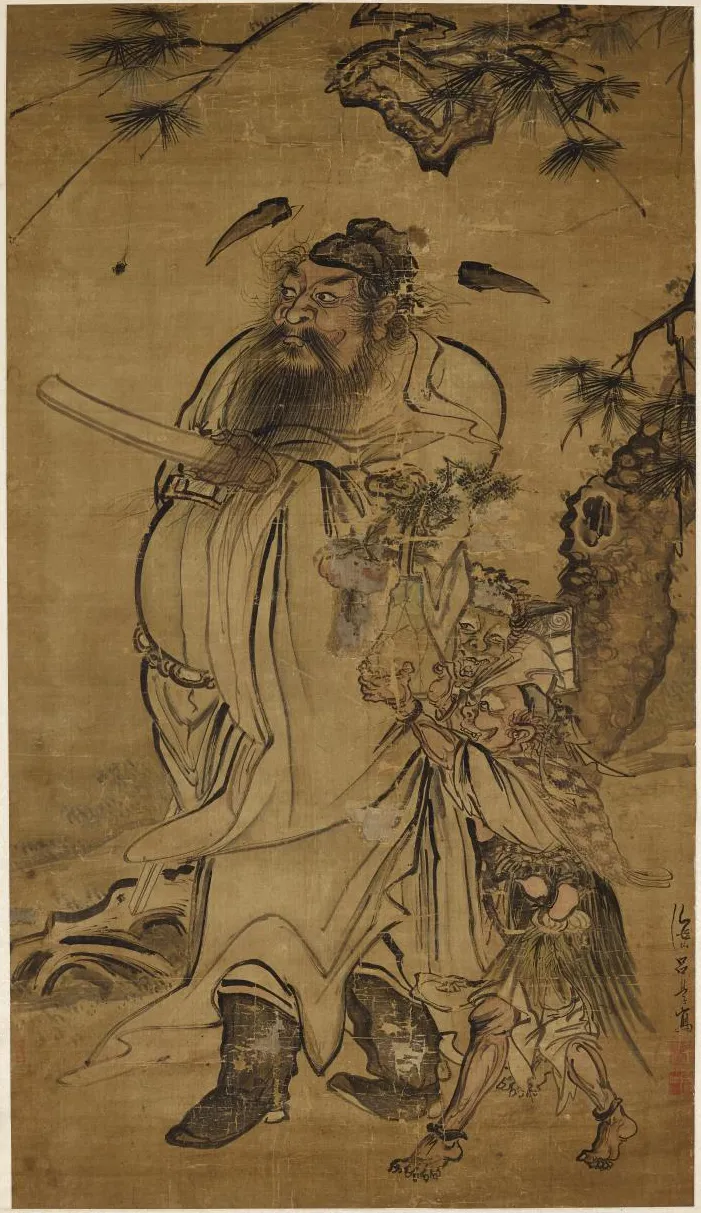
When Zhong Kui stepped off rice paper and woodblock prints to appear on cinema and television screens, his image underwent a visual revolution unlike anything in his previous thousand-year history. From black-and-white Taiwanese-language films of the 1960s to CGI-saturated fantasy epics of the 2010s, from mobile game avatars to whispered rumors of a blockbuster video game, the Ghost Catcher's modern media presence is richer and more varied than at any point since Wu Daozi first painted him during the Tang dynasty.
This richness is itself a compelling cultural puzzle. In a society dominated by scientific rationality, why does an ancient ghost-hunting deity still attract massive audiences and inspire legions of creators? The answer may lie in the timeless core of Zhong Kui's story — a man of extraordinary talent unjustly denied recognition because of his appearance, who found in death the power he was never granted in life. That narrative arc resonates in every era.
Early Cinema: Zhong Kui on the Silver Screen (1960s–1980s)
Taiwanese-Language Films and the First Screen Appearances
The earliest known film portrayals of Zhong Kui emerged in the Taiwanese Hokkien-language cinema (Taiyu pian) of the 1960s. During this brief but prolific golden age, supernatural themes were a staple of low-budget productions, and Zhong Kui — a major figure in Taiwanese folk religion — naturally became a recurring character. These films relied on simple practical effects to stage Zhong Kui's ghost-catching exploits, and their plots drew heavily from well-known folk narratives such as "Zhong Kui Marries Off His Sister" (Zhong Kui Jia Mei) and "Zhong Kui Slays the Five Poisonous Creatures" (Zhong Kui Zhan Wu Du).
Tragically, the majority of these early films have been lost to time, victims of Taiwan's tropical climate and inadequate preservation infrastructure. What survives exists primarily in newspaper advertisements and the fading memories of elderly viewers — fragmentary evidence of a cinematic tradition that deserves further scholarly attention.
Hong Kong and the Martial-Arts Influence
The 1970s and 1980s saw Hong Kong and Taiwanese supernatural cinema enter a new technological era. Advances in prosthetic makeup and miniature photography made on-screen demons more convincing, and Zhong Kui's adversaries evolved from traditional minor ghosts into a more diverse bestiary of monsters and spirits.
More significantly, this era's Zhong Kui films absorbed the kinetic vocabulary of the martial-arts genre — a direct influence of the Bruce Lee and Jackie Chan kung-fu craze that dominated Asian cinema throughout the 1970s. On screen, Zhong Kui was no longer limited to brandishing his demon-quelling sword; he now traded punches, leaped through the air, and engaged in extended choreographed combat sequences with supernatural foes. This martial reinvention would prove durable, shaping the character's action-oriented persona for decades to come.
Taiwanese Opera on Television
A parallel tradition emerged through Yang Li-hua's televised Taiwanese Opera (Gezai xi) productions, the most popular operatic program in Taiwan's broadcast history. When Zhong Kui appeared in these televised performances, he was rendered through the stylized movements and vocal techniques of traditional opera — a fascinating fusion of classical theater conventions with modern television aesthetics.
The Golden Age of Zhong Kui Television Dramas (1990s–2010s)
The 1994 "Heavenly Master Zhong Kui" (Tian Shi Zhong Kui)
In 1994, Taiwan produced the television series "Heavenly Master Zhong Kui," starring Jin Chao-qun in the title role. Jin was already a household name for his portrayal of the famously upright magistrate Bao Zheng, and his Zhong Kui carried forward that same iron-willed sense of justice — now augmented with martial-arts sequences and supernatural powers. Structured as an anthology, each episode arc presented Zhong Kui confronting a different demon or resolving a particular injustice, a format that proved popular with audiences and allowed for enormous narrative flexibility.
The 2010 Mainland Reboot
A new production of "Heavenly Master Zhong Kui" (also marketed as "Heavenly Master Zhong Kui: Tales of Beauty") premiered in 2010, this time produced in mainland China with Bobby Au-yeung (Ouyang Zhenhua) in the lead role. This version represented a quantum leap in production values — grander sets, more elaborate visual effects, and significantly more complex storytelling.
Au-yeung's interpretation of Zhong Kui was notably different from his predecessors. Alongside the character's trademark ferocity, he introduced warmth and humor, transforming Zhong Kui from an implacable spirit of vengeance into a more approachable and emotionally rounded "Heavenly Master." This humanizing approach proved influential, setting a template that subsequent productions would follow.
"The Legend of Zhong Kui" (Zhong Kui Chuan Shuo, 2012)
In 2012, Bobby Au-yeung returned to the role in "The Legend of Zhong Kui," a 40-episode series produced by Huace Media and broadcast on Hunan TV's prestigious Golden Eagle primetime slot. The production assembled a star-studded cast including Pan Changjiang, Patrick Tam (Tan Yaowen), and Hu Bing, and explicitly promised audiences a fusion of "internet trending slang, dazzling animated special effects," and a genre cocktail spanning "mythology, fantasy, romance, martial arts, suspense, and horror."
Technically, the series marked a significant milestone. Zhong Kui's magical abilities — the blinding light of his sword, the grotesque transformations of demons, the climactic supernatural battles — were all rendered through CGI, pushing the visual boundaries of what Chinese television drama had previously achieved.
The Anthology Structure as Creative Engine
All of these television productions shared a defining structural feature: anthology-based storytelling. Each series was composed of semi-independent story arcs featuring different monsters and human dramas, with Zhong Kui as the connective thread running through them all. This format gave screenwriters remarkable creative freedom — they could draw from classical folklore, invent entirely new narratives, or weave in contemporary social commentary, all within a single season.
Zhong Kui on the Big Screen: "Zhong Kui: Snow Girl and the Dark Crystal" (2015)
A 200-Million-Yuan Spectacle
The summit of Zhong Kui's cinematic career arrived on February 19, 2015 — Chinese New Year's Day — with the release of "Zhong Kui: Snow Girl and the Dark Crystal" (Zhong Kui Fu Mo: Xue Yao Mo Ling). Co-directed by Zhao Tianyu and Peter Pau (Bao Dexi), the film starred Chen Kun as Zhong Kui and Li Bingbing as the Snow Demon, with support from Winston Chao (Zhao Wen-xuan), Yang Zishan, and Bao Bei'er.
With a reported production budget of 200 million RMB, the film was shot and released in 3D and ultimately grossed 411 million RMB at the Chinese box office (Box Office Mojo; cbooo.cn). Peter Pau, an Academy Award-winning cinematographer for his work on "Crouching Tiger, Hidden Dragon" (Wohu Canglong, 2000), brought a Hollywood-caliber visual sensibility to the production, while composer Javier Navarrete contributed an internationally flavored orchestral score.
The Controversy of the Handsome Zhong Kui
The film's most provocative creative decision was its complete abandonment of Zhong Kui's legendary ugliness. Chen Kun, one of Chinese cinema's most celebrated leading men, portrayed Zhong Kui as a strikingly handsome young warrior — a radical departure from the classical description of a man with a "leopard's head and ring-like eyes" (bao tou huan yan), whose disfigurement was the very reason he was denied the scholarly honors he had earned.
This aesthetic choice provoked fierce debate. Traditionalists argued that stripping away Zhong Kui's ugliness gutted the moral architecture of his myth — the injustice he suffered was inseparable from his appearance. Defenders countered that creative adaptation was both legitimate and necessary, and that a handsome Zhong Kui could still embody the character's essential themes of justice and sacrifice.
The romantic subplot between Zhong Kui and the Snow Demon, which formed the emotional spine of the film, further intensified this debate. Critics noted that the love story, while commercially savvy, shifted the narrative's center of gravity away from Zhong Kui's defining tragedy and toward a more conventional fantasy romance.
Visual Triumphs and Narrative Shortcomings
Visually, "Snow Girl and the Dark Crystal" represented the state of the art in Chinese 3D fantasy filmmaking. Zhong Kui's demon-slaying sword erupted in photorealistic cascades of light, the underworld landscapes were rendered with architectural ambition, and the creature designs achieved a convincing balance between traditional Chinese iconography and contemporary visual sensibilities.
Yet critical reception was mixed. A recurring critique held that the film's spectacular effects had overwhelmed its storytelling. The traditional spiritual core of the Zhong Kui myth — a brilliant man wronged by a shallow world, who transforms his suffering into righteous power — was, in the view of many reviewers, buried beneath layers of visual spectacle.
The Streaming Era and Low-Budget Productions
Beyond the major studio releases, the explosion of China's online streaming ecosystem has sustained a steady pipeline of lower-budget Zhong Kui films. Between 2020 and 2025 alone, numerous Zhong Kui-themed productions debuted on streaming platforms, their quality varying widely but their existence testifying to the enduring commercial viability of the character. The streaming era has effectively lowered the barriers to entry for Zhong Kui storytelling, ensuring that even without blockbuster budgets, the Ghost Catcher continues to find new audiences.
Animation and Gaming: Zhong Kui in Digital Culture
From Traditional Opera to Anime Aesthetics
In Chinese animation, Zhong Kui has undergone a visual transformation as dramatic as any live-action reinvention. Some animated productions have reimagined him as a hot-blooded youth or a冷酷帅气的战士, abandoning the classical "leopard head and glaring eyes" entirely in favor of aesthetics drawn from Japanese anime and Chinese web novel illustration. This stylistic shift has found a market among younger viewers but has also reignited debates about the preservation and dilution of traditional cultural imagery.
Zhong Kui in "Honor of Kings" (Wangzhe Rongyao)
The most widely encountered digital Zhong Kui is arguably his incarnation in "Honor of Kings" (Wangzhe Rongyao), Tencent's phenomenally popular mobile MOBA game, which boasts over 100 million daily active players. In the game, Zhong Kui is a playable character whose core mechanic revolves around a chain-hook ability — a clever game-design translation of his ghost-catching prowess. Visually, this Zhong Kui is a hybrid: he retains the flowing beard, official robes, and demon-quelling sword that are his traditional iconographic signatures, but his proportions and facial design are calibrated to contemporary gaming aesthetics.
"Black Myth: Zhong Kui" — The Game That Could Redefine the Character
The most tantalizing prospect in Zhong Kui's digital future is the widely rumored "Black Myth: Zhong Kui." Following the explosive global success of Game Science's "Black Myth: Wukong" (Hei Shenhua: Wukong, 2024) — which sold over 10 million copies within days of release and became one of the most celebrated Chinese cultural exports in gaming history — speculation about a Zhong Kui installment has reached a fever pitch.
While no official announcement has been made, the concept alone speaks volumes about Zhong Kui's position in China's mythological IP hierarchy. He is, arguably, the mythological figure most naturally suited to follow Sun Wukong as a major game protagonist.
The game-design potential is enormous. Zhong Kui's ghost-catching abilities translate naturally into rich combat mechanics. His status as King of Ghosts in the underworld supports vast world-building possibilities. The demons, bats, swords, and talismans that populate his mythology are ready-made material for items, equipment, and boss encounters. And perhaps most importantly, Zhong Kui's emotional core — a wronged soul who achieves justice on his own terms in the afterlife — is precisely the "dark hero" archetype that has driven some of gaming's most beloved narratives.
How Modern Media Has Reimagined Zhong Kui: Three Key Trends
The Beautification of the Ghost Catcher
The most conspicuous trend across modern Zhong Kui media is the systematic handsome-ification of a character defined by his ugliness. From Chen Kun to Bobby Au-yeung, contemporary live-action Zhong Kuis are almost invariably conventionally attractive. The commercial logic is clear: star power drives box office, and marquee-name actors require leading-man aesthetics.
But the cultural implications run deeper. In the original myth, Zhong Kui's ugliness is not incidental — it is the engine of his entire narrative. He was denied the jinshi degree he had earned because the emperor found his face repulsive. That rejection drove him to suicide. His death transformed him into the Ghost King. Remove the ugliness, and the entire arc of injustice, despair, and posthumous redemption collapses. Modern adaptations that erase this feature are, in effect, severing the character from the very foundation of his mythological significance.
Role Diversification: Warrior, Lover, Detective, Comedian
Traditional Zhong Kui had a straightforward professional mandate: catch ghosts, exorcise evil. Modern media has dramatically expanded his portfolio. On screen, he is simultaneously a martial-arts fighter, a romantic lead, a source of comic relief, and a detective solving supernatural mysteries. This multifaceted character design adds dimensionality but also risks diluting the concentrated symbolic power that made Zhong Kui compelling in the first place.
The CGI Revolution and Its Discontents
The trajectory from practical makeup and miniature photography to full-CGI demon battles represents a technological leap as significant as the transition from woodblock prints to cinema itself. Yet the history of Zhong Kui on screen suggests that technological sophistication is no guarantee of narrative depth. The central creative challenge remains unchanged: how to harness visual spectacle in service of the character's moral and emotional core, rather than as a substitute for it.
What Remains: The Enduring Iconographic DNA
Through every visual reinvention, certain core elements persist: the demon-quelling sword, the official robes, the mission to protect the living from supernatural evil, the unwavering commitment to justice. These elements constitute Zhong Kui's iconographic DNA. However much his face, his enemies, or his special effects may change, audiences can still recognize him — because these essential markers endure.
Zhong Kui's journey through modern media is, in microcosm, the story of traditional Chinese culture navigating the demands of the contemporary marketplace. The balance between preservation and innovation is elusive, and not every adaptation finds it. But every attempt — successful or not — adds new layers of meaning to a figure who has been evolving for over thirteen centuries, proving that the Ghost Catcher is as resilient as he is adaptable.
The Zhong Kui on screen is an ancient soul in a new body. His face has changed — from grotesque to glamorous. His enemies have grown — from minor spirits to demon kings. His weapons have evolved — from an iron blade to cascades of digital light. But in the moment he draws his sword and fixes his gaze on injustice, you can still recognize him: the same Great Ghost who first opened his eyes under Wu Daozi's brush, thirteen hundred years ago. A millennium later, he has not put down that sword.
References:
- Zhong Kui: Snow Girl and the Dark Crystal (Zhong Kui Fu Mo: Xue Yao Mo Ling), dir. Zhao Tianyu & Peter Pau, 2015.
- The Legend of Zhong Kui (Zhong Kui Chuan Shuo), Huace Media, 2012.
- Heavenly Master Zhong Kui: Tales of Beauty (Tian Shi Zhong Kui: Meili Chuanshuo), 2010.
- Honor of Kings (Wangzhe Rongyao), Tencent Games — character database.
- Chinese box office data: cbooo.cn.
- Johnson, David, ed. Ritual Opera, Operatic Ritual: "Mu-lien Rescues His Mother" in Chinese Popular Culture. Berkeley: Chinese Popular Culture Project, 1989. [For context on supernatural figures in Chinese performance tradition.]