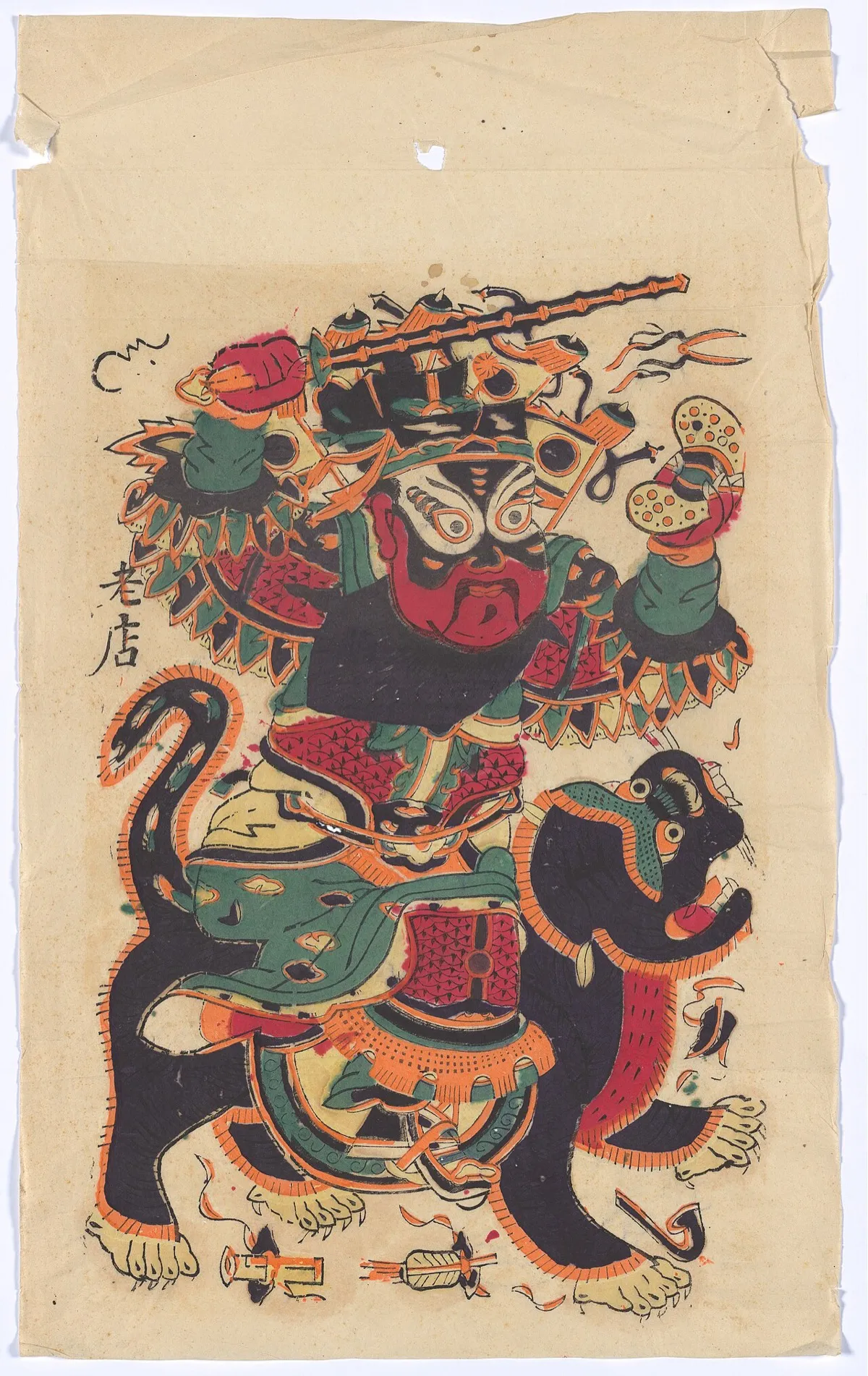
Among all forms of Chinese folk art, New Year pictures — known as nianhua — hold a singular place in both popularity and vitality. Each Lunar New Year, families across China paste fresh nianhua on their doors and walls, renewing a centuries-old ritual of banishing misfortune and welcoming prosperity. Of the countless subjects depicted in this tradition, none has commanded a more distinctive presence than Zhong Kui, the Demon Queller. He is the only nianhua figure who functions simultaneously as a door god, an independent deity, and a standalone artistic subject. His demon-quelling purpose, geographic reach, and visual diversity are unparalleled in the history of Chinese folk imagery.
From Imperial Dream to Household Door: The Origins of Zhong Kui as a Door God
Zhong Kui's role as a door god is inseparable from the origin story of Zhong Kui painting itself. The well-known legend holds that Emperor Xuanzong of the Tang Dynasty dreamed of a demon-quelling scholar, awoke cured of his fever, and commissioned the court painter Wu Daozi to capture the figure on silk. This foundational narrative already encodes a central premise: Zhong Kui's image is an extension of his supernatural power. The transition from the emperor's gifting of paintings to high-ranking officials to ordinary households hanging Zhong Kui prints for protection was a natural and inevitable evolution.
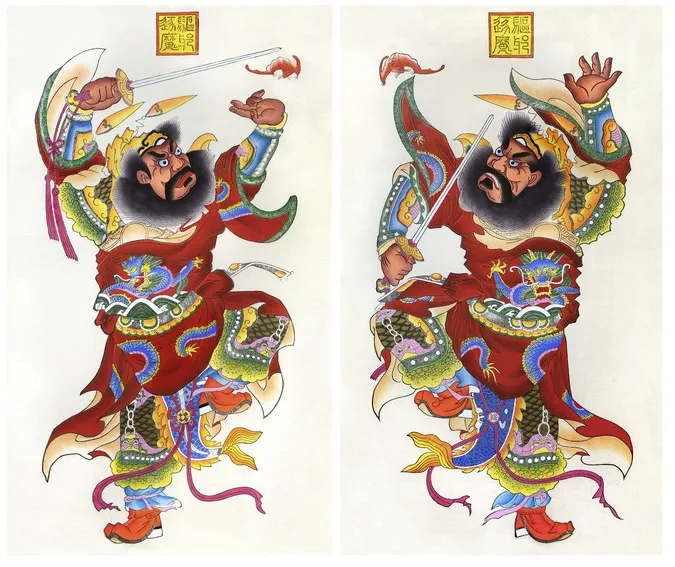
Yet Zhong Kui occupies a distinctive niche within the broader pantheon of Chinese door gods. The tradition of door guardians stretches back to the Han Dynasty, when the names of Shen Tu and Yu Lei were carved on peach-wood charms. After the Tang era, the warrior duo Qin Qiong and Yuchi Gong became the dominant pair for double-leaf doors. Zhong Kui, by contrast, typically served as a single-panel door god. Folk custom held that double doors received Qin Qiong and Yuchi Gong, while single doors were reserved for either Wei Zheng or Zhong Kui. This arrangement positioned Zhong Kui as a complement to the mainstream martial door gods rather than a direct competitor.
The crucial distinction lies in the nature of their authority. Qin Qiong and Yuchi Gong guard the threshold through military prowess and loyalty — their function is defensive. Zhong Kui, by contrast, takes the offensive: he wields his sword to hunt down and destroy demons outright. This difference profoundly shapes the visual character of Zhong Kui nianhua. Where the warrior door gods stand relatively still and sentinel-like, Zhong Kui is always in motion — brandishing a sword, seizing a demon, or glaring with righteous fury.
The timing of display further reveals the depth of Zhong Kui's cultic significance. The Ming imperial court maintained the custom of hanging Zhong Kui images on New Year's Eve. The scholar Shi Xuan recorded in his Jiujing Yishi (Recollections of the Old Capital) that "on New Year's Eve within the Forbidden City, every palace gate received new spring couplets and a silk painting of Zhong Kui." Beyond the New Year, however, the Dragon Boat Festival emerged as an equally important occasion for displaying Zhong Kui imagery. The Yanjing Sui Shi Ji (Record of Seasonal Customs in Beijing), compiled by Fucha Dunchong in the Qing Dynasty, notes that "at the Dragon Boat Festival, shops sold small paintings on yellow paper stamped with vermillion seals, depicting either the Celestial Master or Zhong Kui, or else charms against the Five Poisonous Creatures. Everyone in the capital competed to buy them, pasting them on the central door to ward off evil." This dual-season practice reflects a seasonal logic: the fifth lunar month marked the onset of summer heat, when epidemics were most likely to strike, and Zhong Kui's protective power was in peak demand.
Regional Traditions: Zhong Kui Across China's Major Nianhua Production Centers
China's woodblock nianhua tradition is anchored by seven renowned production centers — Taohuawu in Suzhou, Yangliuqing in Tianjin, Yangjiabu in Shandong, Mianzhu in Sichuan, Wuqiang in Hebei, Foshan in Guangdong, and Zhuxianzhen in Henan. Virtually every one of these centers produced Zhong Kui imagery, each inflecting the Demon Queller with its own regional aesthetic.
Yangliuqing, Tianjin: Courtly Refinement Meets Folk Grandeur
Yangliuqing is the most celebrated nianhua center in northern China, originating in the town of the same name in Tianjin's Xiqing District. Its lineage is traced to the late Northern Song Dynasty; legend holds that when Jin Dynasty forces swept south and carried Song Dynasty artisans northward, the sophisticated painting traditions of the capital found a new home — a transfer sometimes summarized as "the paintings of the Northern Song were transmitted to Yangliuqing." Scholars generally date the formal emergence of the Yangliuqing school to the Wanli reign of the Ming Dynasty, with its golden age spanning the Yongzheng, Qianlong, and Guangxu eras of the Qing.
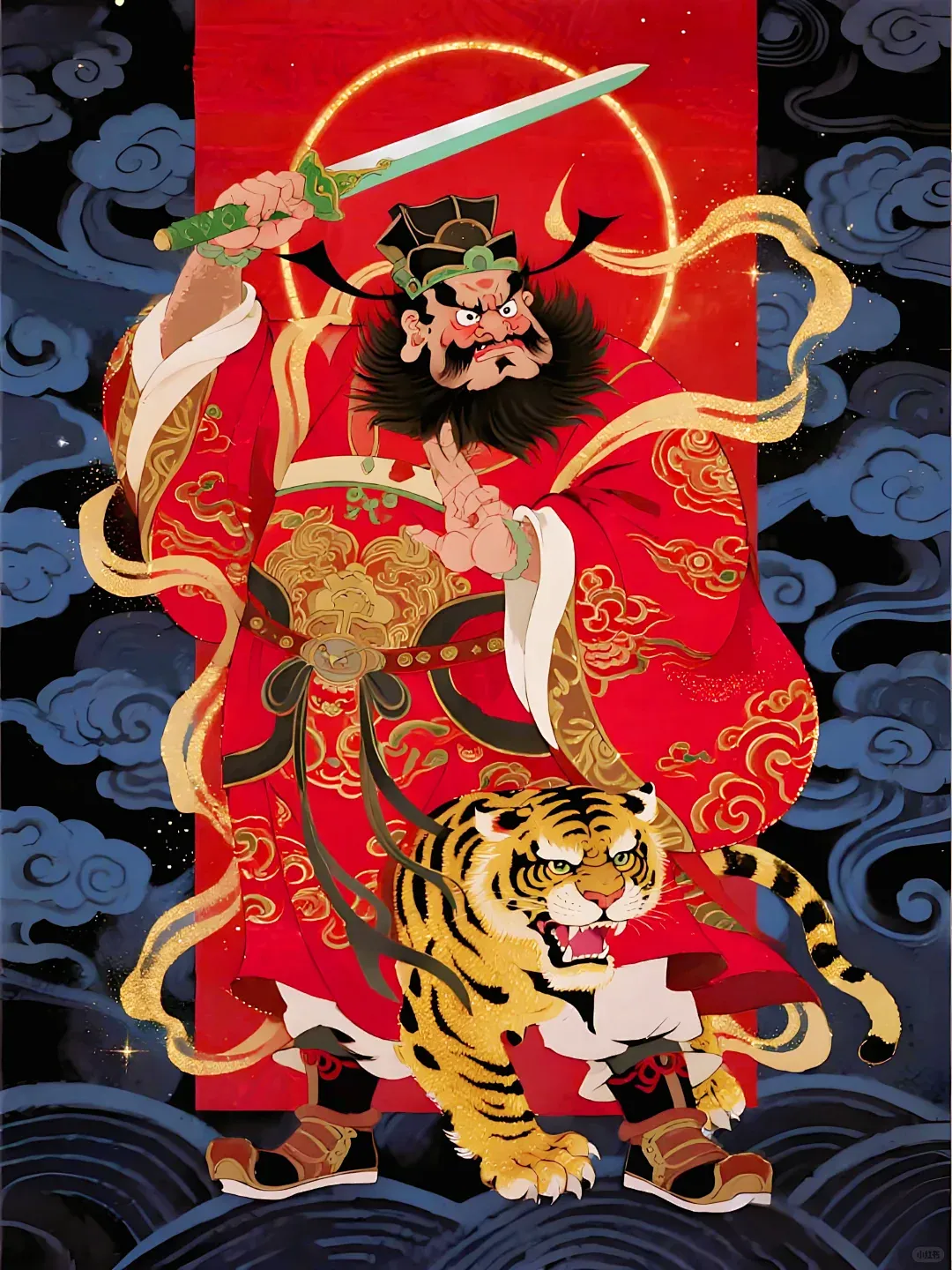
Yangliuqing nianhua is distinguished by its hybrid technique of woodblock outlines hand-colored with brush-applied pigments. Its Zhong Kui prints draw on the refined gongbi (meticulous brushwork) tradition of court painting, resulting in dignified figure modeling and sumptuous color. Zhong Kui's official robe is typically filled in with vermilion red, his face rendered in heavy ink and umber to convey the bristling beard and iron visage, and his sword outlined in gold or silver powder. The overall effect is simultaneously imposing and festive. Yangliuqing's Zhong Kui figures are most often shown standing, one hand gripping a sword and the other lifting a captured demon by the hair — fierce in posture yet tempered with an underlying geniality that embodies the northern aesthetic of grandeur, dignity, and celebration.
Taohuawu, Suzhou: Literati Elegance and Western Influences
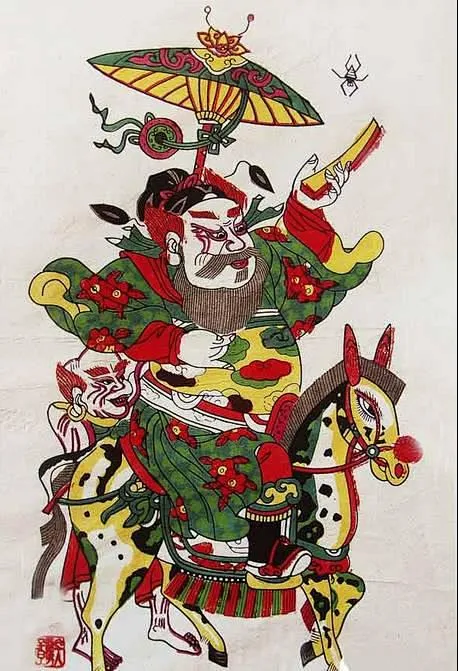
The Taohuawu woodblock nianhua tradition, centered in the Taohuawu quarter of Suzhou, arose in the mid-Ming period and flourished from the early Qing through the Taiping Heavenly Kingdom era. Together with Yangliuqing, it earned the paired epithet "South Peach, North Willow" — a recognition of their standing as the two greatest nianhua traditions in China. Taohuawu prints share the technique of printed outlines with hand-applied color, but are known for their bold palette and exuberant atmosphere.
Situated in the heartland of Jiangnan literati culture, Taohuawu nianhua imparted a distinctly scholarly sensibility to Zhong Kui's image. Early Taohuawu prints depict the Demon Queller with the fluent line work and restrained palette associated with wenrenhua, or literati painting, and his pose is more relaxed and expansive. During the Yongzheng and Qianlong reigns, the arrival of foreign missionaries in Suzhou introduced Western printmaking conventions, and certain Taohuawu Zhong Kui prints show the influence of European copperplate techniques, with shaded modeling that lends the face a heightened sense of volume and three-dimensionality.
Zhuxianzhen, Henan: Ancient Boldness from the Central Plains
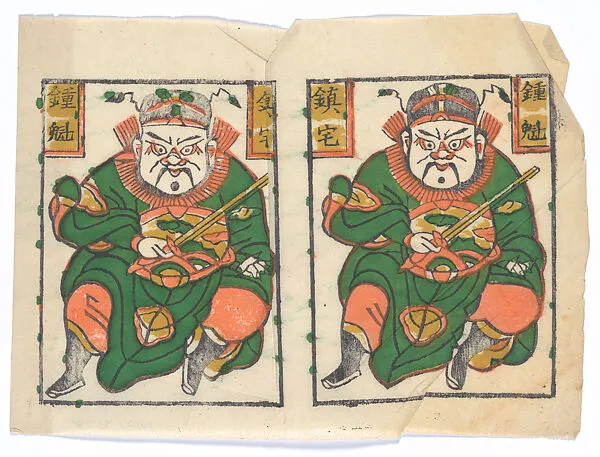
Zhuxianzhen, located near Kaifeng in Henan Province, preserves one of the oldest continuous nianhua traditions in China. Its prints are celebrated for their bold, vigorous linework and fierce color contrasts — pure, unmodulated reds, greens, yellows, and purples that produce an immediate and powerful visual impact. The Zhong Kui prints of Zhuxianzhen are characteristically dense in composition, with the Demon Queller dominating the center of the picture plane: squarely built, radiating authority, and embodying the rugged, forthright character of the Central Plains.
Wuqiang, Hebei: Functional Symbolism and Long-Range Legibility
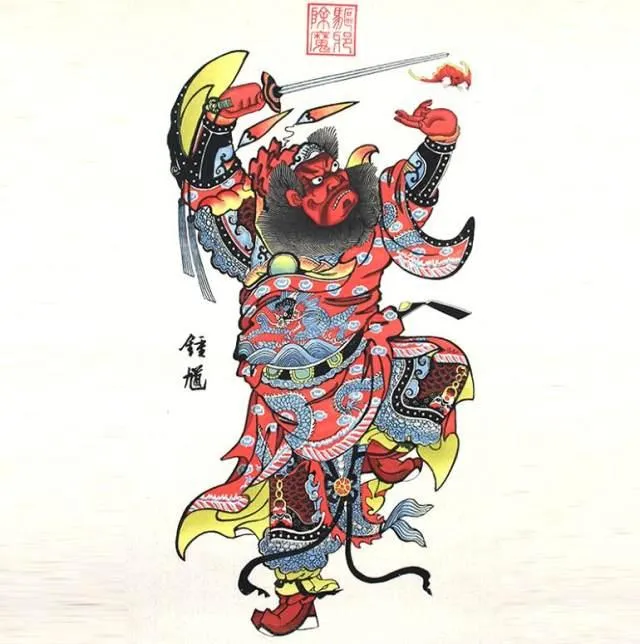
Wuqiang nianhua, from Wuqiang County in Hebei, is distinguished by its forceful line and stripped-down compositions. Wuqiang's Zhong Kui prints place a premium on immediate visual function: the deity's标志性 features — his leopard-like head, glaring eyes, and bristling beard — are deliberately exaggerated so that he can be identified at a glance. The palette favors bold reds and greens in sharp juxtaposition, a design strategy optimized for distance recognition. After all, the primary viewing context for a door-god print is not close inspection but a glance from across a courtyard — the moment a visitor or a wandering spirit sees the door, Zhong Kui must already be unmistakable.
Other Notable Centers
Yangjiabu in Shandong, Mianzhu in Sichuan, and Foshan in Guangdong all produced distinctive Zhong Kui prints of their own. Yangjiabu's versions carry the homespun directness of Shandong peasant painting. Mianzhu nianhua is famous for its "tianshuijiao" technique — a rapid method of applying broad washes of ink to the figure's robes, yielding an expressive, semi-calligraphic effect in its depiction of Zhong Kui. Foshan, situated in a region where devotion to Zhong Kui ran especially deep, produced an unusually wide variety of Demon Queller prints.
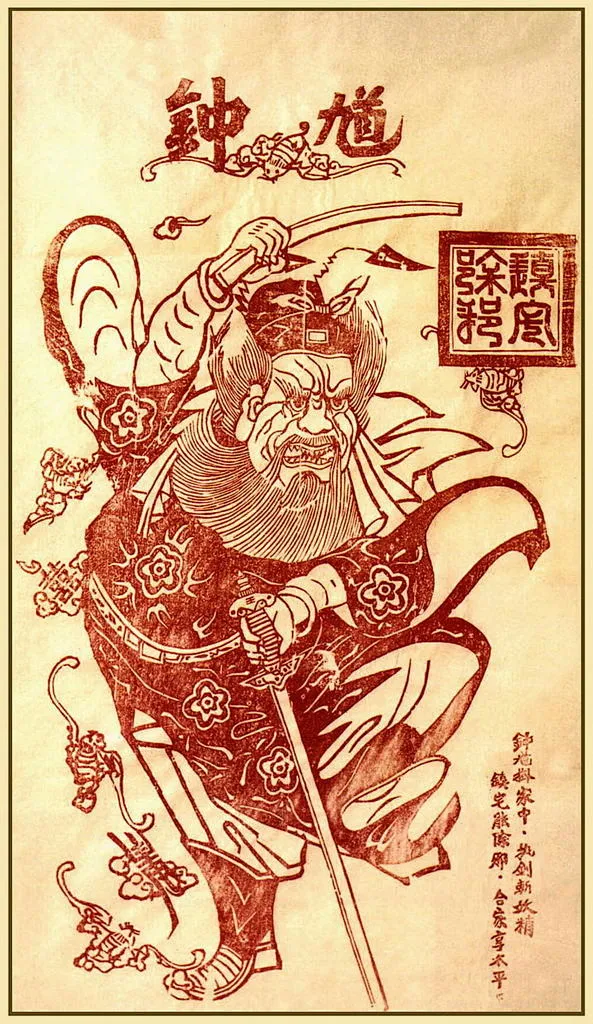
Classic Compositions: The Stable Iconographic Patterns of Zhong Kui Nianhua
Over centuries of development, Zhong Kui nianhua crystallized into a set of recognizable compositional types, each carrying distinct ritual significance and cultural meaning.
Sword-Brandishing Zhong Kui: The most fundamental and widely circulated type. Zhong Kui appears in his official robe, sword in one hand, eyes blazing. This composition descends directly from the Wu Daozi tradition of the "demon-catching" Zhong Kui, emphasizing the deity's martial authority and fearsome power to vanquish evil.
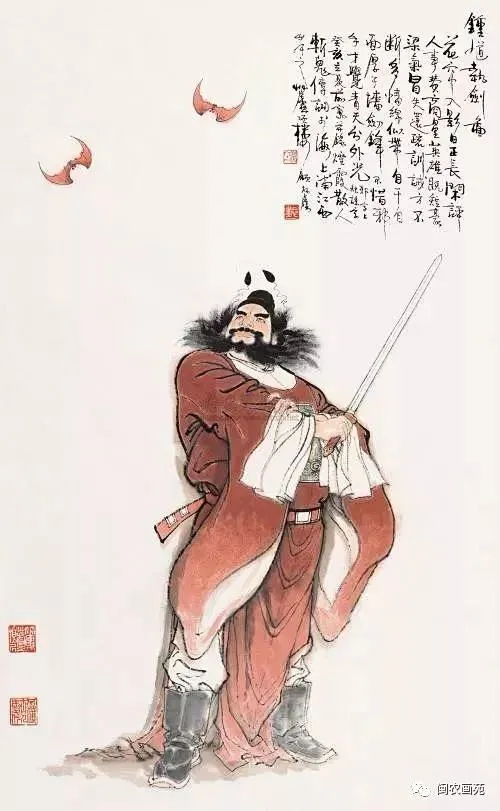
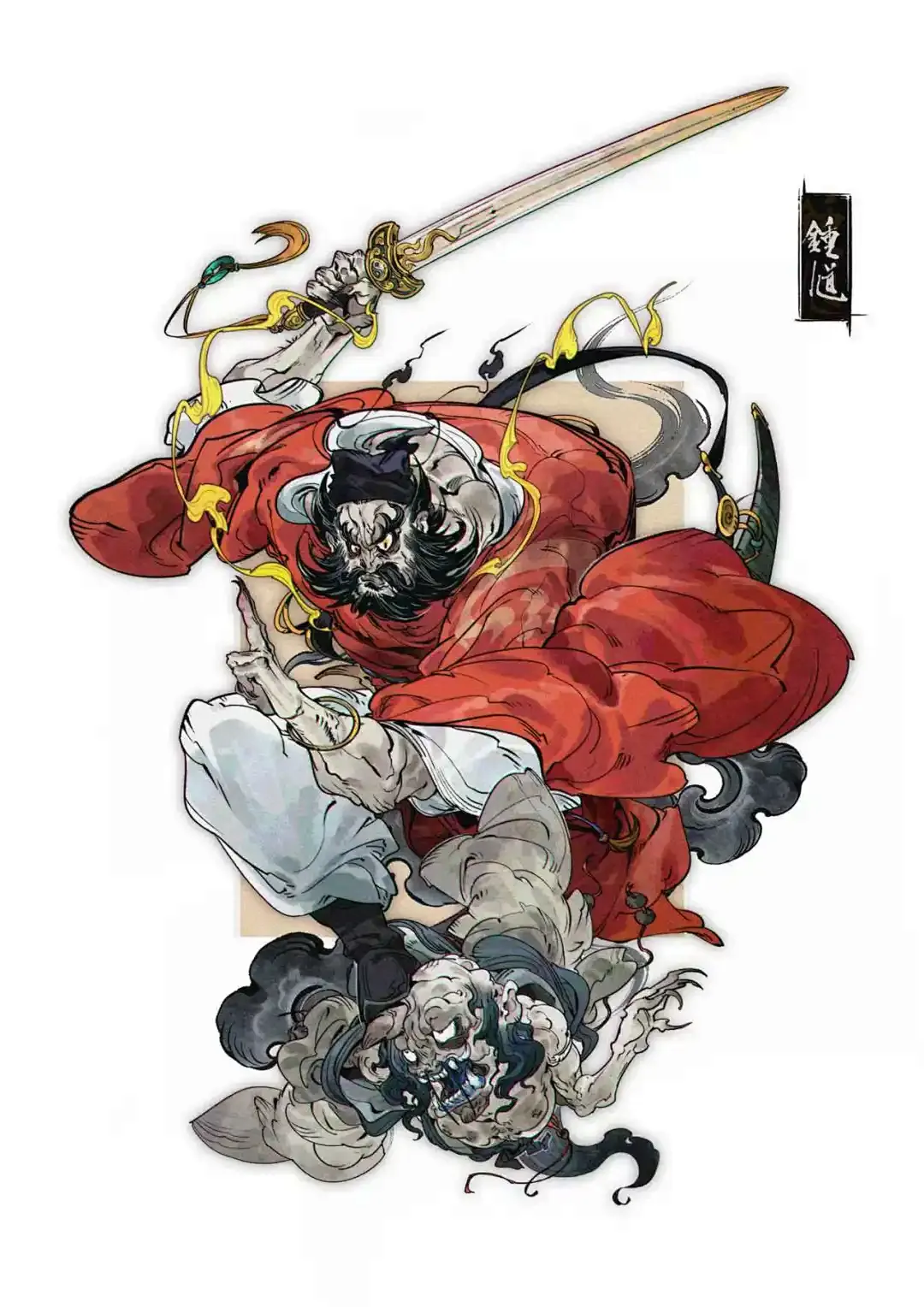
Demon-Seizing Zhong Kui: Zhong Kui grabs a small demon by the hair or collar with one hand while the other strikes or menaces. The captured demon is invariably depicted as cringing and grotesque, providing a comic-ominous counterpoint to Zhong Kui's overwhelming force. This is the most dramatic and widely beloved of all Zhong Kui nianhua types.
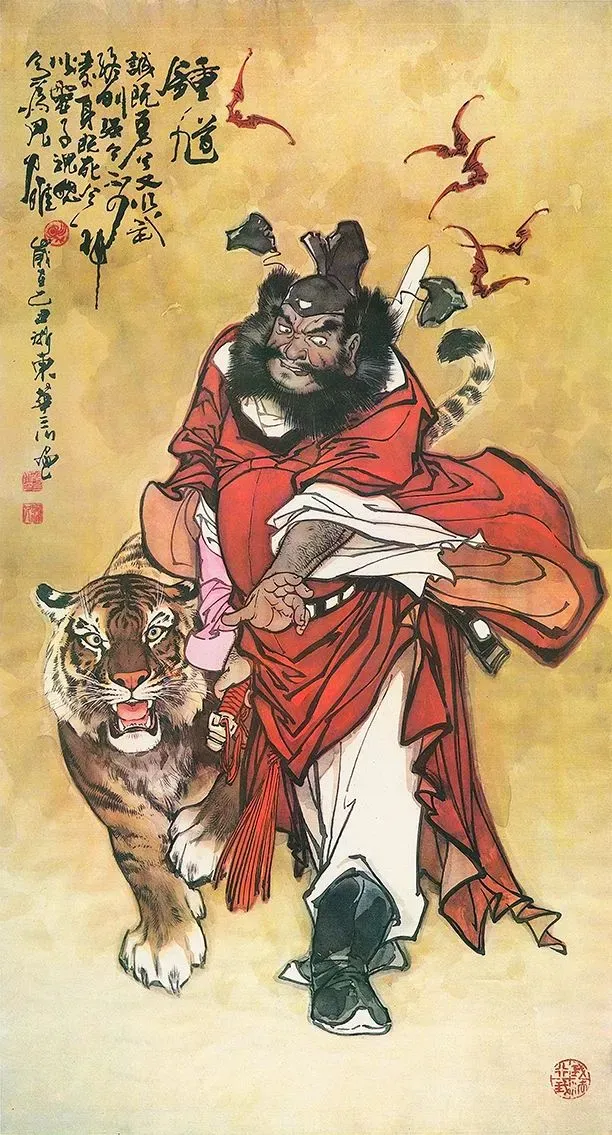
Tiger-Riding Zhong Kui: Zhong Kui sits astride a fierce tiger, sword raised. In Chinese folk belief, the tiger is itself an apotropaic animal — a creature that naturally repels evil. The image of the Demon Queller mounted on a beast of exorcism thus represents a doubling of protective power. This composition is especially common in southern nianhua traditions.
Wedding Procession Zhong Kui: This depicts the popular legend of Zhong Kui leading a retinue of demons to escort his sister to her wedding. The scene is bustling and festive: demon attendants carry palanquins, bear banners, and play musical instruments while Zhong Kui follows on a donkey. This is the only Zhong Kui nianhua type in which warmth and humor displace ferocity, and such prints were often used in wedding celebrations.
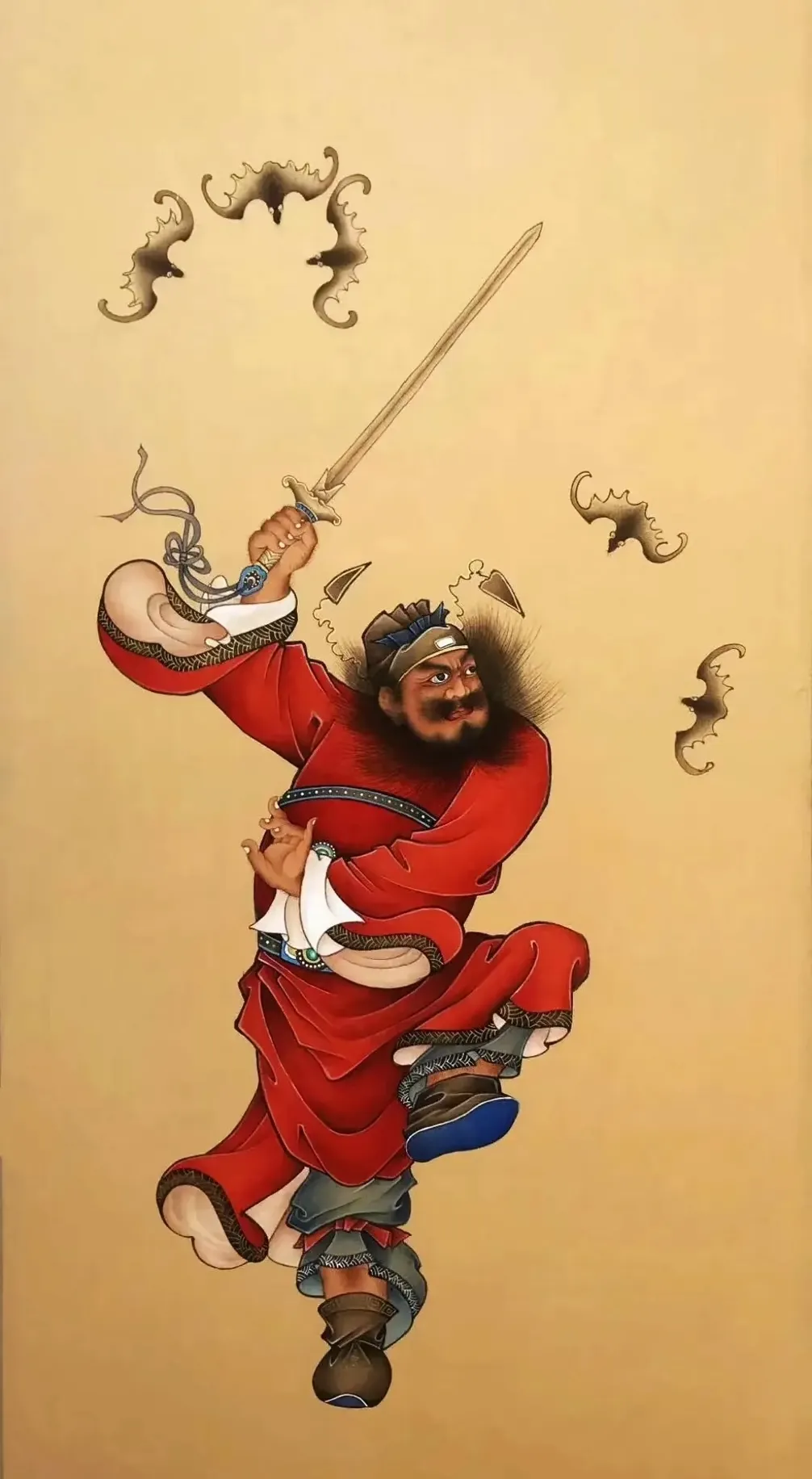
Five-Bat Zhong Kui: Zhong Kui surrounded by five bats. The Chinese word for bat, fu, is a homophone for "fortune," and the five bats symbolize the arrival of the Five Blessings — longevity, wealth, health, virtue, and a peaceful end. This composition transforms Zhong Kui from a demon queller into a bestower of good fortune, merging the functions of exorcism and blessing. The famous Ming Dynasty painting Zhong Kui the Demon Queller with Five Bats exemplifies this type.
The Color Code and Symbolic Vocabulary of Zhong Kui Nianhua
The palette of Zhong Kui nianhua functions as a precise symbolic language, not a matter of arbitrary aesthetic preference.
Red is the anchor of the entire color system. Zhong Kui's official robe is almost invariably red — a visual echo of the Tang Dynasty legend in which the emperor posthumously granted him a green burial robe, a detail that folk tradition gradually transformed into a vermilion garment. Red also draws on deep-rooted Chinese beliefs about the color's innate power to repel evil. Within the visual logic of nianhua, red is not merely a hue but an active apotropaic force.
Black defines the face and beard. Zhong Kui's "iron visage" and dense, curling whiskers are rendered in heavy ink. Far from connoting darkness or ill omen, black here signals strength and incorruptible rectitude — the visual source of the enduring association between Zhong Kui and the concept of "tie mian wu si," or impartial justice with a face of iron.
Gold is reserved for the sword and ornamental details. Zhong Kui's blade is frequently painted in gold powder or yellow pigment, distinguishing it as a supernatural weapon rather than an ordinary sword. The addition of gold also contributes to the festive atmosphere essential to nianhua.
Green and Purple appear in supporting roles — most often for the skin of demons or the lining of Zhong Kui's robe. These cooler tones provide chromatic contrast with the dominant red while symbolically evoking the cold, yin-associated realm of ghosts set against the warm, yang-infused world of the living.
Beyond color, Zhong Kui nianhua deploys a stable repertoire of accessory symbols: the bat for good fortune, the sword for demon-quelling power, the official seal referencing Zhong Kui's identity as a jinshi scholar, and the subjugated demon representing conquered evil. These elements appear in predictable combinations, forming a visual code that ordinary viewers could read at a glance.
Living Heritage: Zhong Kui Nianhua in the Modern Era
From the late Qing Dynasty onward, the rise of lithographic and offset printing devastated the traditional woodblock nianhua industry. Zhong Kui prints underwent the same transition from hand-colored woodblocks to machine reproduction. Yet the image of Zhong Kui did not fade — if anything, modern printing technology extended his reach further and faster than ever before.
In 2006, Yangliuqing woodblock nianhua was inscribed on China's national list of Intangible Cultural Heritage. Taohuawu, Zhuxianzhen, and Wuqiang followed in subsequent listings. Across these production centers, artisans and cultural authorities have made concerted efforts to preserve and revive the traditional craft of Zhong Kui nianhua. In Yangliuqing, hereditary practitioners still follow the five-stage process of outlining, carving, printing, hand-coloring, and mounting. In Zhuxianzhen, ancient woodblocks bearing Zhong Kui's bold ink outlines survive in workshop collections.
Few people today believe that pasting a Zhong Kui print on the door will literally repel demons. Yet the tradition endures. Each Lunar New Year and Dragon Boat Festival, families across China still hang Zhong Kui images — no longer as acts of supernatural protection, but as gestures of cultural memory and affectionate nostalgia for a way of life rooted in ritual, craft, and the deep symbolic grammar of folk art.
The Zhong Kui on the door is perhaps the most unpretentious and yet most profound expression of belief in all of Chinese folk art. Over a millennium ago, Wu Daozi fixed an emperor's dream on silk; in the centuries since, countless anonymous artisans have carved the same figure into woodblocks, printed it on paper, and pasted it on doorways across the land. From palace to village, from silk scroll to woodblock print, the journey of Zhong Kui is the journey of Chinese folk art itself — ceaselessly renewed, endlessly alive.
References:
- Bo Songnian, A History of Chinese New Year Pictures (Zhongguo Nianhua Shi), Beijing Arts and Crafts Publishing House, 2014.
- Wang Shucun, A History of Chinese Folk Art (Zhongguo Minjian Meishu Shi), Lingnan Fine Arts Publishing House, 2004.
- Ruan Yuan, Guangling Shi Shi (Poetic Accounts of Guangling), Chapter 7.
- Fucha Dunchong, Yanjing Sui Shi Ji (Record of Seasonal Customs in Beijing).
- Shi Xuan, Jiujing Yishi (Recollections of the Old Capital).
- Feng Jicai, ed., Comprehensive Collection of Chinese Woodblock New Year Pictures (Zhongguo Muban Nianhua Jicheng), Zhonghua Book Company.