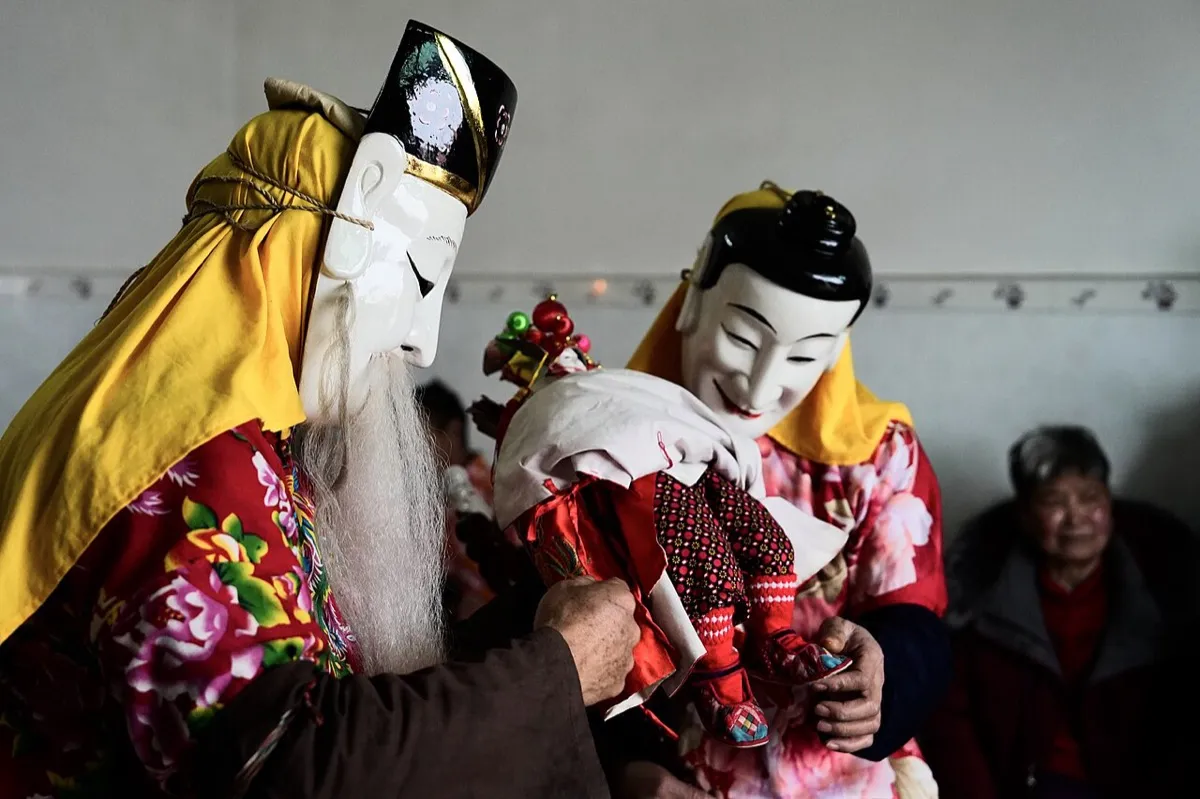
The story of Zhong Kui — China's legendary demon hunter — did not stay confined to scroll paintings and woodblock prints. Over centuries, playwrights and performers transformed his myth into one of the richest character traditions in Chinese opera. From ritual exorcism dances masked as theater, to the refined elegance of Kunqu stylization, to the thunderous percussion of Peking Opera and the face-changing pyrotechnics of Sichuan Opera, Zhong Kui has lived a vivid second life on the Chinese stage.
What the stage offers that painting cannot is the dimension of time. A single inkwash portrait freezes Zhong Kui mid-glare; a full opera unfolds his complete arc — from impoverished scholar to imperial exam laureate, from unjustly rejected candidate to suicide victim, from underworld enforcer to celestial demon queller. This temporal expansion transformed Zhong Kui from a static icon into a complex dramatic figure whose tragedy and heroism could be felt in real time, night after night, in playhouses across the empire.
Origins: Exorcism Rituals and the Mulian Tradition
Zhong Kui's migration onto the stage traces back to two deeply rooted performance traditions: the ancient Nuo exorcism ceremonies and the Mulian cycle of religious dramas.
Nuo Rituals — The Masked Ancestor
The Nuo exorcism rite is China's oldest known form of ritual performance, originating in shamanistic ceremonies where masked performers drove away pestilence spirits. The Zhouli (Rites of Zhou), a text compiled no later than the Han dynasty, already describes a figure called the Fangxiangshi — "wearing a bearskin, with four golden eyes, dark upper garments and red lower garments, wielding a lance and shield, leading a hundred retainers in the seasonal Nuo, to search every room and expel epidemics" (Zhouli, "Xia Guan: Fangxiangshi"). Scholars have long noted the structural parallels between this masked exorcist and Zhong Kui. The Qing-dynasty philologist Gu Yanwu (1613–1682) argued in his Rizhi Lu (Record of Daily Knowledge) that the very name "Zhong Kui" derives from zhongkui (终葵), a ritual implement — essentially a mallet or club — used in Nuo ceremonies to strike down evil spirits. If Gu's etymology holds, then Zhong Kui's earliest "stage" was the Nuo ritual itself, and his original "costume" was a mask.
The "Jumping Zhong Kui" Tradition
In Fujian, Taiwan, and Southeast Asian Chinese communities, a living descendant of this tradition survives as "Tiao Zhong Kui" (跳钟馗) — "Jumping Zhong Kui." Performers don Zhong Kui's full regalia and, accompanied by gongs and drums, execute choreographed movements to expel evil influences. The performance is not purely theatrical; it straddles the line between religious ceremony and folk dance, preserving in amber the original ritual function that gave birth to Chinese theater itself.
The Mulian Cycle and Song-Dynasty Development
The Mulian plays — dramatizing the Buddhist story of Mulian rescuing his mother from the underworld — represent another early performance tradition connected to Zhong Kui operas. In certain regional versions of the Mulian cycle, Zhong Kui appears as an underworld ghost king whose task is to clear a path through the demons obstructing Mulian's descent. Though a supporting role, it gave Zhong Kui his first foothold in scripted drama.
The Song dynasty (960–1279) was the decisive period for Zhong Kui's stage development. The flourishing urban economy gave rise to permanent entertainment venues — the wasi (瓦肆) and goulan (勾栏) — where puppet theater, shadow plays, and variety dramas competed for audiences. Historical records indicate that Zhong Kui-themed puppet and shadow plays were already being performed during this era. Although the specific scripts are lost, it is reasonable to infer that a core dramatic narrative centered on Zhong Kui catching ghosts had taken shape by Song times (Liu Nianzi, A History of Chinese Opera).
Kunqu Opera: "Zhong Kui Marries Off His Sister" — The Painted-Face Benchmark
Among all Zhong Kui operas, the Kunqu version of Zhong Kui Jia Mei (钟馗嫁妹, "Zhong Kui Marries Off His Sister") occupies the most revered position.
Kunqu — The Mother of All Chinese Opera
Kunqu originated in the late Yuan and early Ming dynasties around Kunshan, Jiangsu Province. Performed in the refined Zhongzhou Yun (Central Plains rhyming system) and characterized by a delicately undulating vocal style known as shuimoqiang (水磨腔, "water-polished melody"), Kunqu earned the honorific "Mother of a Hundred Operas." In 2001, UNESCO inscribed Kunqu on its very first list of Masterpieces of the Oral and Intangible Heritage of Humanity (UNESCO, Kunqu, Zhejiang People's Publishing House, 2005).
Why "Marrying Off His Sister" Is the Ultimate Test
Zhong Kui Jia Mei is a zhezixi — a single-act excerpt extracted from a longer work — and it belongs to the hua lian (painted-face) role category, known in formal terminology as the jing (净) role. The plot draws on the popular legend in which Zhong Kui, now ennobled as King of Ghosts, dispatches a retinue of demons to escort his sister to her wedding with a worthy husband.
What makes this piece the litmus test for any painted-face performer is the sheer range of skills it demands: vocal mastery, stylized movement, speech delivery, physical bearing, and footwork — none can be weak. A singer who cannot move convincingly fails the role; an athlete who cannot sustain the vocal line fails equally. The role demands total integration.
The Art of Movement: Ghost Steps and Warrior Grace
The choreography of Jia Mei is its most celebrated feature. Zhong Kui's stage movement fuses the explosive power of the wusheng (martial male) role with the imposing mass of the painted-face tradition, then overlays both with a specialized technique known as guibu (鬼步, "ghost step") — an unsteady, dragging gait that suggests a figure wading through the muck of the underworld.
The performer must execute this while encumbered by heavy costume pieces — thick-soled boots, a ceremonial python robe, and a full back-armor rig — completing demanding sequences that include the tanhǎi (探海, "searching the sea" lean), sheyan (射雁, "shooting the wild goose" pose), rapid turning combinations, and sustained liangxiang (亮相, tableau) holds. Every movement must balance raw force with aesthetic refinement: too rough, and the character devolves into mere brutality; too delicate, and he loses the aura of supernatural authority.
The Face Design: Ugliness as Spiritual Power
Zhong Kui's facial makeup in Kunqu follows a prescribed pattern. The dominant colors are black and white. A bat (fu, homophonous with the word for "blessing") is painted across the forehead. The eye sockets are ringed in exaggerated white circles — a stage stylization of Zhong Kui's legendary "ring eyes." The mouth is rendered as a wide, gaping maw in red or black. The design communicates two truths simultaneously: Zhong Kui's hideous, terrifying exterior and his benevolent, blessing-bestowing divinity. The bat motif transforms a demon-scarred face into a promise of good fortune.
A Tender Ghost Story
The emotional register of Jia Mei sets it apart from every other Zhong Kui drama. Where most Zhong Kui plays emphasize his fearsome power, Jia Mei tells a story of sibling love. A brother who died in injustice and despair, upon receiving supernatural authority in the afterlife, uses his first act of power not for vengeance but to ensure his sister's safe marriage. This warmth of feeling makes Jia Mei the most emotionally accessible — and arguably the most moving — of all Zhong Kui operas.
Peking Opera: From Qiu Shengrong to Shang Changrong
Peking Opera has its own deep tradition of Zhong Kui performance. Ever since the Four Great Anhui Troupes entered Beijing in the fifty-fifth year of the Qianlong reign (1790), Peking Opera gradually crystallized by absorbing elements of Anhui, Han, Shaanxi, and Kunqu opera, and Zhong Kui-themed plays entered its repertoire along the way.
Role Category and Vocal Style
In Peking Opera, Zhong Kui is cast as a hua lian (painted face, jing role), occasionally doubled by a wusheng (martial male). His vocal and physical style falls under the jiazi hualian (架子花脸, "framework painted face") subcategory — as distinct from the tongchui hualian (铜锤花脸, "bronze hammer painted face"), which privileges pure singing. The jiazi type emphasizes physical acting, stylized movement, and facial expression. This lineage of emphasis on total-stagecraft directly echoes the Kunqu Jia Mei tradition.
Qiu Shengrong — The Tragic Zhong Kui
Qiu Shengrong (1915–1971), founder of the Qiu school of painted-face performance, was best known for his tongchui singing in signature works like Zha Mei An (The Case of Chen Shimei) and Jiang Xiang He (The General and the Minister Reconcile). His Zhong Kui, though less widely celebrated than these blockbusters, was distinguished by a voice of extraordinary resonance and depth. Qiu's interpretation stripped away some of the character's blustering aggression and replaced it with a somber, tragic gravity — an approach that resonated powerfully with Zhong Kui's backstory of unjust death and posthumous vindication.
Shang Changrong — Zhong Kui as a Living Character
Shang Changrong (b. 1940), the preeminent Peking Opera painted-face performer of the contemporary era and a triple crown winner of the Plum Blossom Prize, the Wenhua Prize, and the Magnolia Stage Award, inherited the artistic legacy of his father Shang Xiaoyun while introducing new psychological depth into the painted-face tradition. Shang's Zhong Kui, while respecting every convention of the form, treated the character as a psychologically complex figure — not merely a symbol of supernatural might but a being with grief, joy, pride, and tenderness. Under Shang's interpretation, the demon hunter became a fully realized dramatic persona.
The Peking Opera Repertoire
Beyond Jia Mei, Peking Opera's Zhong Kui repertoire includes Zhong Kui Zhuo Gui (钟馗捉鬼, "Zhong Kui Catches Ghosts"), Zhong Kui Song Mei (钟馗送妹, "Zhong Kui Escorts His Sister"), and Zhong Kui Dan Gui (钟馗啖鬼, "Zhong Kui Devours a Ghost"). Each emphasizes different performance skills: Zhuo Gui showcases acrobatic combat; Song Mei highlights sustained vocal passages; Dan Gui foregrounds exaggerated facial and physical comedy.
Regional Opera Traditions: Sichuan, Shaanxi, and Henan
Zhong Kui's stage presence extends far beyond Kunqu and Peking Opera into a rich mosaic of regional traditions.
Sichuan Opera — Face Changing and Fire Breathing
Sichuan Opera's (Chuanju) treatment of Zhong Kui is inseparable from its signature technique: bianlian (变脸, face changing). In a fraction of a second, the performer's mask shifts from a refined white scholar's face to a snarling, fanged demon king's visage — a visual coup de théâtre that externalizes Zhong Kui's transformation from living human to ghostly sovereign. Sichuan Opera Zhong Kui performances frequently incorporate additional pyrotechnic effects — fire spitting, lamp balancing — to create a visceral, almost overwhelming sensory experience.
Shaanxi Qinqiang — Thunder from the Loess Plateau
Qinqiang (秦腔), the oldest opera form of northwest China, brings to Zhong Kui a vocal style described as "broad-voiced, loud-throated, raw and upright" (宽音大嗓, 生硬挺拔). The Qinqiang Zhong Kui demands extraordinary breath control: sustained high-volume, high-pitch singing that channels the character's rage and supernatural authority through sheer vocal force. At temple fairs across rural Shaanxi, Qinqiang Zhong Kui dramas remain among the most popular draws to this day.
Henan Yuju — The Down-to-Earth Demon King
Henan Yuju (豫剧, also called Henan Bangzi) is known for its earthy, vernacular sensibility, and its Zhong Kui reflects this. Performers lace the ghost king's dialogue with Henan dialect humor and colloquialisms, lending the fearsome figure an affable, almost avuncular quality — the demon catcher as next-door neighbor. This approach is no accident: Henan lies at the geographic heartland of the Zhong Kui legend, and in the demon hunter's "hometown," audiences have always preferred to treat him as a familiar friend rather than a distant deity.
Other regional traditions — including Fujian's Puxian Opera, Guangdong's Chaozhou Opera, and Yunnan's Dian Opera — each maintain their own distinctive Zhong Kui repertoire, collectively forming a multicolored map of Zhong Kui's stage life across China.
The Performance Toolkit: Special Demands of the Painted-Face Role
Zhong Kui opera requires a highly codified set of performance techniques that place exceptional demands on the painted-face performer.
The Ghost Step
Zhong Kui's characteristic stage walk — guibu (鬼步) or Zhong Kui bu (钟馗步) — is a wide-striding, heavy-footed gait that, combined with the rhythmic impact of thick-soled boots, produces a resounding boom with each step. The physical logic is character-driven: Zhong Kui is a "great ghost," massive and imposing, and his walk must convey that weight. Training this step while maintaining balance and rhythm in thick-soled boots requires years of dedicated practice.
The Ring-Eye Gaze
Zhong Kui's legendary "ring eyes" translate onstage into a sustained wide-eyed stare — dengmu — that the performer must hold for extended durations while modulating its intensity and direction according to the dramatic moment. This is not simple anger; it is a compound of authority, grief, and defiance that shifts with the narrative.
The Tiger Voice
Zhong Kui's vocal delivery requires two specialized painted-face techniques: huyin (虎音, "tiger voice") and zhayin (炸音, "explosive voice") — a deep, resonant, slightly rasping tone that can fill a theater without amplification. The logic is once again character-driven: a being whose voice commands ten thousand ghosts in the underworld must possess a voice that shakes the rafters.
The Full Regalia
Zhong Kui's standard stage costume includes a ceremonial python robe (red or black), thick-soled boots, and a specialized headpiece featuring an artificial beard and a prosthetically heightened forehead. The total weight is considerable, and the performer must maintain full physical expressiveness throughout the entire show while carrying this load.
Contemporary Preservation and Reinvention
Zhong Kui opera faces the same challenges confronting all traditional Chinese theater: aging audiences, shrinking commercial markets, and generational gaps in training. Yet several encouraging developments are underway.
In 2010, UNESCO inscribed Peking Opera on its Representative List of the Intangible Cultural Heritage of Humanity. Zhong Kui plays, as canonical works of the painted-face repertoire, received implicit international recognition for their preservation value. Peking Opera troupes and conservatories across China continue to teach Jia Mei and other Zhong Kui excerpts systematically, ensuring the transmission of this performing tradition to new generations.
Some contemporary artists are experimenting with bold reinterpretations. Certain directors have incorporated modern-dance vocabulary into Zhong Kui's movement design, giving the traditional "ghost step" new expressive range. Composers have introduced electronic elements into Zhong Kui's vocal lines, seeking to attract younger audiences. These experiments draw mixed reviews, but they demonstrate that the art form's creative vitality endures.
In Taiwan, the "Jumping Zhong Kui" ritual continues to thrive in folk practice. During festivals and funerals, performers don the demon hunter's costume and, amid gongs, drums, and firecrackers, execute the exorcism ceremony. This tradition — where religious function and performing art remain inseparable — preserves the most archaic and authentic form of Zhong Kui's stage existence.
The Zhong Kui of the stage has something the Zhong Kui of the scroll can never offer: the warmth of living flesh. When the performer dons the python robe, paints on the mask, and steps into the thick-soled boots, the ghost king who has stared silently from a thousand paintings suddenly speaks, walks, and turns his terrible gaze upon the audience. If Wu Daozi — the Tang-dynasty painter said to have dreamed Zhong Kui into existence — were sitting in the front row, he might recognize the figure before him as the very "great ghost" of his vision.
References:
- Zhouli: Xia Guan, Fangxiangshi (Rites of Zhou, Section on the Ministry of Summer, "The Fangxiangshi")
- Gu Yanwu, Rizhi Lu (Record of Daily Knowledge), fascicle 7, entry on Zhongkui (终葵)
- Ruan Dacheng, Yanzi Jian (The Swallow Letter)
- Xu Wei, Nan Ci Xulu (An Account of Southern Drama)
- Liu Nianzi, Zhongguo Xiqu Shi (A History of Chinese Opera)
- UNESCO / Zhejiang People's Publishing House, Kunqu (Masterpieces of the Oral and Intangible Heritage of Humanity series), 2005