Zhong Kui paintings occupy a singular position in the history of Chinese art. Few divine figures have commanded the brushes of master painters across more than thirteen centuries — from Wu Daozi in the Tang dynasty, through Gong Kai at the fall of the Song, Chen Hongshou in the twilight of the Ming, Ren Bonian in the flourishing Shanghai school, and on to modern titans like Xu Beihong, Qi Baishi, and Li Keran. Virtually every pivotal era in Chinese painting history has produced its own definitive vision of the Ghost Catcher.
The enduring vitality of Zhong Kui as a painterly subject lies in the figure's layered contradictions: he is a god who suffered a mortal's tragic fate; he is hideous to behold yet embodies justice and raw power; he began as a religious talisman for exorcising evil and gradually became a vessel through which literati artists channeled their deepest frustrations. The history of Zhong Kui painting is, in microcosm, the history of Chinese figure painting itself.
The Origins of Zhong Kui Painting: Wu Daozi's Imperial Commission
The story of Zhong Kui in Chinese painting begins with a dream — and with the Tang dynasty's most celebrated artist.
According to Shen Kuo's Mengxi Bitan (Dream Pool Essays, supplementary volume), Emperor Xuanzong of Tang fell gravely ill with malaria after military exercises at Mount Li. In his feverish delirium, the emperor dreamed of a enormous ghost devouring a smaller one. The great ghost introduced himself as "Zhong Kui, one who failed the martial examinations," and vowed to rid the empire of all demons. Xuanzong awoke cured and immediately summoned the court painter Wu Daozi, ordering him to commit the dream image to silk. Wu Daozi reportedly painted as though guided by a vision, and the emperor marveled that the result matched his dream exactly.
Wu Daozi (ca. 685–758), a native of Yuzhou in modern Henan province, is revered as the "Sage Painter of a Hundred Generations" (百代画圣). Born into humble circumstances, he trained initially as an artisan painter and studied calligraphy under the "Sage of Cursive Script" Zhang Xu and the poet He Zhizhang. During the Kaiyuan era, Emperor Xuanzong brought him to court, where he served as a resident painter and instructor. Wu Daozi earned his reputation through Buddhist and Daoist figure paintings and murals — legend credits him with over three hundred murals in the temples of Chang'an and Luoyang alone. His distinctive drapery style, in which robes seem to flutter in an unseen breeze, was canonized as "Wu's Ribbons Caught in the Wind" (吴带当风), contrasting with the stiff, clinging drapery of Northern Qi painter Cao Zhongda.
Although no authenticated Tang-dynasty Zhong Kui painting by Wu Daozi survives, later texts and copies allow scholars to reconstruct its probable appearance: a broad face bristling with a wild beard, eyes glowering in fury, clad in a blue official robe (the standard dress of Tang officials of the sixth rank and below), one hand seizing a demon and the other poised to swallow it. This image established the fundamental iconographic template that would persist for over a millennium — Wu Daozi, in a single brushstroke session, essentially fixed the face of a god.
The Tang court also developed an institutional practice around these paintings: the year-end bestowal of Zhong Kui images. Zhang Yue, a chancellor under Xuanzong, composed a formal "Memorial of Thanks for the Gift of Zhong Kui and the Calendar." The mid-Tang poet Liu Yuxi wrote two similar memorials of gratitude — one on behalf of Commissioner Li and another for Chancellor Du of Huainan — demonstrating that for nearly half a century, from Xuanzong through Emperor Dezong, presenting Zhong Kui paintings alongside new calendars at year's end had become established court protocol. Meanwhile, the "Zhong Kui Exorcism Text for New Year's Eve" among the Dunhuang manuscripts confirms that the cult had radiated outward from the palace into popular religion.
The Five Dynasties and Song: Shi Ke's Wild Brushwork and Gong Kai's Loyalist Ink
Between the Five Dynasties and the Song, Zhong Kui painting gradually shifted from its original exorcistic function toward a vehicle for personal artistic expression. Two painters from this period — Shi Ke and Gong Kai — epitomize contrasting approaches to the subject.
Shi Ke (active during the Later Shu kingdom and early Northern Song), courtesy name Zizhuan, was a native of Chengdu. His painting style was renowned for its untrammeled boldness; he excelled at capturing the grotesque expressions of his subjects with deceptively simple brushstrokes. Shi Ke's Zhong Kui was described as "free and unconstrained in brushwork, disregarding conventional rules" — a vision that had transcended religious functionality and moved decisively into the realm of literati self-expression. Art historians regard Shi Ke as one of the key figures who transformed Zhong Kui painting from devotional icon into autonomous artwork.
Gong Kai (1222–ca. 1307), courtesy name Shengyu, sobriquet Cuiyan, known colloquially as "Bearded Gong," was a native of Huaiyin in Jiangsu. He stands as the most significant Zhong Kui painter of the Song-Yuan transition and the first to infuse the subject with loyalist sentiment.
Gong Kai lived through the catastrophic Mongol conquest of the Southern Song. Ambitious but thwarted in his political aspirations, he refused to serve the new Yuan regime after the dynasty fell, eking out a living by selling his paintings. His art became the outlet for his fury and grief, and the Zhong Kui subject served this purpose with singular aptitude — was not a ghost king who died in unjust despair the perfect mirror for a displaced loyalist?
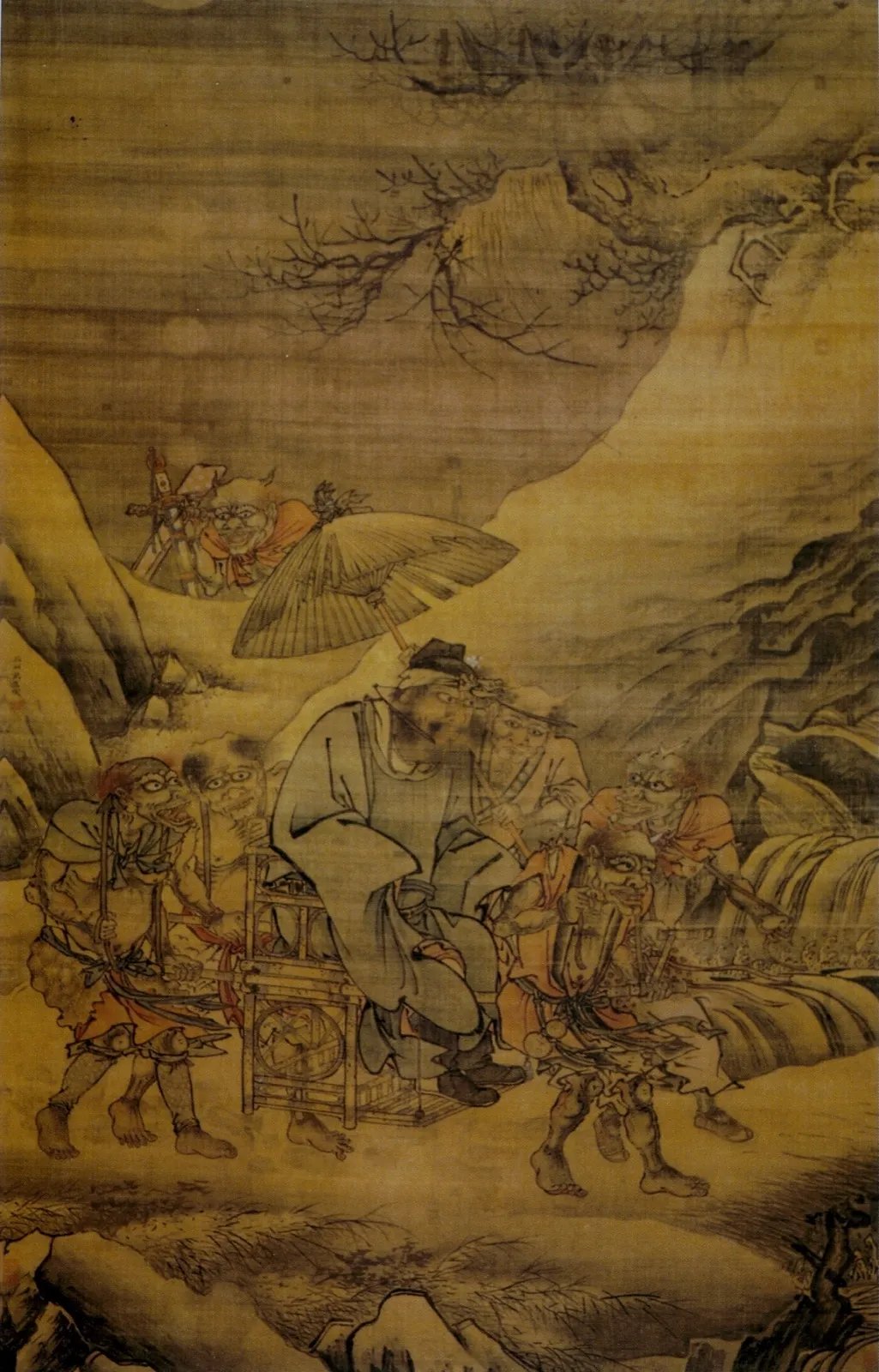
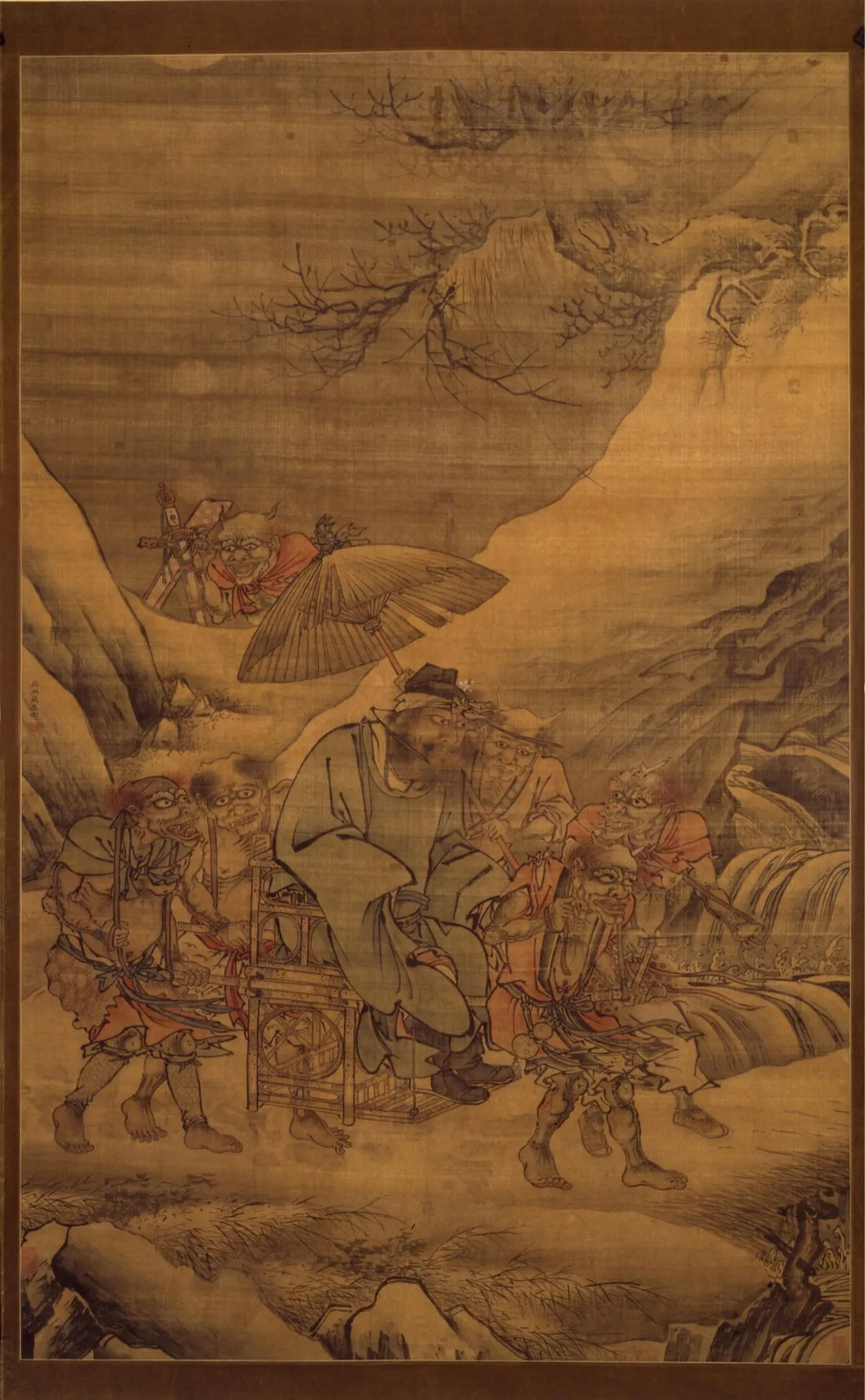
The most important of Gong Kai's surviving Zhong Kui works are Zhong Kui's Procession from Mount Zhong (Zhongshan Chuyou Tu, dated 1304, now in the Freer Gallery of Art, Washington, D.C.) and The Ghost King Moves House (Zhong Jinshi Yiju Tu, in the National Palace Museum, Taipei). The former depicts a grand procession of Zhong Kui accompanied by his sister and a retinue of demons, each figure distinct in posture and mood — some carrying palanquins, others bearing banners — while Zhong Kui himself sits centrally, an expression of imperious authority softened by something melancholy and remote. Gong Kai built up forms through repeated dry-brush ink layers, using pale washes to model flesh and volume, the lines rounded and deliberate, always executed with centered brush. The result is a visual language of somber grandeur — desolate, austere, and profoundly moving.
This "procession" is more than mythological narrative. It is the projection of Gong Kai's inner world — a Song loyalist who would not serve the Yuan, sending Zhong Kui to wander on his behalf through landscapes he could no longer traverse in waking life.

The Late Ming: Chen Hongshou's Grotesque Transformations
The apex of Ming-dynasty Zhong Kui painting arrived with Chen Hongshou, working in the turbulent decades straddling the Ming-Qing transition.
Chen Hongshou (1598–1652), courtesy name Zhanghou, sobriquets Laolian and Huichi, was born in Zhuji, Zhejiang, and became the most idiosyncratic figure painter of the late Ming. Precociously gifted, legend holds that at the age of four he painted a nine-foot image of the martial deity Guan Yu on a whitewashed wall, terrifying his future father-in-law into making obeisance. He studied under the painter Lan Ying, who reportedly exclaimed: "If this man masters painting, even Wu Daozi and Zhao Mengfu would have to defer to him — how could the rest of us presume to add a single stroke?"
Chen Hongshou's figure painting was celebrated for being "bizarre yet close to principle" (奇怪近于理). His subjects underwent radical exaggeration and distortion — enormous heads atop diminutive bodies, grotesque facial features, stiff angular drapery lines — yet possessed an uncanny inner vitality that transcended mere eccentricity. Contemporaries traced an evolution in his art: "marvelous in youth, divine in maturity, transformative in old age" (少而妙,壮则神,老而化).
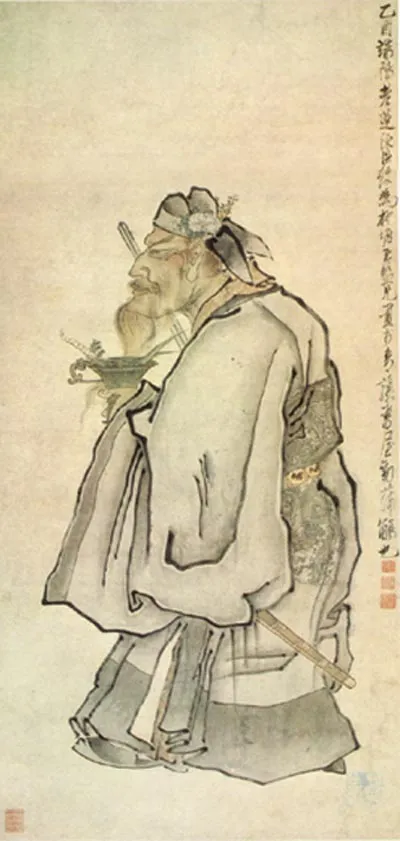
Chen Hongshou painted Zhong Kui multiple times, consistently applying his signature grotesque idiom: a massively enlarged head, exaggerated features, a compact torso radiating formidable presence, drapery rendered in iron-wire lines of unyielding rigidity. This apparent deformity was, in fact, a philosophical escalation of Zhong Kui's defining paradox — the idea of finding beauty in ugliness. Since Zhong Kui was a man who killed himself after being denied office because of his appearance, Chen Hongshou deliberately intensified that ugliness, elevating it into an artistic manifesto against conventional aesthetic norms.
There was also a deeply personal dimension to Chen Hongshou's engagement with Zhong Kui. After the fall of the Ming, he refused to adopt Qing mandated hairstyles and dress, briefly becoming a Buddhist monk and changing his sobriquet to "Huichi" (Belated Regret), explaining: "How could I truly become a monk? I merely use the monk's life to survive." A brilliant artist rejected by the world he inhabited, Chen Hongshou painted Zhong Kui as, in some sense, a self-portrait — another figure of extraordinary talent, denied recognition by a system that judged only surfaces.
Chen Hongshou's Zhong Kui paintings exerted a lasting influence. The Qing critic Zhang Geng, in his Guochao Huazheng Lu (Records of Painters of the Current Dynasty), praised Chen's approach for its "breadth of power and loftiness of spirit." The late-Qing Shanghai school master Ren Bonian would draw directly from Chen Hongshou's tradition.
The Qing Dynasty: Ren Bonian, the Yangzhou Eccentrics, and the Shanghai School
The Qing dynasty witnessed the most prolific period of Zhong Kui painting. Members of the "Eight Eccentrics of Yangzhou" — Jin Nong, Luo Ping, Huang Shen, and Hua Yan among them — all turned their brushes to the subject. But it was Ren Bonian who elevated Zhong Kui painting to unprecedented heights of popular appeal without sacrificing artistic sophistication.
Jin Nong (1687–1763), sobriquet Dongxin, was the de facto leader of the Eight Eccentrics. His Zhong Kui paintings employed a deliberately archaic, almost naive brushwork that defied academic convention, suffused with literati sensibility. Jin Nong typically accompanied his Zhong Kui images with lengthy inscriptions — lamenting the state of the world or playfully teasing the gods — effectively transforming the fearsome deity into an eccentric old friend.
Ren Bonian (1840–1895), given name Yi, courtesy name Bonian, a native of Shaoxing in Zhejiang, was the leading figure of the Shanghai school. Steeped in popular printmaking traditions from childhood, he studied under Ren Xiong and Ren Xun, absorbed Chen Hongshou's legacy, and incorporated Western drawing and sketching techniques to forge a distinctive style that balanced meticulous finish with expressive freedom, all bathed in luminous color.
Ren Bonian painted Zhong Kui prolifically throughout his career. His 1882 Portrait of the Ghost King (Zhong Jinshi Tu, now in the Art Museum of Tsinghua University) stands as a signature work. His Zhong Kui departs from both the brooding austerity of Gong Kai and the angular grotesquerie of Chen Hongshou — Ren Bonian's demon catcher is more worldly, more human. The drapery flows with effortless grace, color is applied in masterful gradations, and the face projects ferocity tempered by an unmistakable warmth. This treatment carried Zhong Kui painting out of the literati's private studios and into a broader art market.
The Shanghai school's approach to Zhong Kui was inseparable from the cultural ecology of Shanghai as a burgeoning commercial metropolis. Ren Bonian made his living selling paintings in the city, and his work needed to satisfy both refined literati tastes and popular demand. The Zhong Kui subject proved ideal for this dual audience: for the educated elite, the Ghost Catcher served as a channel for indignation at injustice; for ordinary citizens, he was a lucky talisman against evil. With consummate technical mastery, Ren Bonian fused these functions within a single frame.
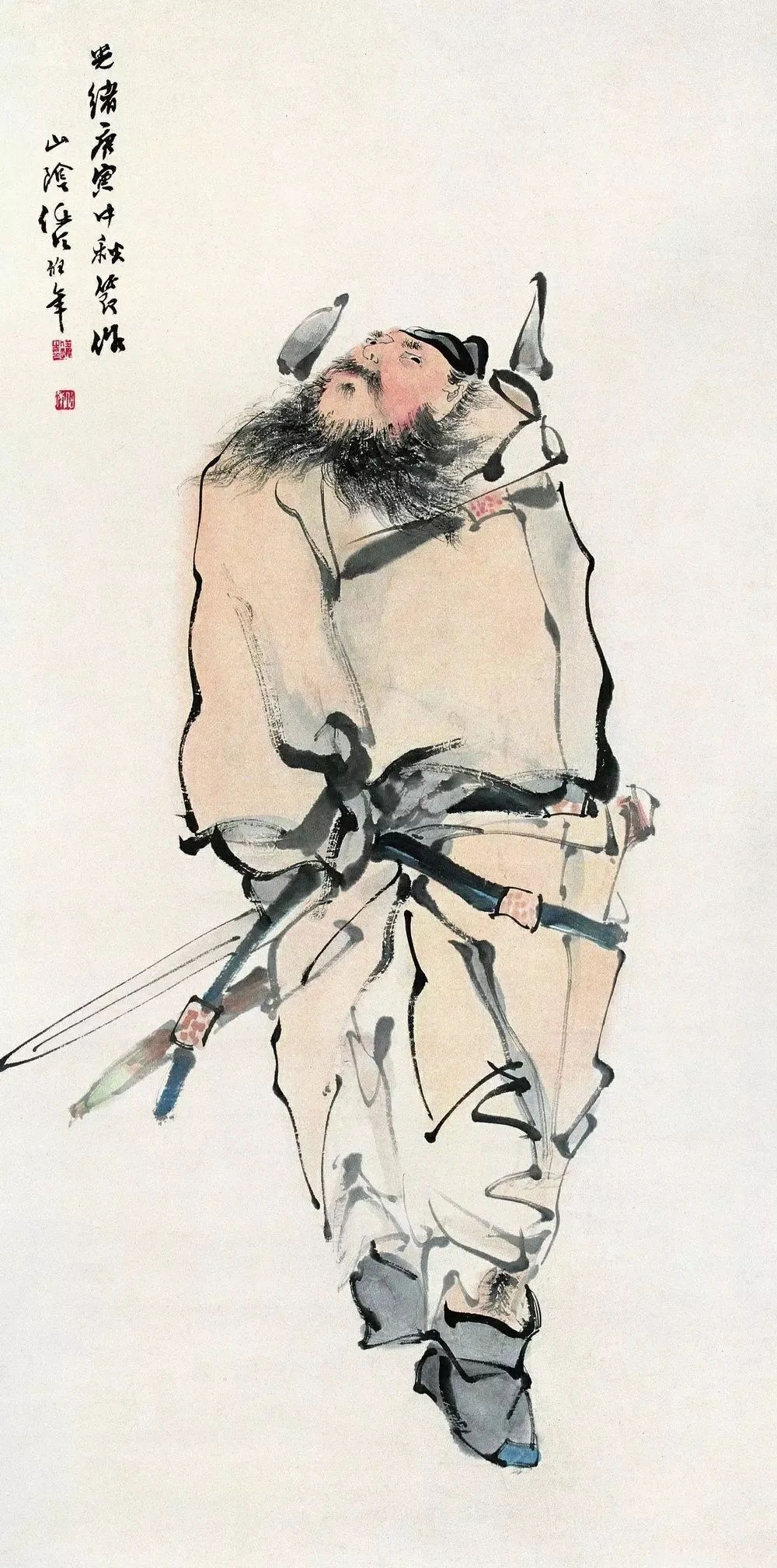
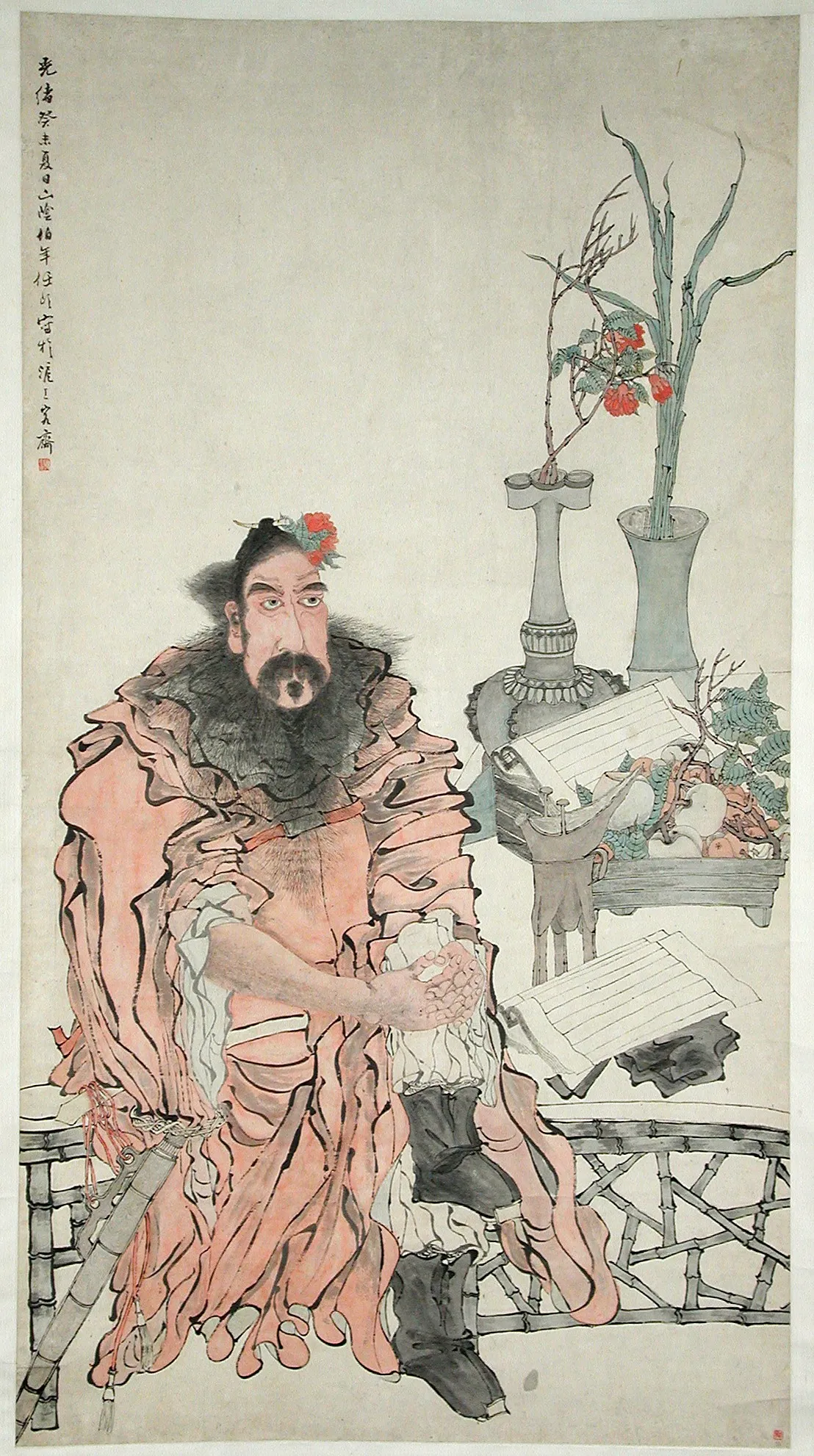
Ren Bonian, "Zhong Kui"
Ren Yi (Ren Bonian), "Zhong Kui" Scroll (Metropolitan Museum of Art)
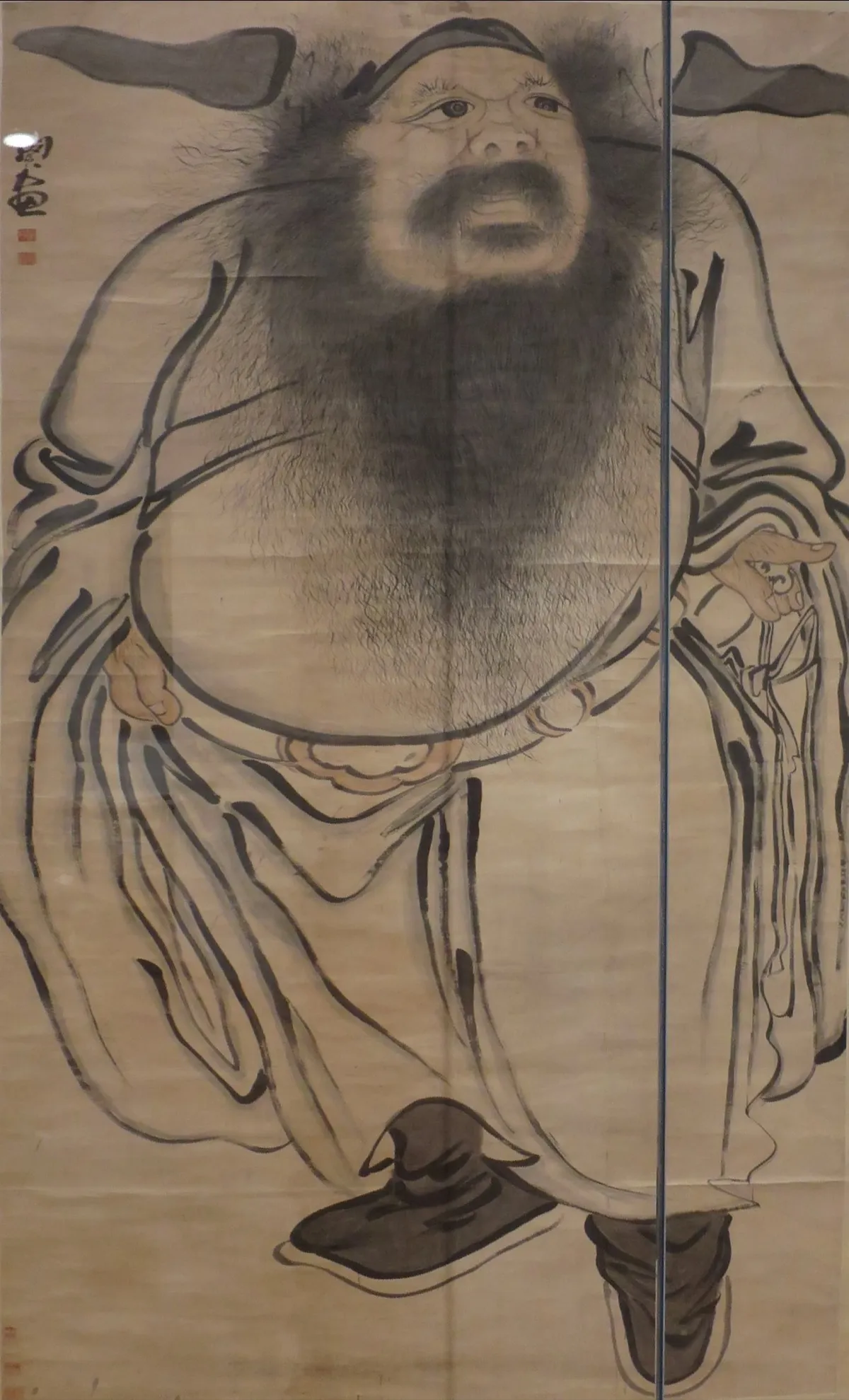
Min Zhen, "Zhong Kui," 18th century, Private Collection
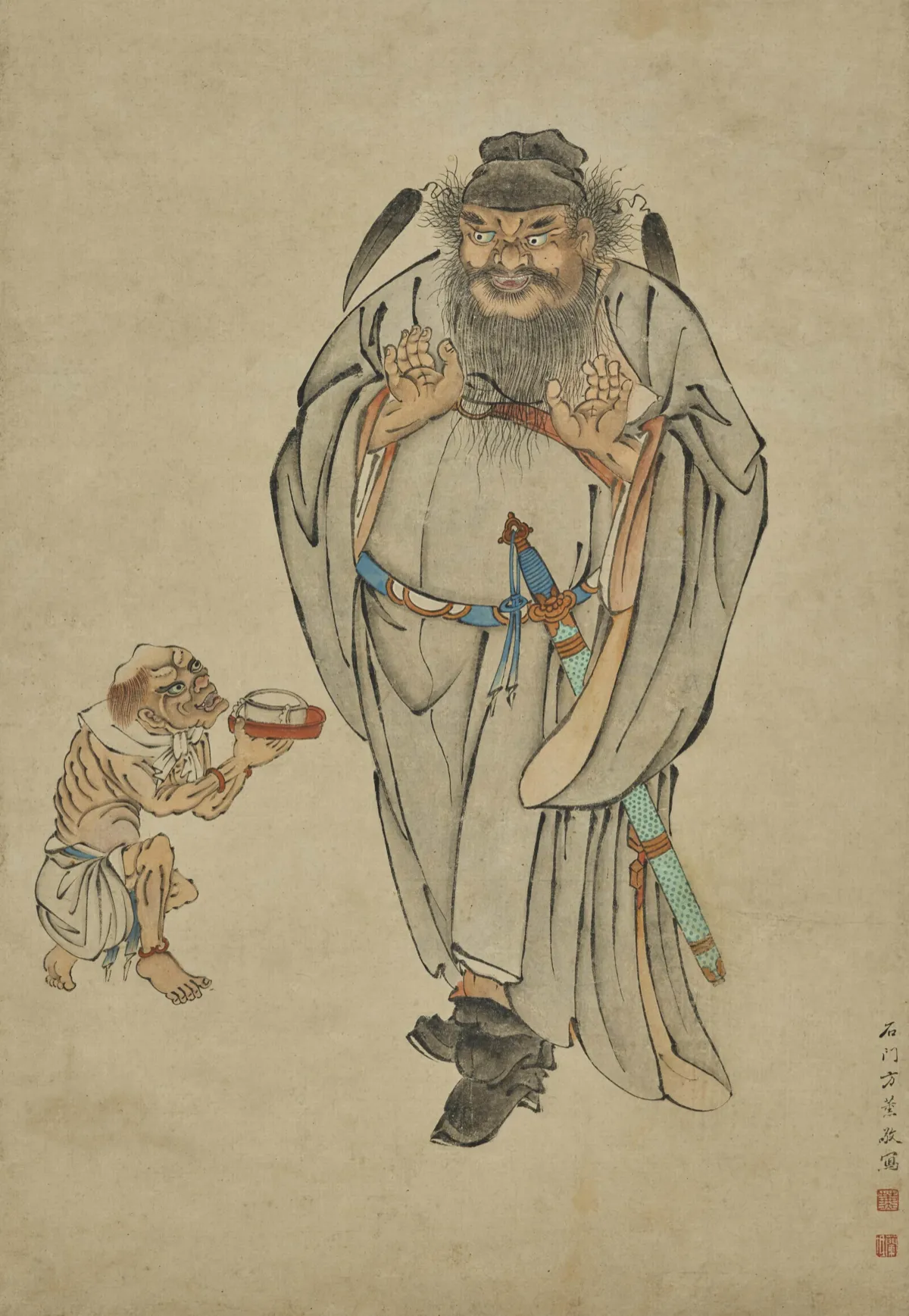
Fang Xun, "Portrait of Zhong Kui"
The Modern Era: Xu Beihong, Qi Baishi, and Li Keran Reinvent the Tradition
Twentieth-century Chinese painting underwent transformations more radical than any since the medium's origins, and Zhong Kui painting evolved accordingly.
Xu Beihong (1895–1953) was the pioneer who integrated Western academic realism into Chinese painting. After years of study at the École Nationale Supérieure des Beaux-Arts in Paris, he returned to China committed to reforming traditional figure painting through rigorous anatomical draftsmanship. When Xu Beihong painted Zhong Kui, he discarded the tradition of deliberate exaggeration, grounding the figure instead in precise musculoskeletal structure. His Zhong Kui is no spectral ghost king but a powerfully built man with tangible muscular bulk and three-dimensional presence. This approach was entirely consistent with Xu Beihong's crusade to "improve Chinese painting" — he regarded the neglect of proportion and structure as traditional figure painting's greatest weakness, and the Zhong Kui subject offered the perfect laboratory for reform.
Qi Baishi (1864–1957) took a fundamentally different path. Famous primarily for his bold freehand flower-and-bird paintings, he brought the same reductive, high-contrast ink vocabulary to his Zhong Kui subjects. Qi Baishi's demon catcher materializes in just a few decisive strokes — a pair of blazing eyes, a fierce sweep of bristling beard — yet conveys the full measure of the deity's righteous ferocity. He frequently appended poetic inscriptions in a wry, colloquial register: "Zhong Kui eats ghosts as a matter of course — no need to trouble the master for a hasty brushstroke" (钟馗吃鬼也寻常,不借先生一笔忙), pushing the literati ink-play tradition into territory that was simultaneously playful and profound.
Li Keran (1907–1989) brought his signature accumulated-ink technique from landscape painting to bear on Zhong Kui, building the figure from dense, layered ink washes of extraordinary textural richness. His demon catcher typically emerges from an engulfing darkness, only the face and the blade of his sword caught in a shaft of light — a dramatic chiaroscuro that heightens both the theatricality and the quasi-religious solemnity of the image.
The Art-Historical Significance of Zhong Kui Painting
From Wu Daozi to Xu Beihong, Zhong Kui painting traversed more than thirteen centuries. Over this vast arc, it underwent several critical functional transformations:
During the Tang and Song dynasties, Zhong Kui painting served primarily religious and apotropaic functions. Wu Daozi's imperial commission and the court's year-end distribution of Zhong Kui images treated these paintings as instruments of spiritual protection rather than autonomous art objects.
In the Song-Yuan transition, Zhong Kui painting began to carry deeply personal meaning. Gong Kai used the subject to channel loyalist grief, transforming Zhong Kui from a public religious symbol into a vessel for private anguish — a shift that lent the tradition an artistic depth it had never possessed before.
Through the Ming and Qing periods, Zhong Kui painting moved toward secularization and commercialization. Chen Hongshou's mannerist distortions and Ren Bonian's crowd-pleasing elegance both reflect the subject's ongoing negotiation between elite aesthetic standards and popular taste.
In the modern era, Xu Beihong's realism, Qi Baishi's freehand expressionism, and Li Keran's heavy-ink synthesis each represented distinct avant-garde explorations. Zhong Kui painting was no longer merely a subgenre of figure painting — it had become a comprehensive test of artistic skill and a vehicle for expressing the spirit of the age.
The enduring power of the Zhong Kui painting tradition ultimately rests on the figure's internal tensions — the unity of ugliness and beauty, the overlap of ghost and god, the interweaving of personal tragedy and communal faith. Every era found its own emotional resonance in Zhong Kui. As Su Shi once wrote of Wu Daozi: "He brings forth new ideas within the bounds of tradition and lodges subtle truths beyond the reach of boldness" (出新意于法度之中,寄好理于豪放之外) — a description that captures not only the Sage Painter's genius, but the secret of Zhong Kui painting's immortality.
For a thousand years, countless painters poured their own fury and ideals onto that hideous, majestic face. Zhong Kui was rejected by the establishment for his looks, yet in the world of art he received the fairest treatment imaginable — every hand that held a brush vindicated him in its own way. The Zhong Kui on silk and paper may well be the truest portrait of justice the mortal world has ever produced.
References:
- Shen Kuo, Mengxi Bitan (Dream Pool Essays), Supplement, vol. 3, "Miscellaneous Records"
- Zhang Yanyuan, Lidai Minghua Ji (Record of Famous Painters of All the Dynasties)
- Zhang Geng, Guochao Huazheng Lu (Records of Painters of the Current Dynasty)
- Ruan Yuan, Guangling Shishi (Poetic Affairs of Guangling), vol. 7
- Dunhuang Manuscript: "Zhong Kui Exorcism Text for New Year's Eve" (Chuxi Zhong Kui Qunuo Wen)
- Zheng Zunren, Zhong Kui Yanjiu (Studies on Zhong Kui), Xiwei Information, 2004
- Wang Bomin, Zhongguo Huihua Shi (A History of Chinese Painting), People's Fine Arts Publishing House, 1982