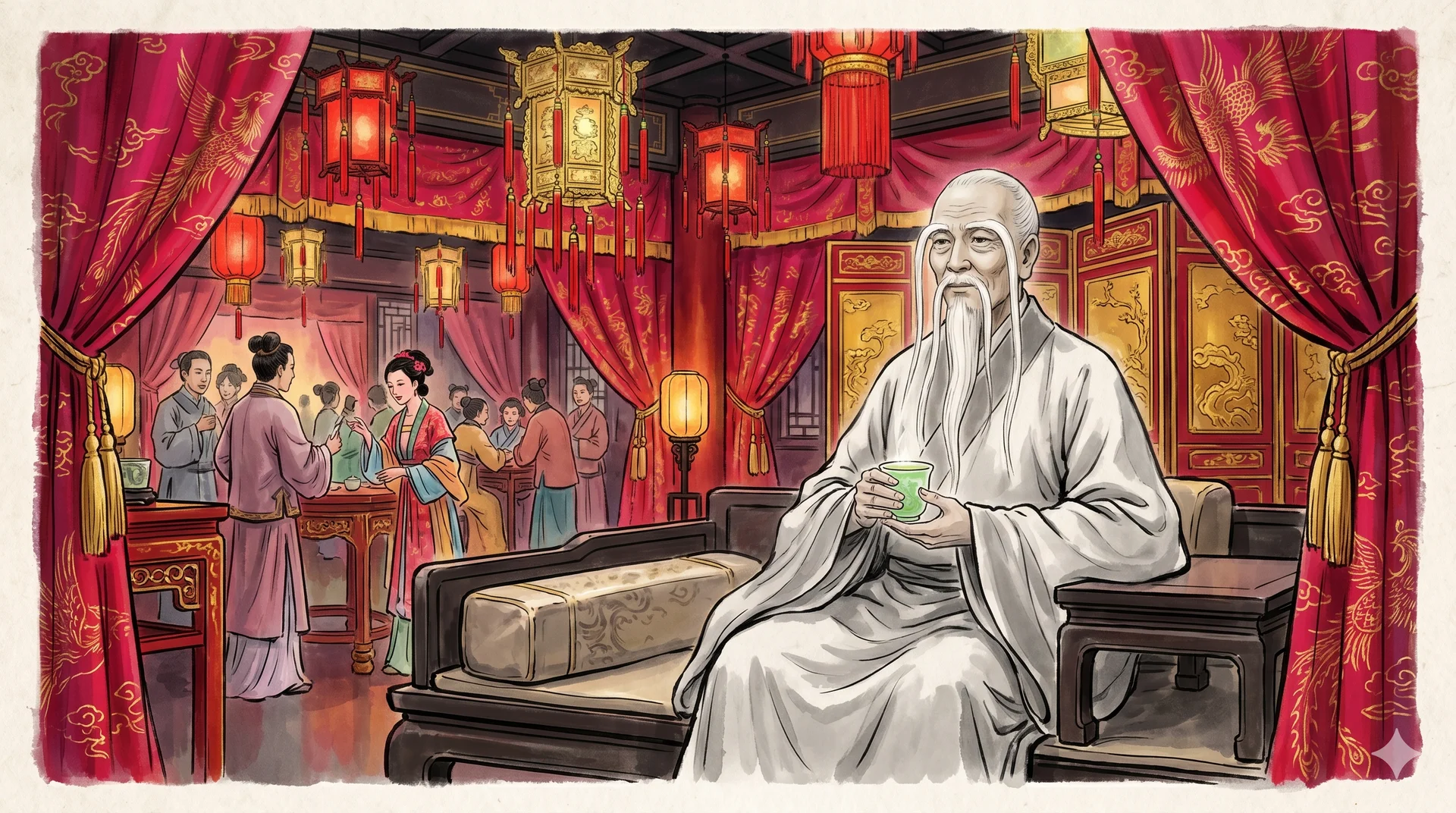
Among the rogues' gallery of demons in the classical novel Zhong Kui Zhanshi Zhuan (Chronicles of Zhong Kui the Demon Slayer), nearly every creature represents a clear-cut vice — the Lie Demon, the Shameless Demon, the Lust Demon, the Drunkard Demon — each embodying a human weakness that must be exterminated. Yet the Baimei Shen (白眉神), the White-Browed Spirit, who appears in Chapter Eight within the pleasure quarters known as the Flower and Smoke Fortress, defies this binary moral universe. It is not a demon Zhong Kui must slay, but a morally ambiguous figure he must recruit through cunning diplomacy rather than brute force.
The chapter title itself signals this departure: "At the Flower and Smoke Fortress, Wisely Inviting the White-Browed Spirit." Notice the crucial verb — "inviting" (qǐng 请), not "slaying" (zhǎn 斩) or "exterminating" (zhū 诛). Across the entire novel, this approach is virtually unprecedented. Confronted with Baimei Shen, Zhong Kui sheathes his sword and reaches for intellect instead. The implication is profound: certain social ills cannot be hacked apart with a blade — they demand strategic thinking and nuanced understanding.
Who Is Baimei Shen? Name, Image, and Symbolism
The Significance of "White Brows" in Chinese Cultural Tradition
The epithet "white-browed" carries layered connotations in Chinese culture. Visually, white eyebrows are the hallmark of advanced age and accumulated experience — they signal an elder who has witnessed far more than most. In the lore of the Three Kingdoms period, the Shu Han strategist Ma Liang was famously nicknamed "White-Browed Ma Liang" (白眉马良) because of the distinctive white hairs in his eyebrows. A popular saying of the time declared, "Among the five talented Ma brothers, White-Brow is the finest" (马氏五常,白眉最良). In this context, white brows became a badge of exceptional ability rather than mere old age.
Within the imaginative world of Zhong Kui Zhanshi Zhuan, however, the "white brows" take on a more unsettling significance. Baimei Shen haunts the pleasure quarters — a euphemism for brothels and entertainment houses — and its pale, stark eyebrows form a striking contrast against the garish rouge and painted faces that surround it. In a realm drenched in sensory indulgence, this figure with its colorless gaze serves as a silent rebuke: a reminder that even in the most hedonistic corners of society, there exists a watchful presence that sees through the painted facades.
Neither Demon Nor Deity: A Unique Ontological Position
Baimei Shen occupies an extraordinary niche in the novel's cosmology. It is not a demon (guǐ 鬼) to be executed, nor a god (shén 神) who offers divine assistance. Instead, it dwells in the grey zone between moral absolutes — a liminal being that resists easy categorization. This positioning makes Baimei Shen arguably the most literarily sophisticated character in the entire novel.
For Zhong Kui's two loyal companions — Hanyuan (含冤, "Harboring Grievance") and Fuqu (负屈, "Bearing Injustice") — Baimei Shen's existence creates a genuine philosophical crisis. Their mission is to assist Zhong Kui in slaying demons, but when confronted with a being that is emphatically not a demon, the entire logic of demon-slaying breaks down. Baimei Shen forces the trio to redraw the boundaries between friend and foe, right and wrong, justice and mercy.
The White-Browed Spirit in Chapter Eight: A Demon-Slayer Without a Sword
The Flower and Smoke Fortress: A Complex Social Microcosm
In Chapter Eight, Zhong Kui and his companions arrive at the Flower and Smoke Fortress (烟花寨, Yānhuā Zhài), a district given over to the world's oldest profession. The challenge here is not a single identifiable evil demon but an intricate social ecosystem populated by pleasure-seeking patrons, women forced into servitude, and madams who profit from the trade. Each participant is simultaneously victim and victimizer, and the moral boundaries blur beyond recognition.
Baimei Shen plays a singular role within this environment. It is neither the ruler of the pleasure quarters nor one of its suffering inhabitants. Rather, it functions as a hybrid of detached observer and quiet guardian. Zhong Kui requires Baimei Shen's cooperation to neutralize the demonic forces lurking within the district, but the White-Browed Spirit will not be compelled by violence — it must be courted with intelligence and respect.
Wisdom Over Warfare: Why Zhong Kui Sheathed His Sword
The narrative strategy of "wisely inviting" Baimei Shen represents one of author Liu Zhang's (刘璋) most thought-provoking choices in the entire novel. When facing other demons, Zhong Kui's procedure is straightforward: identify, pursue, and destroy. Against Baimei Shen, this entire operational framework collapses.
Three reasons explain this departure. First, Baimei Shen is not an evil demon, and treating it as one would be a category error with potentially disastrous consequences. Second, the Flower and Smoke Fortress is a densely populated social space where indiscriminate violence could easily harm innocent bystanders — particularly the very women Zhong Kui might wish to protect. Third, Baimei Shen possesses knowledge or resources essential to Zhong Kui's mission; the demon-slayer must learn the art of persuasion over annihilation.
Even Zhong Kui's lieutenants undergo a subtle transformation in this chapter. Hanyuan's defining trait — unresolved grievance — finds a new object in the women trapped within the pleasure quarters, who are themselves victims of profound injustice. Fuqu's burden of unmerited suffering resonates with the hidden hardships of every soul in the district. The narrative suggests that true understanding of "grievance" and "injustice" requires confronting social realities far more complex than any single demon.
The Folk Religion of Baimei Shen: Patron Deity of the Pleasure Quarters
A God of Survival, Not of Virtue
Beyond the pages of fiction, Baimei Shen was an actual figure in Chinese folk religious practice. During the Ming and Qing dynasties, the White-Browed Spirit was venerated as the patron deity of sex workers — a protector invoked within the very brothels that respectable society preferred to ignore. According to Shen Defu's (沈德符) Wanli Yehuobian (万历野获编, Unofficial Gleanings from the Wanli Era), a major Ming dynasty compendium of social observations, women in the pleasure quarters would burn incense and pray to Baimei Shen before receiving clients, seeking safety in a profession that offered precious little of it.
What makes Baimei Shen's cult remarkable is its fundamental departure from the logic of most Chinese folk deities. In the traditional pantheon, gods are typically associated with clear moral virtues: Guan Yu embodies loyalty and righteousness, Guanyin represents boundless compassion, Caishen bestows material prosperity. Baimei Shen's cult, by contrast, is rooted not in moral aspiration but in survival. The women who prayed to the White-Browed Spirit did not do so because it exemplified some lofty ethical ideal. They prayed because they needed a protector in one of the most dangerous and marginalized spaces in traditional Chinese society.
Guan Zhong and the Patron Saint Paradox
Chinese folklore holds that the legendary statesman Guan Zhong (管仲, c. 720–645 BCE), the brilliant chancellor who transformed the State of Qi into a hegemonic power during the Spring and Autumn period, was the unwitting founder of the pleasure quarters. During his sweeping economic reforms, Guan Zhong established the nülu (女闾) — state-operated brothels designed to generate government revenue. As a result, later generations of sex workers revered him as the patron saint of their profession, and in some regions, the worship of Baimei Shen became syncretically fused with the cult of Guan Zhong.
This historical backdrop adds a fascinating layer of irony to Baimei Shen's role in the novel. Guan Zhong was one of ancient China's most capable administrators — a master strategist whose reforms strengthened an entire nation. Yet his pragmatic innovation inadvertently gave rise to an institution that would be memorialized in folklore as a domain of sorrow and exploitation. The contradiction between Guan Zhong's political genius and his accidental patronage of the pleasure trade mirrors Baimei Shen's own ambiguous position in the novel: neither wholly benevolent nor truly malevolent, but an inescapable feature of the social landscape.
"Wisely Inviting" vs. "Lazily Executing": Two Strategies in One Chapter
A Masterclass in Narrative Contrast
Chapter Eight carries a paired title that encapsulates two parallel storylines: "At the Flower and Smoke Fortress, Wisely Inviting the White-Browed Spirit; At Wukong Temple, Lazily Executing the Black-Eyed Demon." The deliberate juxtaposition of these two episodes reveals Liu Zhang's sophisticated understanding of strategic thinking.
Against the Black-Eyed Demon, Zhong Kui adopts the strategy of "lazy execution" (lǎnzhū 懒诛) — a counterintuitive approach of apparent passivity and avoidance when dealing with a treacherous,阴险 opponent. Against Baimei Shen, he chooses "wise invitation" (zhìqǐng 智请) — a proactive, diplomatic strategy designed to win the cooperation of a morally ambiguous figure. The contrast is elegantly balanced: one lazy, one wise; one executing, one inviting. Together, they form Liu Zhang's comprehensive meditation on the art of dealing with fundamentally different types of adversaries.
The Limits of the Sword
The episode of Baimei Shen also delivers an unambiguous message: brute force has its limits. Zhong Kui's demon-slaying sword can cleave the Lie Demon in two and destroy the Shameless Demon without hesitation. But in the tangled social reality of the Flower and Smoke Fortress, that same blade becomes a crude and insufficient instrument.
Some problems simply cannot be solved by cutting them away. The existence of the pleasure quarters is not the product of a single malevolent demon. It arises from the convergence of economic pressures, social hierarchies, cultural norms, and human vulnerability — a web of causes far too intricate to be severed with a single stroke. Addressing such a problem demands not a demon-slayer's sword but a statesman's understanding of how societies actually function. Through the "wise invitation" narrative, Liu Zhang signals his awareness that the most intractable evils are structural rather than individual.
The Literary Significance of Baimei Shen: Morality in Shades of Grey
Shattering the Binary of Good and Evil
In the vast majority of traditional Chinese vernacular fiction, characters occupy clearly defined moral positions. The righteous stand on one side; the wicked on the other; the space between is a void. Zhong Kui Zhanshi Zhuan, while broadly adhering to this moralistic framework, introduces a profound disruption through the figure of Baimei Shen.
Baimei Shen is neither Zhong Kui's enemy nor his ally. It maintains its own position within the pleasure quarters, pursues its own interests, and follows its own logic of behavior. Zhong Kui needs its help but cannot command it. Baimei Shen is willing to assist but sets its own terms. This refusal to be neatly categorized transforms Chapter Eight into what may be the novel's most literarily ambitious installment.
Enriching the Zhong Kui Mythos
In the broader mythological tradition surrounding Zhong Kui, the demon-slayer's characterization tends toward the monolithic: he is a figure of righteous fury and martial prowess, a supernatural warrior who destroys evil without hesitation or doubt. Liu Zhang's novel, however, grants Zhong Kui a richer emotional and intellectual palette. Confronted with Baimei Shen, the demon-slayer displays not ferocity but finesse, not hot-blooded anger but cool strategic calculation. This transformation elevates Zhong Kui from a mere supernatural warrior into something far more compelling: a sage who understands that true strength lies in knowing when not to strike.
Baimei Shen also grounds the Zhong Kui myth in the messy reality of human experience. In a straightforward demon-slaying narrative, everything is black and white — demons are evil, Zhong Kui is righteous, and the sword settles all disputes. But the White-Browed Spirit whispers an uncomfortable truth: the moral landscape of the human world is far more complicated than any demon-slaying story can capture. Between the extremes of darkness and light stretches an enormous expanse of grey. Genuine wisdom consists not in attempting to bleach every shade of grey into pristine white, but in learning to navigate the ambiguities — to find a path through uncertainty without losing one's moral bearings.
Baimei Shen teaches us that not every problem in this world can be dispatched with a single sword stroke. Some beings are neither purely evil nor purely good; they are simply an inseparable part of the world's tangled fabric. The moment Zhong Kui laid down his blade and extended an invitation instead of a death blow is more moving than any demon-slaying battle in the entire novel — because it represents a demon-slayer's profound bow before the complexity of the human condition.