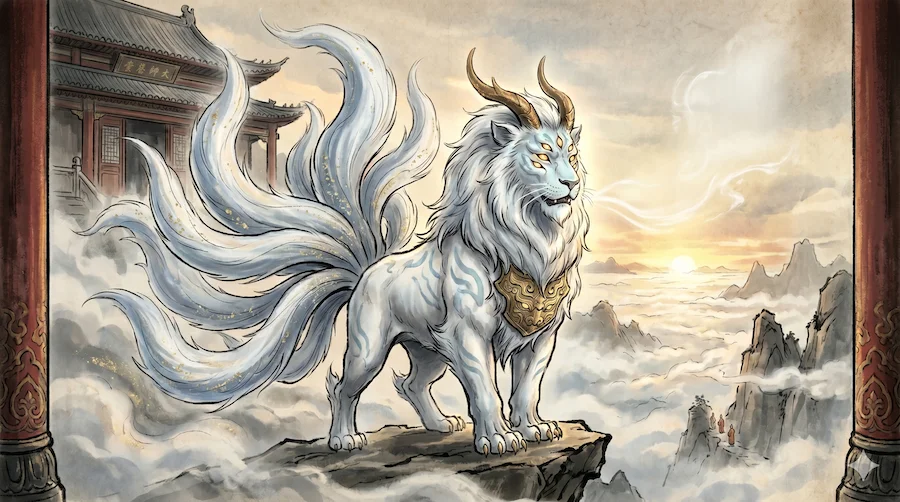
Among the vast menagerie of Chinese mythical creatures, one being stands apart. It does not dominate through brute strength or terrorize with ferocity. Instead, it wields a power far more unusual in the world of ancient myth — omniscient knowledge. This creature could speak human languages, understand the nature of all things, and knew the names, appearances, and vulnerabilities of exactly 11,520 kinds of demons, spirits, and supernatural beings. Its name is Baize.
What makes Baize truly unique in Chinese mythology is its core attribute: total knowledge of the supernatural realm. The Dragon commands rain, the Phoenix heralds auspicious fortune, and the Qilin signals peace and prosperity — each has a specific domain. Baize alone possesses comprehensive knowledge of every demon and spirit in existence. This concept of "knowledge as power" is remarkably rare in ancient mythological systems worldwide, making Baize the ultimate symbol of intellect triumphing over evil in Chinese culture.
In the Qing dynasty novel Zhan Gui Zhuan (The Tale of Demon-Slaying) by Liu Zhang, Baize took on an additional identity: the faithful steed of Zhong Kui, China's most legendary demon hunter. A demon-slaying celestial marshal who can identify every kind of demon, riding a divine beast that knows every demon's secret — the symbolism of this pairing runs deep. This article traces Baize's journey from its mythological origins and the legendary encounter with the Yellow Emperor, through the circulation of the famous Baize Diagram, to its literary role alongside Zhong Kui and its cultural influence across East Asia.
What Is Baize? The Omniscient Divine Beast of Antiquity
A Creature Defined by Knowledge, Not Strength
Baize is a benevolent divine beast from China's most ancient mythological traditions, first appearing in pre-Qin texts. While descriptions of its physical form vary across historical sources, its essential characteristics remain remarkably consistent: the ability to speak human languages and a complete understanding of all things in the world. The Jin dynasty scholar Ge Hong, in his seminal work Baopuzi (The Master Embracing Simplicity), recorded that the Yellow Emperor "exhausted his study of all malevolent spirits by recording the words of Baize" (Ge Hong, Baopuzi, chapter "Jiyan").
This brief passage reveals two critical facts. First, Baize possessed comprehensive knowledge of "shen jian" — a term encompassing all demons, evil spirits, and supernatural malefactors. Second, this knowledge was systematically recorded, becoming what later generations would know as the famous Baize Tu — the Baize Diagram.
Over the centuries, Baize's visual representation evolved. Early texts offered only vague physical descriptions. Later traditions gradually settled on a composite form featuring a lion-like body, twin horns, six eyes, and nine tails. Yet regardless of how artists imagined its appearance, two defining traits never changed: wisdom and speech. Baize was never a silent auspicious beast. It was a divine being that actively chose to share its knowledge with humanity.
The Guardian That Wards Off Evil Through Knowledge
In China's traditional system of auspicious beasts, Baize occupies a singular position. It does not repel evil through magical force — it disarms evil through knowledge. The principle is elegantly simple: if you know a demon's name, appearance, and weakness, you are protected from its harm. This is a classic expression of "naming as protection" — a belief that runs deep in many ancient cultures.
In the worldview of early Chinese civilization, a demon's power fed on the unknown and the fear it generated. Once identified and named, the demon lost its ability to cause harm. This concept profoundly shaped later Daoist talismanic traditions and folk exorcism practices across China. In a very real sense, Baize represents the primordial source of the "knowledge defeats demons" philosophy in Chinese mythology.
The Yellow Emperor's Legendary Encounter with Baize
A Mythic Meeting at the Edge of the Eastern Sea
The most famous tale associated with Baize involves the figure revered as the cultural ancestor of the Chinese people — the Yellow Emperor. According to texts such as the Xuanyuan Benji (Annals of Xuanyuan), preserved within the Song dynasty Daoist compilation Yunji Qiqian (Seven Lots from the Bookbag of the Clouds), the Yellow Emperor encountered Baize while on an imperial inspection tour that brought him to the shores of the Eastern Sea.
The timing of this meeting is significant. The Yellow Emperor was in the process of unifying the Huaxia peoples and bringing order to the known world. His arrival at the coast — the very edge of the civilized world — carried symbolic weight. Having brought peace to the human realm, he now faced the unknown dangers of the supernatural dimension. Baize was the key that allowed him to bridge that gap, transforming the chaotic world of spirits and demons into something that could be understood, catalogued, and ultimately controlled.
11,520 Spirits: A Cosmic Catalog of the Supernatural
Baize spoke to the Yellow Emperor of 11,520 distinct types of demons, spirits, and supernatural entities — describing each one's appearance, name, and defining characteristics. This strikingly precise number was not chosen at random. Scholars have suggested that it may encode ancient calendrical mathematics (360 days multiplied by 32 types equals 11,520), implying that Baize's catalog of spirits corresponded to the natural rhythms and cosmic order governing heaven and earth.
The Yellow Emperor immediately ordered his officials to paint illustrations of every spirit and demon Baize described, creating a visual record to share with all people. This illustrated compendium became the legendary Baize Tu, also known as Baize Jingguai Tu (Baize's Illustrated Guide to Strange Phenomena).
Ge Hong's note in Baopuzi about "recording the words of Baize to exhaust all knowledge of malevolent spirits" serves as a concise summary of this foundational event. Baize's oral teachings were systematized into a comprehensive illustrated manual — arguably the first demon encyclopedia in Chinese history, and perhaps in world history.
The Baize Diagram: China's Earliest Demon Encyclopedia
From Imperial Secret to Household Protection Manual
The creation of the Baize Diagram stands as a landmark moment in Chinese cultural history. It was very likely the world's first systematic, illustrated encyclopedia of supernatural beings. The Yellow Emperor commissioned artists to render each creature's form alongside written descriptions, creating a practical reference tool. When ordinary people encountered something strange or frightening, they could consult the diagram, identify what they were dealing with, and learn the appropriate response.
By the Han, Wei, and Six Dynasties periods, copies of the Baize Diagram had spread to virtually every household. It functioned much like a modern emergency preparedness guide — a practical manual for navigating encounters with the unknown. This phenomenon reveals something profound about ancient Chinese society: people believed that evil spirits lurked everywhere, but they also held an unshakable conviction that the right knowledge could turn any danger into something manageable.
The Dunhuang Fragments: Physical Evidence of a Lost Masterwork
The original Baize Diagram has long been lost to history, but archaeologically invaluable fragments were discovered among the Dunhuang manuscripts. The Bibliothèque nationale de France holds surviving portions of the Baize Jingguai Tu recovered from the Dunhuang caves, providing firsthand physical evidence of this ancient text. Though damaged and incomplete, these fragments reveal the work's original format: each demon or spirit was accompanied by an illustration, its name, a description of its characteristics, and instructions for repelling it.
The Dunhuang fragments confirm that the Baize Diagram was still widely circulated among ordinary people during the Tang and Five Dynasties periods, and its reach extended far beyond central China to the northwestern frontier. It was far more than a demon catalog — it was the conceptual framework through which ancient Chinese people understood and organized the supernatural world.
A Precursor to the Study of the Strange
Viewed through a modern academic lens, the Baize Diagram stands as a pioneering work in what we might call the "study of the strange" — a proto-taxonomy of the supernatural. It established a four-element system: know the demon's name, understand its form, recognize its behavior, and master the method of countering it. This framework bears a remarkable structural similarity to later Japanese demon encyclopedias (such as Toriyama Sekien's celebrated Edo-period works) and even to Western medieval demonologies. All of these traditions represent humanity's shared attempt to confront the fear of the unknown through rational categorization.
Baize in Zhan Gui Zhuan: Zhong Kui's Steed and Strategic Mind
A Gift from the King of Hell
In Liu Zhang's Qing dynasty novel Zhan Gui Zhuan, Baize receives an entirely new literary identity — Zhong Kui's designated mount. According to the novel, the King of Hell himself presents Baize to Zhong Kui as a divine steed to assist in his mission of eliminating demons from the mortal realm.
This narrative choice reveals careful literary craftsmanship. Zhong Kui has been charged by the King of Hell with the monumental task of slaying demons across the human world. The gift of Baize is no ordinary convenience for travel — it is an arsenal of cognition. Consider what Zhong Kui faces: enemies who excel at disguise and deception. The Shameless Demon hides behind an impenetrable facade of brazenness, the Liar Demon weaves elaborate verbal traps, and the Lustful Demon presents a mask of moral respectability. Without the ability to see through these disguises, how could any demon hunter hope to succeed?
This is precisely where Baize proves invaluable. Knowing the true nature of every demon, Baize helps Zhong Kui pierce through all deception. In the novel's narrative logic, Zhong Kui represents the force of justice, while Baize represents the light of understanding. Justice without insight can be easily misled by hypocrisy. The partnership of demon hunter and divine beast embodies an ancient ideal: one must possess both the resolve to confront evil and the perceptiveness to recognize it.
Bo Pi's Redemption: From Treacherous Minister to Divine Beast
The novel introduces a striking backstory for Baize: it was transformed from Bo Pi, a notorious minister of the Spring and Autumn period. Bo Pi served as grand chancellor of the State of Wu, where his slanderous intrigues led to the death of the loyal general Wu Zixu and ultimately contributed to Wu's destruction. In Liu Zhang's narrative, Bo Pi was punished in the underworld after death before being transformed into Baize and assigned as Zhong Kui's mount. This transformation represents the possibility of atonement — even the most treacherous figure in history might find a path to redemption.
Liu Zhang's literary design carries a sharp ironic edge. Bo Pi's greatest crime in life was his inability to distinguish loyalty from treachery — he could not tell a faithful minister from a treacherous one. After his transformation into Baize, he gained the ability to recognize every type of demon and spirit — a direct reversal and redemption of his mortal failing. Slaying demons demands the ability to identify them, and a man who once "could not tell good from evil" becomes, after gaining omniscient perception, the ideal companion for a demon hunter. This paradox is one of the novel's most elegant literary devices.
Baize's Practical Role: More Than a Mere Mount
In Zhan Gui Zhuan, the demons Zhong Kui confronts are not traditional ghosts or monsters. They are living embodiments of human weakness — the Flattering Demon, the Shameless Demon, the Lying Demon, the Lustful Demon, the Drunken Demon. Each one wears a human mask and moves undetected through everyday society. Baize's function extends far beyond carrying Zhong Kui from place to place. Its true value lies in helping the demon hunter see through every disguise.
This elevates Baize from the role of a passive mount to that of an indispensable cognitive partner in Zhong Kui's mission. If Zhong Kui's sword represents the power to strike, Baize represents the power to perceive. Neither can accomplish anything alone without the other — without perception, there is nothing to strike; without the strike, perception leads to no result.
The Cultural Legacy of Baize: From Household Talismans to Imperial Banners
"A Home With the Baize Diagram Need Fear No Demon"
The Baize Diagram became so pervasive in ancient Chinese life that it even found its way into Zen Buddhist sayings. One well-known phrase declared: "A home that possesses the Baize Diagram will see its demons dissolve of their own accord."
Beneath its homespun simplicity, this statement contains a profound philosophical insight. The power of evil feeds on ignorance and fear. Knowledge — specifically, the systematic understanding of supernatural phenomena that the Baize Diagram represents — dissolves fear, and in doing so, removes the very foundation on which evil's power rests. This resonates closely with Zen Buddhist teachings about breaking through delusion and attachment.
The Baize Diagram thus became a protective talisman as common as door gods. In fact, these two traditions formed the twin pillars of ancient Chinese demon-warding culture. Door gods and demon hunters like Zhong Kui represented protection through martial force. The Baize Diagram represented protection through knowledge. Together, they embodied a complete approach to confronting evil in all its forms.
The Imperial Baize Banner of the Tang Dynasty
Baize's influence reached far beyond folk tradition and entered the highest levels of state ritual. During the Kaiyuan era of the Tang dynasty, the emperor's processional guard included a dedicated Baize Banner. As part of the imperial regalia, this flag symbolized the sovereign's comprehensive knowledge and mastery over all things — including the unseen world of spirits and demons.
Incorporating Baize into the imperial procession elevated the creature from a folk guardian to an emblem of legitimate royal authority. When the emperor traveled under the Baize Banner, he was making a declaration to the world: the sovereign, like Baize, sees and knows all. No evil, however well-hidden, can escape detection.
Baize and Zhong Kui: Complementary Symbols of Demon-Warding
It is worth noting how Baize and Zhong Kui form a natural pair within China's demon-warding traditions. During the Tang dynasty, the emperor bestowed Zhong Kui paintings on his ministers as protective charms, while the Baize Banner appeared in the imperial procession. One originated in folk belief, the other in state ceremony. One drove away evil through force, the other through knowledge.
By the Qing dynasty, Liu Zhang unified these two symbols within a single narrative: Zhong Kui riding Baize to slay demons. This was not an arbitrary literary arrangement. It was a precise grasp of the deep structure underlying Chinese demon-warding culture — the combination of martial force and intellectual wisdom is the complete formula for overcoming evil.
Baize's Journey to Japan
Crossing the Eastern Sea
Baize's cultural influence was never confined to China. It crossed the ocean and left a deep imprint on Japanese culture as well. Japanese engagement with Baize can be traced back to the Nara period, when Chinese texts arriving in Japan brought knowledge of the Baize Diagram to Japanese scholars and the educated elite.
During the Edo period, the celebrated Japanese yokai artist Toriyama Sekion included Baize in his influential work Konjaku Hyakki Shui (Supplement to the Hundred Demons from Past and Present). Toriyama Sekion's rendering of Baize blended traditional Chinese descriptions with distinctly Japanese aesthetic sensibilities, producing one of the most iconic depictions of the creature in Japanese yokai culture. In Toriyama Sekion's classification system, Baize was categorized as a "spirit beast" — a designation that aligns closely with the Chinese concept of a benevolent auspicious creature.
Similarities and Differences Between Chinese and Japanese Baize
The Chinese and Japanese traditions regarding Baize reveal some intriguing divergences. In Chinese tradition, Baize's defining trait is its omniscience — it knows everything about every demon and spirit. In the Japanese reception, however, the emphasis shifted more heavily toward Baize's protective function, and it was often depicted in images intended to serve as talismans.
Japanese traditional medicine also developed a practice known as the "Baize illness-warding talisman," linking the creature specifically to disease prevention. This concept of using knowledge to combat illness parallels the original Chinese idea of using knowledge to combat evil spirits — the spiritual core remains remarkably consistent across both cultures.
Baize's Cameo in Journey to the West
Baize also makes a brief but notable appearance in Wu Cheng'en's Ming dynasty masterpiece Journey to the West. In Chapter 90, Baize appears as one of the grandsons of the powerful demon Nine-Headed Lion. Though its role is minor, this appearance demonstrates that by the Ming dynasty, Baize had achieved the status of a universally recognized mythological figure — an image that any reader of the era would identify instantly.
Conclusion: The Eternal Wisdom of the All-Knowing Beast
From the mythic encounter with the Yellow Emperor on the shores of the Eastern Sea to its role as Zhong Kui's loyal companion in Zhan Gui Zhuan, Baize has traveled through thousands of years of Chinese culture. Through every transformation, one identity has remained constant: the divine spirit that knows every evil in existence.
In the literary world of Zhan Gui Zhuan, the partnership of Baize and Zhong Kui carries timeless symbolic weight. Zhong Kui embodies the power of righteous action — slaying demons, eradicating evil, and sweeping injustice from the world. Baize embodies the power of perceptive wisdom — identifying demons, seeing through deception, and piercing every disguise. A Zhong Kui without Baize would be like a sailor without a compass — brave, but potentially lost. A Baize without Zhong Kui would be like a doctor who can diagnose but cannot treat — knowledgeable, but powerless to change anything.
When Liu Zhang wrote the scene of Zhong Kui mounting Baize to slay demons during the Kangxi reign of the Qing dynasty, he was creating more than a colorful plot device. He was articulating a profound insight about what humanity needs to overcome evil: justice requires knowledge, knowledge requires action, and only when the two become one can the demons of this world be truly vanquished.
Baize reminds us that courage alone is not enough to face the evils and injustices of the world — you must also be able to see them for what they truly are. With its knowledge of 11,520 spirits and demons, this ancient divine beast carries an enduring lesson: knowledge itself is the oldest form of demon-slaying.