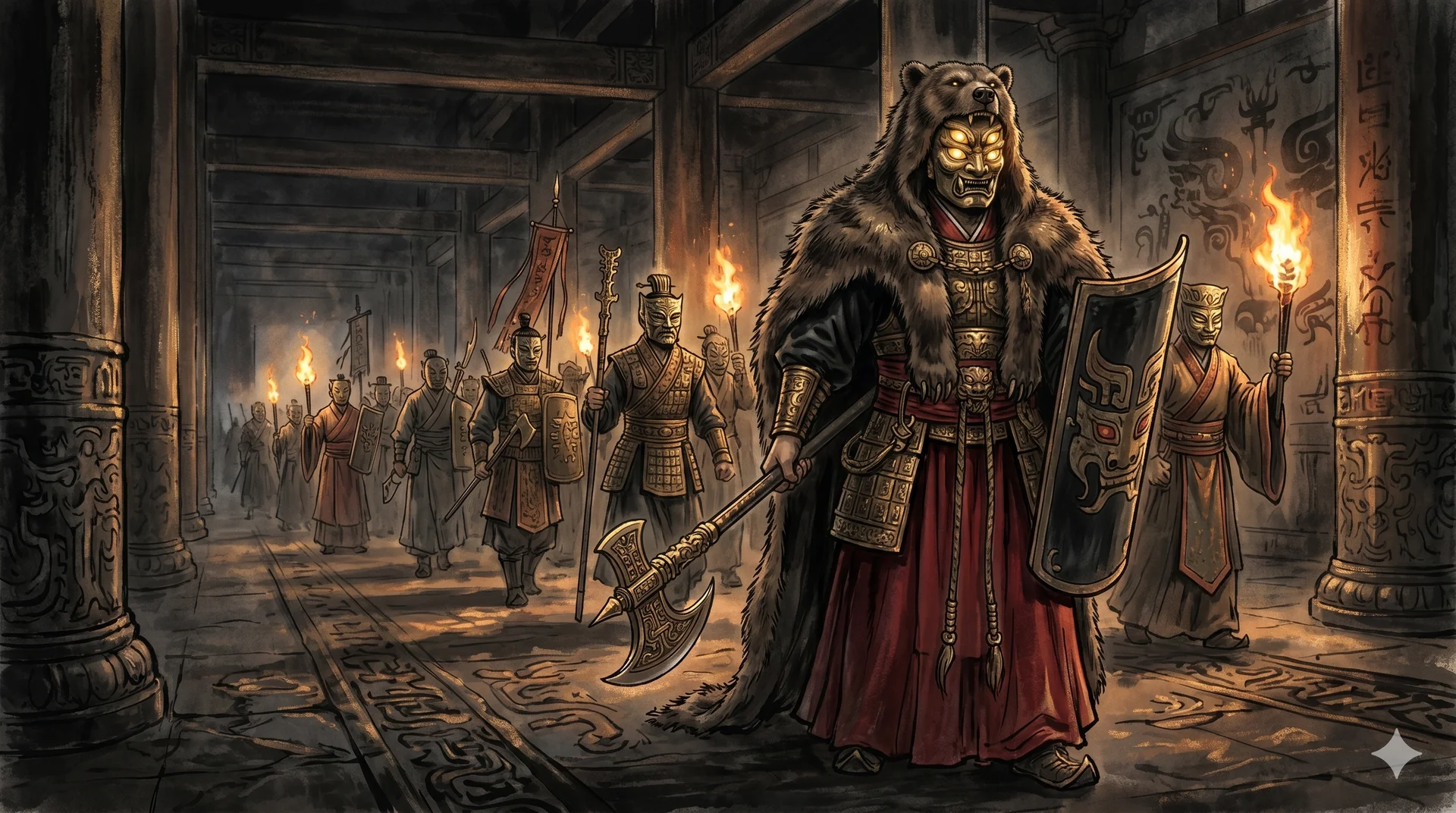
More than a thousand years before Zhong Kui first drew his sword, China already had its own demon-hunting champion. His name was Fangxiangshi — a shrouded, bear-skinned warrior wearing a mask with four gleaming golden eyes, dressed in black and crimson, wielding a bronze axe and shield. From the Zhou Dynasty through the Tang, Fangxiangshi commanded the imperial Nuo exorcism ceremony for over a millennium, standing as the undisputed centerpiece of China's state-level ritual for expelling plagues and evil spirits.
Yet Zhong Kui's arrival ultimately ended Fangxiangshi's reign. As the grand court Nuo ritual gradually shifted from solemn shamanic rite toward popular entertainment during the Tang Dynasty, a fresh demon-quelling figure — Zhong Kui — emerged to claim the throne. Scholar Chen Ke, in his landmark study on the transformation from shaman to Fangxiangshi to Zhong Kui, argues convincingly that Zhong Kui is the direct inheritor and reinvention of Fangxiangshi's role and spirit.
This article traces the full arc of Fangxiangshi's story — his origins, his terrifying appearance, his ritual duties, his long decline, and his deep connection to the Zhong Kui legend.
Who Was Fangxiangshi?
An Official Post in the Zhou Dynasty Ritual Code
What makes Fangxiangshi historically unique is that he was not some folk healer or village conjurer. He was a formally established government office under the Zhou Dynasty's ritual system. The Zhouli (Rites of Zhou), one of the Three Ritual Classics that shaped Chinese statecraft, records the position in precise administrative language:
The Fangxiangshi was tasked with donning a bearskin, wearing four golden eyes, dressing in a black upper garment and red lower skirt, and taking up axe and shield. He was to lead a hundred servants in performing the Nuo exorcism at regular intervals, searching every room to drive out pestilence. At state funerals, he marched ahead of the coffin; upon reaching the grave, he descended into the tomb pit and struck the four corners with his axe to expel the corpse-devouring demon called Fangliang. (Zhouli, "Offices of Summer")
This single passage reveals a staggering amount of information. Fangxiangshi's responsibilities fell into two broad categories. First, he performed house-to-house exorcisms in the palace — literally searching every chamber and corner to flush out pestilence and malevolent spirits. Second, he served as the vanguard of state funerals, clearing the path ahead of the imperial coffin, then entering the tomb itself to battle the Fangliang, a demon believed to devour the dead.
Notably, the Zhouli specifies that Fangxiangshi commanded "four madmen" (kuangfu) as subordinates — a formal headcount within the bureaucratic establishment. In the Zhou Dynasty's administrative hierarchy, demon hunting was an official government position with real staffing allocations. This is exceptionally rare in world history: a professional exorcist incorporated directly into the machinery of state.
Decoding the Name
The meaning of "Fangxiang" has attracted centuries of scholarly debate:
The Yellow Emperor Legend — According to the Xuanyuan Huangdi Zhuan (Legend of the Yellow Emperor), when the emperor's primary consort Leizu died during his travels, he ordered his secondary consort Momu to serve as guardian — and she was designated "Fangxiang." Although modern scholars generally consider this text a Tang-era composition, the story reveals how ancient Chinese imagination traced the exorcist's origins back to the mythic dawn of civilization.
The "Fangxiang as Terror" Theory — Zheng Xuan, the great Han Dynasty classicist, glossed the term in his commentary on the Zhouli: "Fangxiang is like saying fangxiang — a terrifying appearance." Tang scholar Jia Gongyan elaborated that this was common Han-era speech, describing something fearsome to behold. In this reading, the name itself encodes Fangxiangshi's purpose: to be so horrifying that even demons would flee.
The "Guardian of Funerals" Theory — Feng Jian of the Former Shu Dynasty noted that "Fangxiang may also be called fangsang — guardian against death." Scholar Xiao Bing argued this was a phonetic drift that preserved the office's original purpose — Fangxiangshi's most essential function was always serving as the spiritual vanguard in funeral rites.
The Terrifying Aesthetic: Appearance and Arsenal
Four Golden Eyes: A Supernatural Gaze
No feature defines Fangxiangshi more than the four golden eyes mounted on his head. These were not his own eyes — they belonged to a mask or headdress. In Chinese shamanic tradition, multiple eyes signify supernatural perception. Four eyes meant the ability to see what ordinary humans could not: the invisible world of demons, pestilence spirits, and lurking evil.
The "four golden eyes" served both aesthetic and functional purposes. Practically, a gleaming gold mask reflecting torchlight would produce an overwhelming visual impact, especially in the dim corridors of a palace or the shadowed interior of a freshly opened tomb. Combined with the bearskin and weapons, the whole ensemble formed a complete system of ritual terror. Symbolically, four eyes implied total surveillance — no spirit could hide from Fangxiangshi's gaze.
Bearskin, Black Robe, and Crimson Skirt
Fangxiangshi's attire followed strict ritual protocol: a bearskin draped over his body, with a black upper garment (xuanyi) and a red lower skirt (zhushang) beneath.
The Bearskin — Bears represented raw strength and ferocity in ancient China. Draping himself in bearskin meant channeling the animal's brute power against supernatural evil. The thick, shaggy pelt also exaggerated Fangxiangshi's physical bulk, making him appear even more imposing.
Black and Crimson — This color combination carried deep cosmological meaning in Chinese ritual thought. Black symbolized the north, water, and the underworld of the dead. Red symbolized the south, fire, and the vital energy of the living. Together, they signaled that Fangxiangshi commanded both realms — he could navigate the darkness of the spirit world and wield the life-force of the yang world simultaneously.
Axe and Shield: The Warrior-Exorcist
Fangxiangshi carried a ge (dagger-axe) and a dun (shield) — the two most common bronze weapons of the Shang and Zhou periods. The ge was designed for slashing; the shield for defense. The fact that Fangxiangshi wielded real battlefield weapons rather than ritual implements tells us something crucial: in the Zhou mind, exorcism was not merely a symbolic ceremony. It was actual combat against invisible enemies.
Fangxiangshi was no quiet incantation-chanting priest. He was a battle-grade exorcist — stepping, lunging, and striking his way through darkened chambers in search of demons. This kinetic, physically aggressive style of demon hunting directly prefigures Zhong Kui's own later image: sword drawn, eyes blazing, confronting evil head-on.
Ritual Duties: State Exorcism as National Policy
The Three Annual Nuo Ceremonies
The Liji (Book of Rites), another of the Confucian classics, records that the Zhou court held three Nuo exorcisms each year:
The Son of Heaven's Nuo — Held in mid-autumn, this was an exclusive ritual performed solely for the Zhou king. Only the sovereign received Fangxiangshi's personal room-by-room cleansing — the highest tier of spiritual protection.
The State Nuo — Held in late spring, this ceremony involved the king and regional lords together. Fangxiangshi performed his exorcisms across the capital city, reaching far beyond the palace walls.
The Great Nuo — Held in late winter, this was a nationwide event in which the entire population participated. Fangxiangshi led his company of servants through the city on the grandest demon-hunting expedition of the year.
Critically, Fangxiangshi's presence was restricted to ceremonies that included the Zhou king himself. This meant that in Zhou-era China, exorcism was an instrument of state power, not a private or folk activity. Fangxiangshi embodied not only shamanic force but also the hierarchical authority of the ritual order.
Guardian of the Dead: Fangxiangshi in State Funerals
Fangxiangshi's other core duty was serving as the vanguard of grand state funerals. When the nation held its highest-ranking burial ceremonies, Fangxiangshi marched ahead of the coffin, clearing the route of all spiritual threats. Upon reaching the cemetery, he descended into the tomb shaft and struck the four corners with his axe to drive out the Fangliang — a corpse-eating demon believed to lurk in graves.
Han Dynasty tombs frequently yield Fangxiangshi figurines — ceramic tomb guardians crafted specifically to protect the dead. This reveals that by the Han period, Fangxiangshi had become a protector of both the living and the deceased, his influence spanning the complete arc from birth to death.
The Long Decline: From Imperial Exorcist to Folk Relic
Han Dynasty: The Peak of Nuo Ritual
By the Eastern Han period, devastating epidemics swept through China with grim regularity. With limited medical understanding of disease, the populace turned to ritual protection — and the Nuo ceremony reached unprecedented scale and grandeur. Fangxiangshi's image and rituals spread widely, appearing not only at court but also in folk funerals and household apotropaic practices.
Yet even at this peak, the seeds of decline were visible. Under the Han system, the Nuo ceremony was no longer led by the Fangxiangshi as a ritual official — court eunuchs had taken over the proceedings. Fangxiangshi's authority was being diluted. This was the first warning sign.
Tang and Song: Zhong Kui Takes the Throne
The Tang Dynasty marked the turning point in Fangxiangshi's fate. As Buddhism gained cultural influence, Fangxiangshi's raw, ferocious aesthetic clashed with the more serene and compassionate visual ideals that were becoming mainstream. The old bear-skinned warrior simply looked out of place in a world increasingly shaped by Buddhist imagery.
Into this vacuum stepped Zhong Kui. Though equally terrifying in appearance, Zhong Kui came with something Fangxiangshi never had: a relatable human backstory. He was a brilliant scholar who, after being denied the top exam honors because of his hideous face, smashed his head against the palace steps and died — only to be appointed King of Ghosts by the emperor in the afterlife. This narrative of injustice, rage, and redemption resonated far more powerfully with ordinary people than the abstract figure of a masked shaman.
The Tang court also restructured the Nuo ceremony, creating new positions such as the Taizhu (Grand Invocator) and zhailang (Purification Officers). These changes further marginalized Fangxiangshi's traditional role. By the Song Dynasty, the name "Fangxiangshi" had vanished entirely from court Nuo records — surviving participants were generically referred to as "performers" or simply "Nuo dancers." Fangxiangshi had fallen from imperial exorcist to a ghost of folk memory.
A Funeral Legacy: Kailushen and Xiandaoshen
Although Fangxiangshi disappeared from state ceremony, he left a lasting imprint on folk funeral customs. From the Tang and Song onward, Fangxiangshi gradually evolved into two folk deities — Kailushen (Path-Clearing God) and Xiandaoshen (Way-Revealing God) — whose specific role was to march at the head of funeral processions, driving away evil.
This transformation is quietly revealing. Fangxiangshi went from cleansing the living emperor's chambers to clearing the road for the dead. From the star of a national spectacle to a supporting character in village funerals. Yet one thing never changed: he always walked at the very front. Whether leading the Son of Heaven or preceding a wooden coffin, Fangxiangshi and his successors always faced the unknown dangers first.
Fangxiangshi and Zhong Kui: Inheritance and Transformation
The Scholarly Consensus: From Shaman to God
Chen Ke's influential study systematically traces the evolution from archaic shaman to Fangxiangshi to Zhong Kui. The trajectory can be summarized as:
Shaman (primal exorcist) → Fangxiangshi (state-appointed ritual officer) → Zhong Kui (folk demon-quelling god)
Each stage preserved the core function — expelling evil and fighting demons — while undergoing a fundamental transformation in character: from a pure ritual practitioner, to an institutionalized government official, to a fully humanized deity with a complete life story and emotional depth.
Visual Lineage
The visual parallels between Fangxiangshi and Zhong Kui are unmistakable:
| Feature | Fangxiangshi | Zhong Kui |
|---|---|---|
| Face | Terrifying (four golden eyes) | Hideous (leopard head, glaring eyes) |
| Build | Massive (wrapped in bearskin) | Powerfully built (described as a great demon) |
| Garb | Black robe, red skirt, bearskin | Blue or green robe, soft-winged cap |
| Weapon | Dagger-axe and shield | Sword |
| Function | Room-by-room plague exorcism | Slaying demons and evil spirits |
| Era | Zhou through Tang | Tang to present day |
The shift from axe-and-shield to a single sword mirrors the technological evolution from Bronze Age to Iron Age weaponry. The change from a bear-skinned, four-eyed mask to a leopard-headed, scowling human face reflects a deeper cultural shift: from animalistic shaman to humanized god.
The Shared Spirit
The deepest continuity between Fangxiangshi and Zhong Kui lies in their spiritual core: the principle of meeting evil with overwhelming force — using terror to defeat terror. Fangxiangshi's four golden eyes and shaggy bearskin were designed to make him more frightening than the demons he hunted. Zhong Kui's grotesque face and furious glare serve the same purpose: outmatching evil at its own game.
This "fight fire with fire" philosophy of exorcism is a hallmark of Chinese apotropaic culture. Unlike Western traditions of demonology that emphasize faith, prayer, and divine authority, the Fangxiangshi-Zhong Kui lineage champions direct physical confrontation — striking with weapons, overpowering through strength, dispersing evil through sheer intimidation. It is a martial, visceral, unapologetically aggressive approach to spiritual warfare.
Fangxiangshi in Japan: When the Exorcist Becomes the Demon
Crossing the Sea with the Nuo Ritual
Fangxiangshi arrived in Japan sometime before the Nara period, carried across the sea along with the broader Nuo ceremonial tradition. In Japanese texts he is called Hōsōshi (ほうそうし), and his original function was identical to his Chinese role: the lead exorcist in the court's annual Tsuina purification rite.
But then his story took a dramatic turn.
The Reversal: From Exorcist to Exorcised
Because Fangxiangshi's appearance was so profoundly unsettling — the bearskin, the four eyes, the snarling mask — Japanese popular belief gradually reclassified him as a plague demon himself. He was no longer the hero driving away evil; he became the evil that needed to be driven away.
By the tenth century, this reversal was complete. In Japanese court rituals, Hōsōshi was no longer the pursuer — he was the pursued. This stands as a textbook case of what scholars call "semantic drift" in cross-cultural transmission: a figure so terrifying that the receiving culture simply could not associate it with benevolence.
The Edo-period artist Toriyama Sekien immortalized this transformation in his Konjaku Hyakki Shūi (Supplement to the Hundred Demons Past and Present), where he illustrated Fangxiangshi as a full-fledged yōkai — a monster. The journey from solemn exorcist to catalogued creep was complete.
A Tale of Two Cultures
The contrasting fates of Fangxiangshi in China and Japan reveal something fundamental about how each culture processes fear:
In China, Fangxiangshi declined in status but never lost his positive identity. Even after Zhong Kui replaced him, Fangxiangshi remained a force of protection — simply pushed to the margins. The Chinese cultural logic accepts that a terrifying appearance can serve a righteous purpose. Evil can be fought with something equally fearsome.
In Japan, Fangxiangshi started from the same position but ended up in the opposite place — from demon slayer to demon itself. This suggests a cultural instinct that reads terror as intrinsically malevolent, regardless of intent. If it looks like a monster, it is a monster.
Legacy: The Exorcist Who Made Zhong Kui Possible
Fangxiangshi's history is a compressed narrative of Chinese exorcism culture itself. From a formal post in the Zhou ritual code, to the star of Han Dynasty Nuo ceremonies, to his gradual displacement in the Tang and disappearance in the Song, to his strange afterlife as a Japanese monster — every step reflects deeper shifts in Chinese religion, politics, and aesthetics.
His most important legacy, without question, is Zhong Kui. Without Fangxiangshi's thousand-year accumulation of ritual authority, demon-hunting iconography, and martial exorcism tradition, there would have been no Zhong Kui bursting onto the scene in the Tang Dynasty. Zhong Kui inherited Fangxiangshi's terrifying visage, his warrior ethos, and his sacred mission — then added something new: a heartbreaking human story, a vivid personality, and a folk appeal that would endure for over a thousand years more.
In a sense, Zhong Kui was Fangxiangshi's renaissance — a successful reinvention of an ancient shamanic tradition into a popular cultural icon. And Fangxiangshi himself? He is the forgotten pioneer, the one who cleared the path and then quietly stepped aside.
Fangxiangshi reminds us that the demon hunter does not need to be gentle. In China's oldest tradition of spiritual protection, the most effective weapon against darkness is not prayer or blessing — it is a power greater than evil itself, even if that power is terrifying to behold. Wrapped in bearskin, glaring through four golden eyes, this ancient exorcist still stands in Zhong Kui's shadow, watching over the millennium-long enterprise he began.