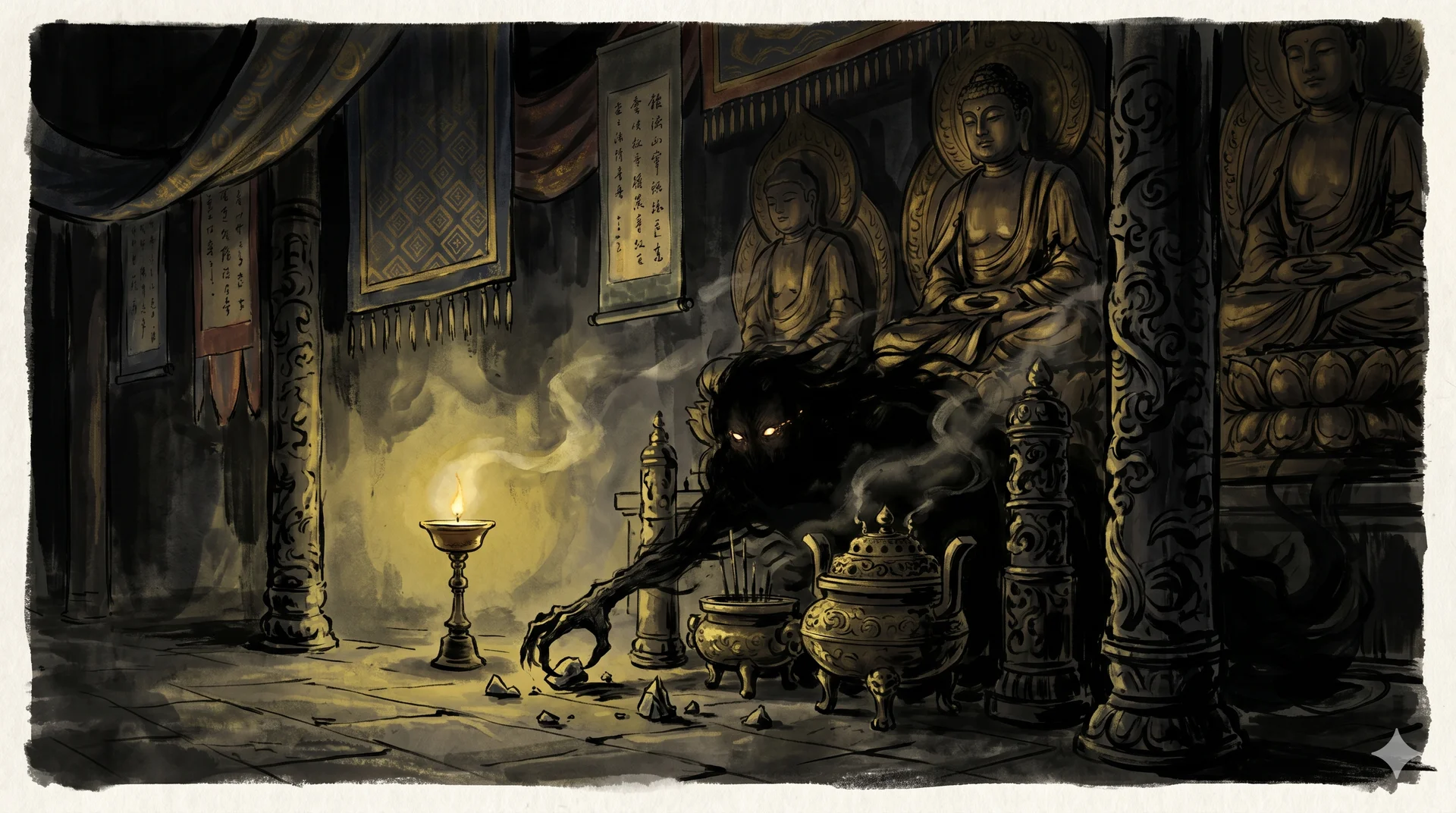
In Chapter 8 of Legend of the Demon Slayer (斩鬼传), Zhong Kui and his companions arrive at a Buddhist temple called Wukong Temple (悟空庵, "Temple of Awakening to Emptiness"). This sacred ground, meant for meditation and spiritual enlightenment, has been infiltrated by a demon known as Heiyan Gui (黑眼鬼) — the Dark-Eyed Ghost. The chapter title contains a remarkable seven-character phrase: "lazily executes the Dark-Eyed Ghost" (懒诛黑眼鬼). It stands alone in the entire novel as the only moment when Zhong Kui, the great demon hunter, displays laziness toward vanquishing a monster.
The term "heiyan" carries rich cultural connotations in Chinese folk parlance, referring to those who scheme in the shadows — sabotaging others behind their backs, spreading rumors out of sight, and striking when no one is watching. Unlike the brash, in-your-face demons Zhong Kui typically faces, Heiyan Gui's menace lies entirely in its invisibility. And Zhong Kui's reluctance to engage carries a layered message: the petty schemer is despicable, yet often unworthy of a direct confrontation.
Who Is Heiyan Gui?
The Metaphor Behind the Name
"Heiyan" (黑眼) translates literally as "dark eyes" or "black eyes," but in colloquial Chinese it carries a much sharper edge. At its most direct, it describes someone who watches others with malicious intent — eyes lurking in the darkness, waiting for an opportunity to strike. On a deeper level, it evokes "yanhei" (眼黑) — the green-eyed jealousy, the bitter resentment toward another person's success.
In northern Chinese dialects, "giving someone the dark eye" means covertly sabotaging them: setting traps, planting obstacles, and undermining relationships while maintaining a friendly face (cf. Wu, Chinese Demonology and Popular Religion, 2017). Heiyan Gui's name distills this archetype of the treacherous backstabber into a single, vivid demonic figure.
A Sinister Presence in Wukong Temple
Author Liu Zhang's decision to place Heiyan Gui inside Wukong Temple is a masterstroke of irony. "Wukong" derives from Buddhist philosophy — it means awakening to the truth of emptiness (śūnyatā), releasing attachments, and seeing through illusion. Yet the ghost inhabiting this very temple embodies attachment and delusion in their most toxic form. It hides in a place of enlightenment while firing poisoned arrows at the unsuspecting.
Zhong Kui's two companions — Han Yuan (含冤, "Harboring Grievance") and Fu Qu (负屈, "Bearing Injustice") — carry symbolic weight here as well. Han Yuan represents unredressed wrongs: the injuries inflicted by insidious people are the hardest to avenge because the victim cannot identify the attacker. Fu Qu stands for endured humiliation: those harmed by covert sabotage often do not even realize how they were victimized, leaving them with no avenue for appeal.
Heiyan Gui in Chapter 8: Covert Sabotage
The Art of Striking From the Shadows
Heiyan Gui's modus operandi stands in stark contrast to nearly every other demon in the novel. The Shameless Ghost pesters you with brazen persistence, the Liar Ghost spins fabrications to your face, and the Lust Ghost tempts openly — all are visible adversaries. Heiyan Gui never confronts anyone directly. It works entirely in the shadows: poisoning food, laying traps along paths, and sowing discord in relationships.
This pattern of covert sabotage presents Zhong Kui's team with an unprecedented challenge — how do you slay an enemy you cannot find? The ghost's insidious genius lies in keeping its targets perpetually under threat while leaving no evidence behind (see also: Bodde, Festivals in Classical China, 1975, on the folk concept of unseen malevolent forces).
The Significance of "Lazy Execution"
The word "lazy" (懒) in the chapter title is the interpretive key to the entire episode. On the surface, it signals Zhong Kui's contempt — a covert schemer hiding in the shadows is beneath the dignity of the Demon-Slaying Lord. At a deeper level, "lazy" exposes a crack in Zhong Kui's own armor: even the greatest demon hunter can feel fatigue and avoidance when confronted with insidious people.
This "laziness" doubles as a strategic philosophy. Petty schemers want you to exhaust yourself chasing shadows and second-guessing every step. By refusing to engage, Zhong Kui deprives Heiyan Gui of the one thing it needs most: attention.
The Psychology of the Backstabber
Why Some People Operate in Darkness
Heiyan Gui's behavioral profile maps closely onto what modern psychology describes as covert aggression — the use of indirect, deniable tactics to harm others while maintaining plausible innocence. The workplace saboteur who quietly undermines a colleague's project, the social-circle gossip who plants rumors through third parties, the anonymous online attacker who strikes from behind a screen name — all are modern incarnations of Heiyan Gui.
What unites these types is a shared psychological architecture: an unwillingness to compete openly, a fear of direct confrontation, and a deep-seated terror of exposure. They do not operate in darkness because they lack the capacity for open conflict; they do so because they are, at core, afraid — afraid of failure, afraid of being seen, afraid of confronting who they truly are. Insidiousness is a weak person's weapon, a mask that cowards wear to appear powerful.
The Entanglement of Jealousy and Malice
Heiyan Gui's "dark eye" does not merely signify covert action — it also encodes envy. The connection is etymological: in Chinese, "dark eyes" (黑眼) and "red eyes from jealousy" (眼红) are conceptually linked through the organ of sight. Sabotage is frequently the byproduct of jealousy: unable to achieve what another has accomplished, the envious person seeks to destroy it. The "dark" in Heiyan Gui is both literal (hidden action) and moral (a corrupted soul).
The Double Meaning of "Lazy Execution"
Zhong Kui's Moment of Vulnerability
Throughout Legend of the Demon Slayer, Zhong Kui is portrayed as a near-flawless warrior — brave, righteous, and relentless in his pursuit of evil. Chapter 8's "lazy execution" reveals a more human side: even he experiences weariness and the temptation to disengage.
This is not a diminishment of Zhong Kui's character but a psychologically honest portrait. Battling insidious people is uniquely draining. You never know when the next hidden arrow will fly, whom you can still trust, or which step might trigger a concealed trap. That constant hypervigillance is enough to make anyone want to simply stop caring.
Defeating Darkness Through Indifference
From another angle, Zhong Kui's refusal to engage is a masterful tactic. The one thing a covert saboteur fears more than confrontation is being ignored. When the hidden arrow draws no reaction, when the trap catches no one, when the schemer's existence goes completely unacknowledged — Heiyan Gui is stripped of all power.
The deeper wisdom of "lazy execution" is this: the best way to deal with a backstabber is not to match them scheme for scheme, but to grow so strong and focused on your own purpose that their arrows become irrelevant. When your gaze is fixed on a higher goal, when your energy flows into meaningful work, Heiyan Gui's covert attacks are reduced to mosquitos biting an elephant — trivial and forgettable.
Cultural Symbolism and Deeper Meanings
Wukong Temple: The Ultimate Antidote
Placing Heiyan Gui inside a temple dedicated to the Buddhist concept of emptiness was a deliberate philosophical statement by Liu Zhang. If the Dark-Eyed Ghost represents covert malice born of attachment, then "awakening to emptiness" (悟空) is the ultimate remedy.
When a person truly comprehends emptiness — letting go of the hunger for reputation, wealth, and social standing — the backstabber loses every leverage point. Heiyan Gui's arrows find their mark only because people have something that can be damaged: name, status, relationships, possessions. When these are understood as transient and insubstantial, the arrows have nothing to hit (see Heart Sutra translations by Red Pine, 2004, on the Buddhist doctrine of emptiness as liberation from suffering).
A Foreshadowing Thread to Lengzheng Gui
Heiyan Gui appears in Chapter 8; Lengzheng Gui (楞睁鬼, the Staring-Blankly Ghost) surfaces in the final chapter (Chapter 10). The two form a subtle thematic pair. Heiyan Gui makes its victims too lazy to act — a passive disengagement. Lengzheng Gui embodies the active choice to do nothing at all — an aggressive lethargy. Together, they trace a degenerative arc: from "I can't be bothered with schemers" to "I can't be bothered with anything."
Zhong Kui's momentary laziness at Wukong Temple, left unchecked, could metastasize into the total apathy represented by Lengzheng Gui. It is a warning to every would-be demon slayer: battling external monsters matters, but watching for the growth of one's own inner weaknesses matters even more.
Heiyan Gui teaches us that the most exhausting adversaries are not those who attack openly, but those who strike from the shadows. Yet Zhong Kui's "lazy execution" offers a counter-lesson: rather than exhausting yourself chasing hidden arrows, keep walking toward the light. Once you step into the open, the arrows fired from darkness can no longer reach you.