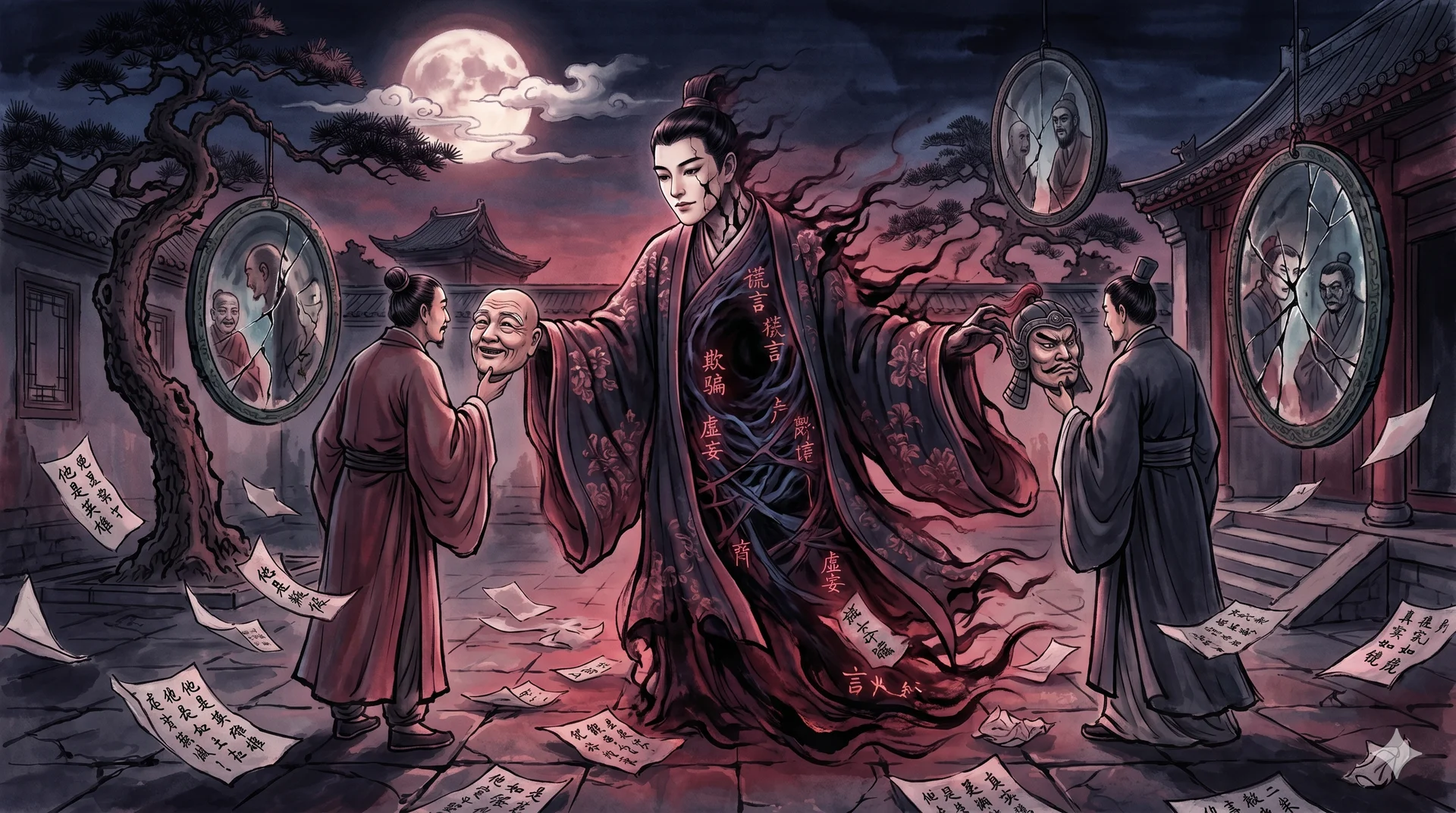
Among the rogues' gallery of "human-natured demons" in Liu Zhang's Qing Dynasty satirical novel Quelling the Demons (斩鬼传), few creatures are as universally recognizable as the Huang Gui — the Lying Demon. While other specters embody flamboyant vices like shamelessness, lust, or gluttony, this deceiver feeds on something far more commonplace: the lie. Not the grand theatrical falsehood, but the everyday untruth — the small distortion, the convenient omission, the self-justifying fiction that nearly every human being has told at least once.
Chapter Six's title encapsulates the demon's fate in a devastating double reversal: "The swindler is himself swindled blind; the Lying Demon's corpse is stolen by ghosts." Deception begets deception. The liar becomes the lied-to. This is not cosmic punishment imposed from above — it is the internal logic of falsehood itself, and Liu Zhang dramatizes it with surgical precision.
Who Is the Huang Gui?
The Demon of Everyday Falsehood
The Huang Gui represents deceit, hypocrisy, and self-deception woven into a single supernatural entity. Its name is deceptively simple — huang (谎) means lie or falsehood, and gui (鬼) means ghost or demon. Together they form a compound that needs no elaboration: this is the Ghost of Lies, the Demon of Deception, the specter that walks among us disguised as truth.
What makes the Huang Gui so insidious is its ordinariness. Unlike the Xianlian Gui (Shameless Demon), whose brazenness provokes immediate revulsion, or the Se Gui (Lust Demon), whose excesses are unmistakably grotesque, the Lying Demon operates in the gray zone of daily life. Its danger lies precisely in its ubiquity — almost no one is entirely free of its influence. As the philosopher Immanuel Kant argued in his foundational essay On a Supposed Right to Lie from Philanthropic Concerns (1797), even seemingly harmless lies erode the foundation of trust upon which all human communication depends. Liu Zhang arrived at a parallel insight two centuries earlier, casting the lie not merely as a moral failing but as a supernatural force with its own demonic avatar.
Why the Huang Gui Appears in Chapter Six
Liu Zhang's placement of the Lying Demon at Chapter Six — the structural midpoint of the novel's early arc — is anything but random. The preceding chapters introduced demons of flattery (Zhou Gui), shamelessness (Xianlian Gui), and ingratitude (Wang En Gui). Each of these creatures relied on deception as a secondary tool: the flatterer lies to curry favor, the shameless rogue lies to cover tracks, the ingrate lies to rationalize betrayal. Lies served as supporting infrastructure for other sins.
By Chapter Six, the infrastructure itself steps into the spotlight. The Lying Demon is not a servant of other vices but their foundation — the bedrock upon which the entire architecture of human corruption rests. Liu Zhang's structural choice implies a devastating observation: before you can be shameless, you must first lie to yourself about the consequences; before you can be ungrateful, you must fabricate a narrative in which gratitude is unnecessary. The lie comes first. Everything else follows.
The Lying Demon's Chapter Six Performance
The Swindler Swindled
The first half of Chapter Six's title — "The swindler is himself swindled blind" — delivers the episode's central irony. The Huang Gui has made a career of deceiving others, wielding honeyed words and fabricated stories with professional ease. It manipulates, distorts, and misleads with the confidence of a creature that has never been caught. But the demon's mastery of falsehood proves to be its greatest vulnerability. In a world of liars, there is always a more skillful deceiver, and the Huang Gui meets its match.
The text's use of the verb koutao (抠掏) — literally "to dig out and pick clean" — is particularly vivid. The demon is not merely tricked; it is hollowed out. What is taken from it extends beyond material possessions to include trust, identity, and social standing. The swindler discovers that the currency of deception is not infinite — eventually, the well runs dry, and the deceiver becomes the mark.
The Corpse Stolen by Ghosts
The chapter title's second half — "The Lying Demon's corpse is stolen by ghosts" — pushes the narrative into darker territory. After the Huang Gui is exposed and attempts to discard its lies — perhaps through a show of repentance or a fresh fabrication to cover the old — the consequences escalate catastrophically. Other demons seize its "corpse," a symbol that operates on multiple levels: its physical form, its accumulated evidence, its residual power.
This image captures an essential truth about the ecology of deception. One lie does not exist in isolation. It generates a trail of supporting fictions, each one leaving behind traces that other predators can exploit. When the Huang Gui tries to walk away from its own falsehoods, it discovers that the lies have taken on a life of their own — and other demons are waiting to feed on the remains. The metaphor anticipates what modern psychologists call the "cascade effect" of dishonesty: as behavioral scientist Dan Arieli demonstrated in The Honest Truth About Dishonesty (2012), one act of deception lowers the psychological barrier to the next, creating a self-reinforcing spiral that the deceiver cannot control.
Liu Zhang's Satirical Architecture
The entire chapter operates as a masterclass in satirical inversion. The Huang Gui believes itself to be the smartest creature in the room — a puppeteer pulling strings from behind a curtain of words. Liu Zhang lets the demon enjoy this illusion for precisely long enough to make its downfall satisfying. When the reversal comes, it is total: the manipulator becomes the manipulated, the storyteller becomes the character in someone else's fiction, and the architect of deception finds himself trapped in a structure built by a superior liar.
The satire cuts deeper than simple irony. Liu Zhang suggests that the world of falsehood operates according to its own Darwinian laws — survival of the most deceptive. In this ecosystem, the Huang Gui is not an apex predator but merely a mid-level operator, destined to be consumed by a more ruthless deceiver. There is always a bigger lie.
The Anatomy of a Liar: Three Defining Characteristics
Characteristic One: The Silver Tongue
The Huang Gui's primary weapon is language itself. It can transform black into white, wrong into right, catastrophe into opportunity — all through the careful arrangement of words. In the social context of Qing Dynasty China, this skill would have evoked two instantly recognizable archetypes: the silk-tongued bureaucrat who deceives his superiors while exploiting his subordinates, and the marketplace hawker who passes shoddy goods as treasures through sheer verbal dexterity.
Liu Zhang's portrayal draws on a deep Confucian suspicion of clever speech. Confucius himself warned in the Analects (Book 1, Chapter 3): "Clever words and an ingratiating appearance are seldom associated with true virtue" (巧言令色,鲜矣仁). The sage recognized that verbal fluency untethered from moral grounding becomes a tool of manipulation. The Huang Gui embodies this danger in its purest form — a creature of pure eloquence with no tether to truth whatsoever.
Characteristic Two: Self-Deception as Foundation
Perhaps the Huang Gui's most psychologically penetrating feature is its commitment to self-deception. The demon does not simply lie to others; it lies to itself first. Before it can deceive with conviction, it must convince itself that its falsehoods are justified, necessary, or even true. This self-directed deception serves as the launchpad for all external dishonesty.
The Stoic philosopher Epictetus observed that "it is impossible for a man to learn what he thinks he already knows" — a paradox that applies perfectly to the self-deceived. The Huang Gui, having convinced itself of its own fictions, loses the capacity to distinguish truth from fabrication. Its blindness is not accidental but structural: self-deception systematically disables the very faculties needed to correct it. Modern cognitive science confirms this pattern. As the psychologist Daniel Goleman documented in Vital Lies, Simple Truths (1985), the mind possesses powerful mechanisms for ignoring inconvenient information, and these mechanisms strengthen with use — each act of self-deception makes the next one easier.
Characteristic Three: Inevitable Self-Destruction
The Huang Gui's trajectory always curves toward collapse. This is not because an external force intervenes — though Zhong Kui eventually does — but because deception contains the seeds of its own destruction. A single lie demands supporting lies. Supporting lies demand still more. The structure grows exponentially until its weight exceeds the deceiver's ability to maintain it. Then it falls.
This pattern follows what scholars of narrative call "the architecture of the cover-up" — the principle that concealment requires ever-escalating investment until the cost of maintaining the fiction becomes unsustainable. Liu Zhang dramatizes this principle through supernatural means: the Huang Gui does not merely fail; it is consumed by the very apparatus of deception it constructed. The tower of lies buries its builder.
Karmic Retribution and the Moral Structure of Chapter Six
The Law of Cause and Effect
Chapter Six operates according to the most fundamental principle of Chinese moral philosophy: karmic retribution (因果报应). The Huang Gui plants the seed of deception and harvests the fruit of being deceived. This symmetry is not coincidence — it is cosmic law rendered in narrative form.
The concept of karmic justice permeates classical Chinese literature from the Ming and Qing dynasties. As the literary scholar Patrick Hanan noted in The Chinese Short Story (1973), the "poetic justice" structure served dual functions: it satisfied readers' moral expectations while reinforcing the broader philosophical claim that the universe operates as an ethical system in which every action produces a proportionate consequence. Liu Zhang deploys this structure with particular elegance because the retribution fits the crime so precisely — the deceiver is destroyed by deception itself.
Zhong Kui's Role: Executioner, Not Avenger
One of the chapter's most subtle features is Zhong Kui's relatively passive role. The Demon Hunter does not hunt down the Huang Gui through heroic effort. Instead, he serves as the final instrument of a cosmic law that the demon has already violated. The Lying Demon is broken by its own lies, exploited by other demons, and dismantled by the very web of falsehood it wove. Zhong Kui merely arrives to sweep up the wreckage.
This narrative choice carries a profound implication: the destruction of a liar does not require divine intervention. Lies are self-annihilating. The universe does not need to punish the deceiver because deception punishes itself. Zhong Kui's sword is not the instrument of destruction but the punctuation mark at the end of a sentence the Huang Gui wrote for itself.
The Lying Demon in the Modern World
Disinformation and Digital Deceit
Place the Huang Gui in the twenty-first century and its relevance becomes almost painful. The information age has amplified every aspect of the Lying Demon's power. Falsehoods now spread at the speed of light across social media platforms, manufactured narratives shape political movements, and deepfake technology threatens to make visual evidence itself untrustworthy. The ecosystem Liu Zhang described — where lies breed more lies and deceiver becomes deceived — has scaled to global proportions.
The economist Tim Harford, in his analysis of misinformation patterns, has argued that the most dangerous lies are not the obvious ones but the plausible ones — the small distortions that feel true because they confirm what we already believe. This is precisely the Huang Gui's domain: not grandiose fabrication but the subtle, comfortable lie that slides past our defenses because it tells us what we want to hear.
The Self-Deception Epidemic
Even more troubling is the modern prevalence of self-deception, the Huang Gui's signature trait. In an era of algorithmic filter bubbles and confirmation bias, millions of people construct personalized information environments that shield them from inconvenient truths. Selective perception, motivated reasoning, the echo chamber effect — each represents a form of self-deception so normalized that it passes for rational behavior.
Liu Zhang saw this pattern three centuries ago. The Huang Gui lies to itself before it lies to others, and this self-directed falsehood is the hardest to detect and the most difficult to sever. In the novel, even Zhong Kui's sword cannot undo self-deception — it can only remove the demon that embodies it.
Where Is Zhong Kui Today?
If the Huang Gui is everywhere in modern life, where is the demon hunter who can slay it? Liu Zhang's narrative suggests an answer: the weapon against lies is not a sword but the willingness to see clearly. Every pair of eyes that refuses to look away from uncomfortable facts, every mind that insists on verification before belief, every voice that demands evidence over assertion — these are the modern equivalents of Zhong Kui's blade. The Lying Demon can be wounded by the simplest of weapons: the truth, spoken plainly and persisted in.
The Huang Gui teaches a lesson that grows more urgent with each passing year: deception is a slow poison. It does not kill instantly but corrodes steadily, eating away at the soul of the deceiver long before it damages the deceived. The swindler swindled, the liar lied to — this is not divine punishment but the natural terminus of falsehood. Zhong Kui's final stroke merely confirms what was already inevitable. In the end, the lie devours its creator.