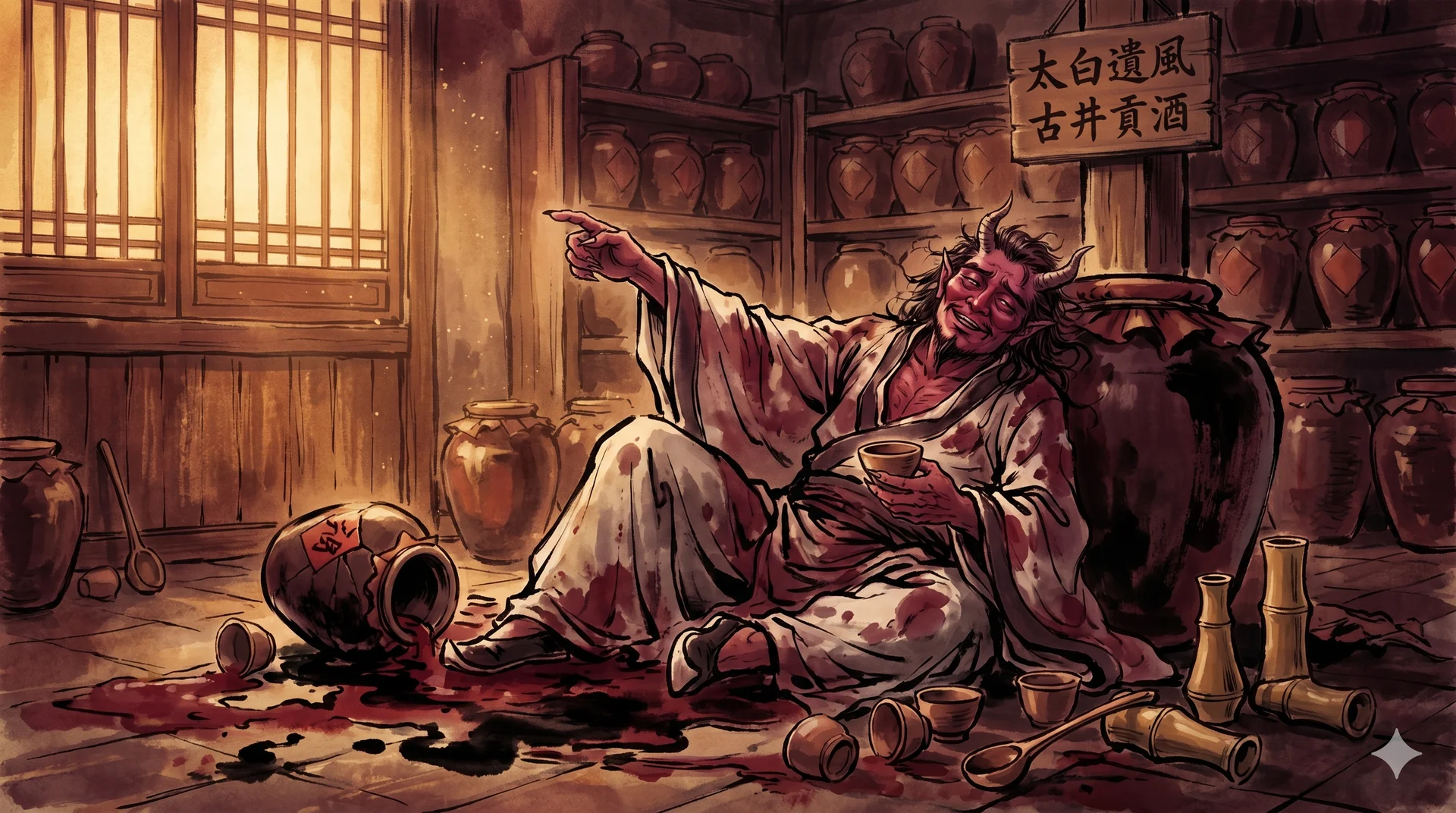
In the Qing dynasty satirical novel Zhong Kui Slays Demons (斩鬼传), the demon-queller Zhong Kui marches across the land with his two lieutenants, Han Yuan and Fu Qu, exterminating creatures that each embody a different human failing. Among the most revealing of these encounters is Jiu Gui — the Liquor Demon — who appears in Chapter 9 alongside the Lust Demon. Together they represent two of humanity's oldest, most stubborn addictions: drink and desire.
The chapter title sums up Jiu Gui's nature in a single poetic line: "Loving the cup, falsely invoking immortals" (爱贪杯谬引神仙). The drunkard does not merely overindulge — he wraps his indulgence in the language of spiritual attainment, convincing himself that the haze of intoxication is a gateway to the divine. That act of self-deception is the real poison, and it is precisely what Zhong Kui's blade must cut through.
Who Is Jiu Gui?
A Name That Needs No Explanation
Among the entire rogues' gallery in Zhong Kui Slays Demons, no creature bears a more transparent name than Jiu Gui. "Jiu" means wine or liquor; "Gui" means demon or ghost. Unlike the Sycophancy Demon or the Brazen-Face Demon — names that require some cultural unpacking — the Liquor Demon announces itself instantly. Anyone who has watched a friend or family member spiral into addiction recognizes this enemy at once.
This directness is deliberate. Author Liu Zhang positioned Jiu Gui not as a complex villain requiring deep analysis, but as a universal weakness that hides in plain sight. The demon's power lies not in cunning strategy but in omnipresence: every tavern, every banquet table, every lonely night is potential territory for Jiu Gui to take hold.
Physical Description and Demonic Aura
Liu Zhang's portrayal draws on stock images of the habitual drunkard: a flushed face, unsteady gait, slurred yet relentless speech. The character's "demonic energy" is not terrifying in the conventional sense — it manifests as that pitiable, half-conscious state where a person has lost control of their own body yet believes they are ascending to some higher realm of understanding.
When Han Yuan and Fu Qu confront Jiu Gui, they face no mighty warrior. Instead, they grapple with chaos itself — a creature devoid of clear logic or coherent behavior, trapped in an endless cycle of indulgence, remorse, and deeper indulgence. The frustration of dealing with someone who cannot reason their way out of addiction is captured perfectly in this formless, staggering adversary.
Jiu Gui in Chapter 9: Drink and Desire Entwine
A Paired Entrance with the Lust Demon
The decision to introduce Jiu Gui alongside the Lust Demon in the same chapter is far from coincidental. Wine and carnal desire have been linked since antiquity. The philosopher Mencius declared that "appetite for food and sex are natural human tendencies" (食色性也), and wine is the substance that removes the inhibitions standing between thought and action. By pairing these two demons, Liu Zhang makes a clear statement: once alcohol has stripped away a person's rationality, desire rushes in to fill the void.
In the narrative, Jiu Gui appears first — stumbling, boasting, proclaiming that the intoxicating effects of wine are actually a form of divine communion. This "falsely invoking immortals" is the demon's signature trick. It does not simply crave drink; it constructs an elaborate ideological defense for drinking. Every rationalization familiar from real life — "wine loosens the tongue," "a thousand cups between true friends is too few," or the inevitable invocation of Li Bai composing a hundred poems after a single bout of drinking — echoes this same logic. The Liquor Demon's true weapon is not a blade or a spell; it is language.
Zhong Kui's Method of Destruction
Zhong Kui's approach to defeating Jiu Gui carries deep satirical bite. Since the demon claims to have achieved a godlike state through drinking, Zhong Kui overwhelms it with absolute, merciless sobriety. In the foggy landscape of the drunkard's self-delusion, the only effective weapon is crystal-clear consciousness.
Han Yuan — whose name literally means "Harboring Grievance" — embodies the righteous anger of every victim destroyed by another person's drinking: the families shattered, the injuries caused by drunken rage, the trust eroded by broken promises made under the influence. Fu Qu — "Enduring Wrong" — represents the silent suffering of those forced to bear the consequences of someone else's addiction. Together, they give voice to the collateral damage that Jiu Gui leaves in its wake.
The Portrait of the Drunkard
The Philosophy of Hiding Behind the Bottle
Jiu Gui personifies something far more insidious than physical alcohol dependency. It embodies a worldview — the calculated use of drunkenness as a social shield. In traditional Chinese culture, the banquet table doubles as a theater of power, where the ability to drink heavily is equated with sincerity, courage, and even moral character. Jiu Gui's existence satirizes this twisted equation: self-destruction dressed up as magnanimity, loss of control celebrated as authenticity.
The phrase "falsely invoking immortals" exposes the psychological machinery at work. Addicts understand, at some level, that they are sinking. What they need is a vocabulary to recast their decline as something noble. Calling intoxication "spiritual awakening," excusing bad behavior as "showing one's true self," or framing dependency as "refined taste" — these are the Liquor Demon's incantations, and they are far more dangerous than any physical weapon.
The Slow Gradient of Decline
Unlike the Lust Demon, whose damage tends to be sudden and catastrophic, Jiu Gui destroys by degrees. Lust can annihilate a relationship or a family in a single impulsive act. Alcohol's corrosion is slower: from an occasional extra glass to habitual excess, from social drinking to solitary binges, from "I can stop anytime" to total loss of control.
Liu Zhang's placement of Jiu Gui in the penultimate chapter of the ten-chapter novel underscores this point. You might sever the grip of lust in one decisive act, but breaking free of addiction requires dismantling a pattern reinforced daily over years. Jiu Gui is not a momentary impulse; it is a lifestyle — and lifestyles are the hardest demons to exorcise.
"Falsely Invoking Immortals": Satire at Its Sharpest
The Logic of the Self-Deceiver
The phrase "falsely invoking immortals" (谬引神仙) is perhaps the most incisive literary distillation of addiction psychology in classical Chinese fiction. "Miu" means erroneous or absurd; "Yin" means to cite or invoke; "Shenxian" refers to transcendent, immortal beings. The drunkard mistakes alcohol-induced hallucination for genuine mystical experience, confused consciousness for superior wisdom.
Chinese literary history is full of legendary drinkers. Li Bai, Liu Ling, and Tao Yuanming all earned fame for their love of wine. Yet through Jiu Gui, Liu Zhang poses an uncomfortable question to this tradition: when the inebriated claim to "speak truth after wine," are they speaking truth or gibberish? When they insist that "wine bridges the human and the divine," is the bridge leading to gods — or to demons?
A Critique of the Scholar-Drinker Culture
The Qing dynasty intellectual world was steeped in drinking culture. Scholars competed to demonstrate their capacity for wine, and literary gatherings invariably featured heavy consumption. Liu Zhang, himself a member of this educated class, would have witnessed these dynamics firsthand. Jiu Gui functions as a mirror held up to his own social circle: when the literati treat drunkenness as elegance and loss of composure as romantic flair, how far are they from becoming the very demon Zhong Kui hunts?
The Twin Demons: Wine and Lust
Why They Appear Last
The pairing of Jiu Gui and the Lust Demon in the penultimate chapter creates a dramatic crescendo. The traditional Chinese formulation "wine, lust, wealth, and anger" (酒色财气) names the four cardinal temptations of human life, and wine and lust occupy the first two positions — suggesting that the ancients regarded these two appetites as the most fundamental.
By reserving these twin demons for nearly the end of the narrative, Liu Zhang sends an unmistakable message: among all human failings that Zhong Kui must vanquish, addiction to alcohol and carnal desire are the most deeply rooted. The demon-queller can dispatch the Lie Demon and the Brazen-Face Demon earlier in the story, but Wine and Lust must be confronted near the finale because they resist easy solutions.
The Order of Slaying as Moral Commentary
The sequence in which demons appear in Zhong Kui Slays Demons is itself a literary device. Earlier adversaries represent weaknesses that are relatively easy to identify and overcome. Later ones correspond to more deeply entrenched flaws. Positioning Jiu Gui and the Lust Demon in Chapter 9 of a 10-chapter work signals Liu Zhang's conviction that loss of control over fundamental desires is the hardest human weakness to eradicate.
This structure reinforces the deeper theme of the Zhong Kui mythos: demon-slaying is not merely an external battle but an internal discipline. The procession of monsters that Zhong Kui cuts down is, symbolically, the sequence in which a person must confront and master their own defects. Jiu Gui and the Lust Demon remind readers that the final enemy is never some external fiend — it is the desire that lives inside every human heart.
Jiu Gui teaches us that the most dangerous kind of ruin is not a sudden plunge into the abyss, but the slow creep of one more drink each night — each one justified as a step toward something divine. When Zhong Kui's blade falls on the Liquor Demon, it does not cut away wine itself. It cuts away the lie: the absurd, eloquent, self-serving fiction that transforms degradation into transcendence.