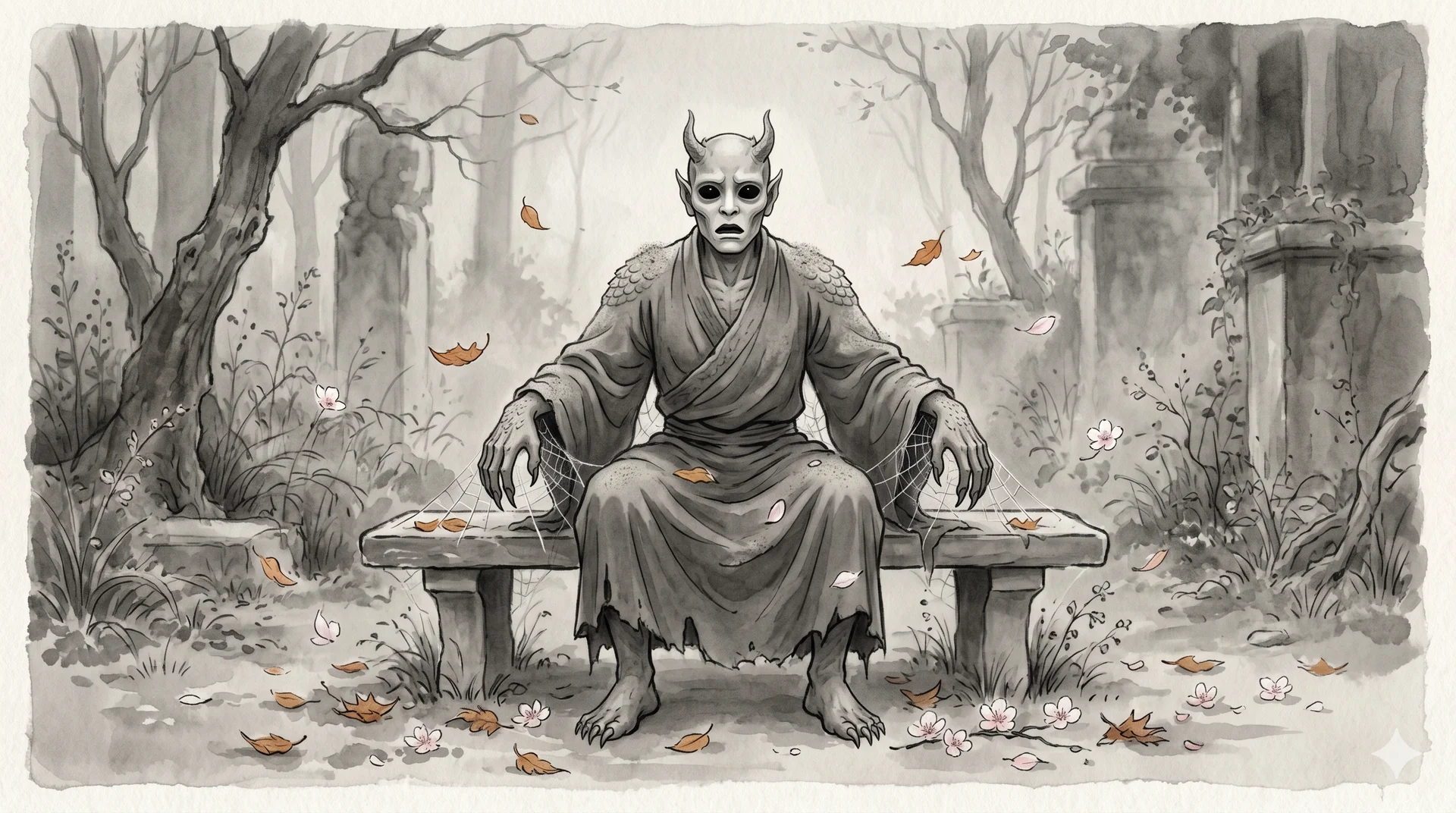
Among the entire rogue's gallery of demons in the Legend of Demon Slaying (斩鬼传), one creature bears a name that hardly sounds threatening at all — Lengzheng Gui (楞睁鬼). The term lengzheng is a Northern Chinese colloquialism describing a person who sits blank-eyed, slack-jawed, doing absolutely nothing. This demon does not steal, swindle, lust, or drink. Its sole defining trait is — doing nothing whatsoever.
Yet Liu Zhang, the novel's author, chose this very creature as the final adversary Zhong Kui faces. After ten grueling chapters of demon-slaying, after every conspicuous villain has been laid low, the last obstacle on the exorcist's road turns out to be a sluggish, numbed, idle phantom. The significance of this arrangement deserves careful attention.
Who Is Lengzheng Gui?
The Linguistic Roots of a Colloquial Demon
The word lengzheng (楞睁) remains in everyday use across northern China. When someone sits motionless, staring into space, a bystander might ask, "What are you lengzheng-ing about?" — meaning, "Why are you just sitting there doing nothing?" The expression carries a dual meaning: outwardly, it signals a glazed, listless demeanor; inwardly, it points to a hollow absence of thought, purpose, or drive.
By naming a demon after such an ordinary expression, Liu Zhang made his intention unmistakable: Lengzheng Gui is no distant bogeyman. It dwells inside every person's daily routine. Whenever someone fritters away time, zones out when action is called for, or procrastinates when a decision is needed — Lengzheng Gui has already taken hold.
A Literary Tradition of Laziness
Chinese supernatural fiction does not frequently elevate laziness to the status of a named demon. Pu Songling's Strange Tales from a Chinese Studio (聊斋志异) includes a tale of a lazy serpent, and Yuan Mei's Zi Bu Yu (子不语) records a spirit of excessive sleep. But to make sloth the ultimate demon, as Liu Zhang does in the Legend of Demon Slaying, is a rarity. This creative choice reflects a penetrating insight: laziness, inconspicuous as it seems, may be the most fundamental vice of all.
Lengzheng Gui in the Final Chapter
The Last Enemy of the Entire Epic
Lengzheng Gui appears in Chapter Ten — the concluding chapter of the novel. By this point, Zhong Kui and his companions Han Yuan (含冤) and Fu Qu (负屈) have already dispatched a procession of demons representing grand, unmistakable sins: the Lie Demon, the Shameless Demon, the Lust Demon, the Drunkard Demon, and more. The reader expects the saga to culminate in a spectacular showdown. Instead, the final opponent is a phantom whose entire nature consists of doing nothing.
The contrast itself is a biting satire. Liu Zhang seems to be saying: you thought slaying the demons of deceit and lust and drunkenness would settle everything? Think again. There remains one demon harder to defeat than all the others — the one that drains away your very will to act.
A Demon Whose "Attack" Is the Absence of Action
What makes Lengzheng Gui so formidable is that it mounts no offensive. Its menace lies in sapping the impulse to do anything at all. In the story, Lengzheng Gui does not challenge Zhong Kui — it simply sits there, radiating an almost taunting indifference. Ignore it, and it continues to idle. Strike at it, and it cannot be bothered to dodge.
This places Zhong Kui and his companions in a paradoxical bind. Slaying a demon of sloth requires initiative, yet the demon's very presence erodes initiative. To defeat it, the demon hunters must first resist becoming sluggish themselves — an ultimate test of willpower directed inward.
The Portrait of the Chronically Idle
The Hidden Harm of Doing Nothing
Lengzheng Gui embodies not occasional rest or necessary leisure, but a sustained, habitual purposelessness. Its victims lack goals, ambitions, and the energy to pursue either. They drift through days like walking corpses,消耗 the hours without consequence or meaning.
In Liu Zhang's own era — the early Qing Dynasty — this portrait likely targeted the indolent sons of Banner families, street-corner loiterers, and the perpetual tea-house loungers of urban China. In a modern context, the image remains alarmingly current: endless phone-scrolling, binging short videos, coasting through workdays on autopilot — behind every such behavior, Lengzheng Gui casts its shadow.
The Contagious Nature of Sloth
One of Lengzheng Gui's most insidious qualities is its infectiousness. A single habitually lazy person can erode an entire group's momentum. Phrases like "Let's just skip it today," "We can always do it tomorrow," and "What's the rush?" spread like a virus, dragging collective energy downward.
Within the narrative, even Han Yuan and Fu Qu must stay vigilant against the miasma of lethargy when they encounter Lengzheng Gui. Demon hunters they may be, but the temptation to "do nothing" is universal — and they, too, must conquer the inertia within.
Why Lengzheng Gui Is the Final Demon
A Descent from Gross Sins to Subtle Ones
The order in which demons appear in the Legend of Demon Slaying follows a deliberate logic. It moves from outward, flagrant sins (the Shameless Demon's brazenness) to inward, concealed ones (the Lie Demon's deception), then to appetitive ones (the Lust and Drunkard Demons' sensory indulgence), and finally to the most root-level vice of all — Lengzheng Gui's paralyzing inertia.
This progression encodes a sobering philosophy. Conquering obvious evil is relatively straightforward — everyone recognizes murder and fraud. Overcoming the "small sins," however, is excruciatingly hard. Laziness is not a crime. Idleness breaks no law. Staring into space harms no one else. Yet these seemingly harmless habits gnaw at a person's life from within, like termites consuming a beam — silently, persistently, and often until the entire structure gives way.
Liu Zhang's Ultimate Message
By placing Lengzheng Gui in the final chapter, Liu Zhang conveys a thought-provoking thesis: once you have vanquished every visible enemy, the last adversary you must face is your own inertia. This is a battle without a definitive finish. Sloth does not vanish because you have beaten it once; it can creep back at any moment.
Zhong Kui can slay the Shameless Demon with a single sword stroke. Han Yuan can shatter the Lie Demon in a burst of righteous fury. But defeating Lengzheng Gui demands relentless, day-after-day self-discipline — which is precisely why this seemingly feeble creature is the most difficult opponent in the entire book.
Sloth as the Ultimate Vice: A Deeper Examination
The Concept of Xiedai in Eastern Philosophy
In Buddhist thought, spiritual sloth (xiedai, 懈怠) is classified among the fundamental afflictions (kleshas), standing alongside greed, hatred, and delusion. In the Confucian tradition, Confucius himself condemned the person who "eats his fill all day and applies his mind to nothing" (饱食终日,无所用心) as living the most pitiable of lives (Analects 17.21). Liu Zhang's decision to crown his demon hierarchy with Lengzheng Gui resonates directly with these intellectual traditions — laziness earns its place as the ultimate vice because it serves as fertile soil for every other failing.
A diligent person, even one troubled by greed, may channel ambition into legitimate achievement. An angry person may find constructive outlets through purposeful action. Laziness, however, renders all self-improvement impossible. The slothful person never corrects mistakes, never addresses shortcomings, never reaches for anything better — because reaching requires effort, and effort is precisely what sloth rejects.
Relevance for the Modern Reader
In the twenty-first century, Lengzheng Gui's threat has grown more acute than Liu Zhang could have imagined. Social media feeds, short-form video platforms, and immersive games compete relentlessly for human attention, making "zoning out" easier and more comfortable than ever. The contemporary Lengzheng Gui no longer simply sits with empty eyes — it stares at a screen, thumb swiping mechanically, brain in a state of semi-hibernation. The person appears to be "doing something," yet in truth, is doing nothing at all.
The tale of Zhong Kui's final battle reminds us that the most dangerous enemy is not the snarling monster across the battlefield. It is the whisper that says, "You don't need to do anything right now." The ultimate meaning of demon-slaying is not the eradication of external threats — it is the awakening of one's own inner drive to act.
Lengzheng Gui teaches a timeless lesson: the greatest enemy is not a fearsome demon but the quiet spirit that lulls you into staring, delaying, and perpetually deferring until "tomorrow." By making it Zhong Kui's final foe, Liu Zhang leaves readers with an uncomfortable mirror — after every monster has been slain, look within and ask: are you, too, still lengzheng?