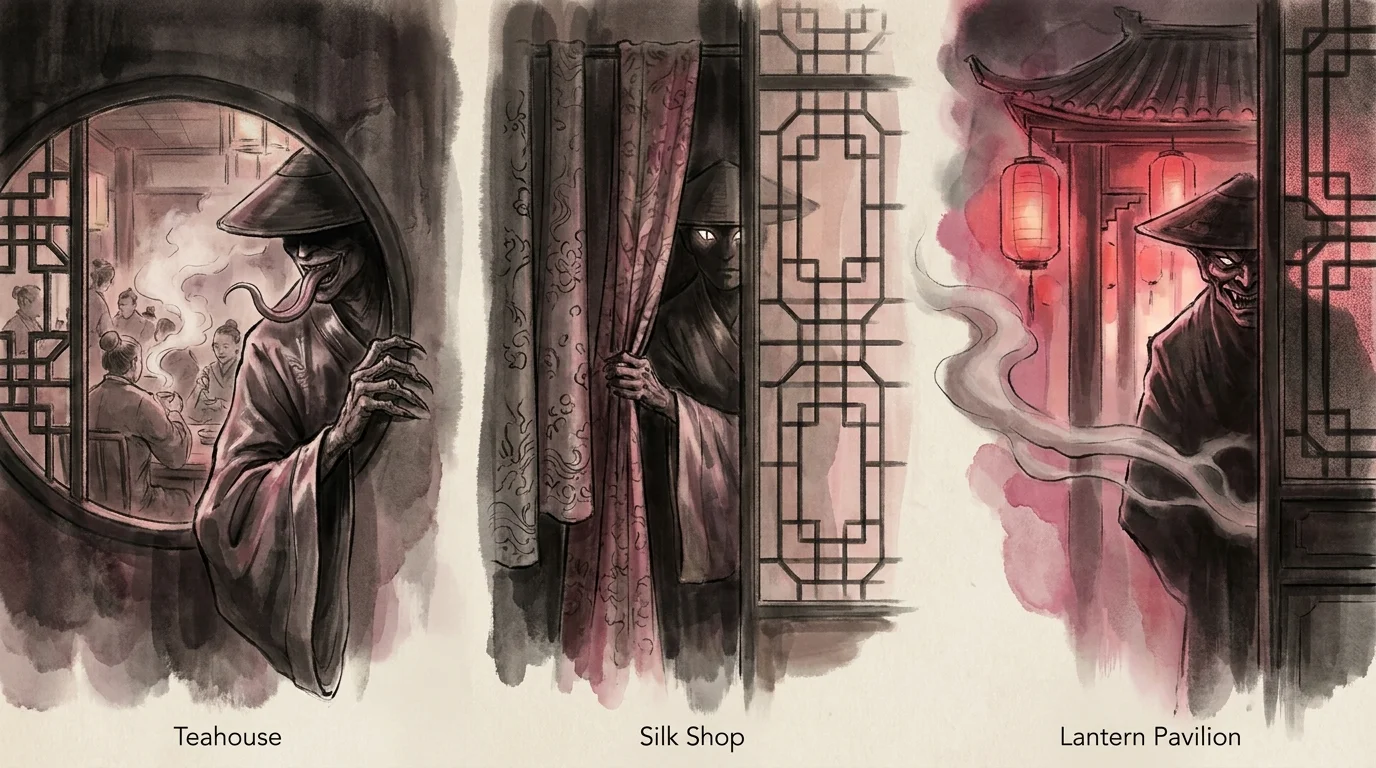
In the carefully structured hierarchy of demons populating Liu Zhang's Tales of Ghost Slaying (Zhan Gui Zhuan), Se Gui — the Demon of Lust — occupies Chapter 9, the penultimate chapter of the entire work. This placement is anything but arbitrary. From the sycophantic Demon of Flattery in Chapter 1 to the Demon of Lust in Chapter 9, the difficulty of Zhong Kui's quarry escalates with each encounter. Liu Zhang positioned the Demon of Lust nearly at the end of the narrative for a clear philosophical reason: of all human frailties, carnal desire is the most pervasive, the most stubborn, and the most resistant to elimination.
The chapter title — "Harboring Lust, Stealthily Shifting Across Three Locations" — captures the Demon of Lust's defining characteristic in just two words: "stealthily shifting." Those consumed by lust never openly acknowledge their weakness. They excel at concealment, at displacement, at gliding between venues while erasing all traces of indulgence and disguising every act of surrender. The Demon of Lust is the most accomplished shape-shifter in Liu Zhang's bestiary — and Zhong Kui's most frustrating prey.
Who Is the Demon of Lust (Se Gui)?
The Demon of Lust makes its appearance in Chapter 9 of Tales of Ghost Slaying, embodying the vices of lechery, debauchery, and unchecked carnal desire. In Liu Zhang's carefully calibrated demon taxonomy, Se Gui possesses a striking dual nature: it operates simultaneously as an external seductive force — much like the fox spirits and bewitching beauties of classical zhiguai (strange tales) literature who lure scholars to their doom — and as an internal impulse, rooted deep within human psychology, an instinctive drive that defies rational control.
The concept of se (色, lust/desire) has always occupied a deeply ambivalent position in Chinese cultural thought. Confucian tradition acknowledges the Mencian maxim that "food and sex are human nature" (食色性也), recognizing carnal desire as a natural human instinct while simultaneously insisting that passion must be governed by ritual propriety — "arising from emotion, yet restrained by propriety" (发乎情止乎礼). Buddhist teaching goes further, categorizing sexual desire among the fundamental attachments to be renounced, with the vow of celibacy standing as both the most basic and the most difficult precept for monastics to uphold.
Liu Zhang's genius lies in how he translates this philosophical tension into narrative form. By having the Demon of Lust "stealthily shift" across three distinct locations, he precisely captures the behavioral signature of the compulsive philanderer: they do not confine their indulgence to a single venue but instead drift, hide, and relocate across multiple settings, convinced that their movements go unnoticed — when in reality, every step leaves an indelible trace.
The Demon of Lust in Chapter 9: A Game of Cat and Mouse
The narrative engine of Chapter 9 revolves entirely around the Demon of Lust's "three-location shifting." Unlike earlier demons that occupy a fixed territory and commit their evils in plain sight, Se Gui slips fluidly between three different venues. At each location it leaves evidence of debauchery — yet by the time Zhong Kui arrives, the demon has already vanished, leaving the Ghost Catcher empty-handed and increasingly exasperated.
This guerrilla-style pattern of transgression presents Zhong Kui with an unprecedented tactical challenge. The demons of preceding chapters — the Demon of Flattery, the Shameless Demon, the Ungrateful Demon, the Demon of Lies — all possess distinct methods of mischief, but they share one critical vulnerability: they are locatable. They operate from a known position, and Zhong Kui can simply track them to their lair. Not so with the Demon of Lust. When Zhong Kui races to Location A, the demon has already relocated to Location B. When he pursues it to Location B, it materializes at Location C. This elaborate cat-and-mouse game drains more than just time — it tests the very limits of Zhong Kui's patience and determination.
The phrase "stealthily shifting" carries a second, more insidious layer of meaning: gradual moral corrosion. Lust does not emerge as a vice overnight. It accretes slowly, silently eroding a person's character and willpower over months and years. Like the proverbial frog in slowly boiling water, by the time the Demon of Lust has completed its migration from the first location through the second to the third, its victim is typically so deeply ensnared that escape has become impossible.
The Portrait of the Compulsive Libertine
The type of person corresponding to the Demon of Lust in Liu Zhang's allegorical scheme exhibits several hallmark traits:
Master of Disguise
Those consumed by lust almost never confess to it publicly. In social settings, they may present themselves as paragons of virtue — stern Confucian gentlemen, scholars who preach benevolence and righteousness, or even reclusive literati celebrated for their moral purity. The demon's "stealthy shifting" perfectly mirrors this capacity for disguise: maintaining a different persona at each venue, ensuring that no single community ever sees the complete picture.
Fluid and Shifting Desire
The Demon of Lust does not fixate on a single object of obsession. Rather, it embodies a restless, perpetually migrating desire. Today's infatuation becomes tomorrow's discarded conquest, replaced by a new target — the "three-location shifting" implies a constant rotation of desire's object. This fluidity renders lust far more difficult to contain than other vices, which tend to anchor themselves to specific habits or targets.
The Illusion of Secrecy
The greatest self-deception of the libertine is the conviction that their behavior remains undetected. The entire strategy of "stealthy shifting" rests on the assumption that what happens at Location A stays unknown at Location B, and what transpires at Location B remains hidden from Location C. But in Liu Zhang's moral universe, this confidence proves utterly unfounded. Zhong Kui sees everything — just as the cosmic order of justice perceives every hidden transgression.
The Metaphor of Three Locations: Lust's Domain in Traditional Chinese Life
The "three-location shifting" operates as more than a narrative device — it is a profound cultural metaphor. In traditional Chinese society, a man typically moved through three distinct spheres of activity: the household, social venues, and secret spaces. The Demon of Lust's migration across these three domains illustrates how carnal desire infiltrates every corner of a person's existence.
The Household
Even within the family compound, the lustful need not restrain themselves. Excessive desire could be channeled through the socially sanctioned framework of concubinage and marital relations, with the "normalcy" of domestic life serving as convenient cover for indulgence that exceeded all reasonable bounds.
Social Venues
Brothels, wine houses, and teahouses constituted the公开 marketplace of carnal desire. During the Qing dynasty, the social lives of many scholars and officials were deeply intertwined with sexual commerce. It was in these spaces that the Demon of Lust thrived most brazenly, feeding openly on the weaknesses of the educated elite who should have known better.
The Secret Space
Every person consumed by lust maintains a "third location" — a hidden domain known to no one else, dedicated exclusively to the pursuit of desire. This space might be a literal concealed room or a psychological interior — a private universe of fantasy and longing that no external authority could ever penetrate.
As the Demon of Lust circulates among these three domains, it creates a closed loop of desire — a self-reinforcing cycle from which escape becomes increasingly difficult, and concealment increasingly impossible.
Why the Demon of Lust Is the Hardest to Slay
Positioning the Demon of Lust in Chapter 9 — virtually at the conclusion of the entire work — ranks among Liu Zhang's most deliberate and philosophically loaded narrative decisions. Three factors explain why Se Gui poses Zhong Kui's greatest challenge:
Universal Vulnerability
Of all human weaknesses, the universality of sexual desire is perhaps unmatched. This does not mean that everyone is a demon of lust, but rather that the temptation of carnal desire admits almost no complete immunity. Liu Zhang recognized with unflinching clarity that while a society might harshly punish the ungrateful and publicly despise the shameless, its attitude toward lust would always remain profoundly ambivalent — because a demon of lust resides, to some degree, within every human heart.
Elusiveness and Stealth
The Demon of Lust's pattern of constant relocation makes it the most difficult quarry to corner. Other demons manifest their vices openly — the Demon of Flattery fawns and grovels, the Shameless Demon displays its brazenness for all to see, the Demon of Lies spins transparent falsehoods. Each leaves traces a skilled hunter can follow. But the Demon of Lust excels at concealment, displacement, and disguise, reducing Zhong Kui's pursuit to something akin to searching for a single needle in an ocean of hay.
The Interior Demon: An Enemy Within
The most fundamental reason the Demon of Lust resists elimination is that it does not exist solely in the external world. It lives inside every person. Zhong Kui can slay the external Demon of Lust with his demon-quelling sword — but how does one cut down the desire that burns within? Where should the blade be directed? By reserving the Demon of Lust for the penultimate chapter, Liu Zhang elevated it to the status of a "final boss" — the challenge on Zhong Kui's ghost-slaying journey that comes closest to being an impossible mission.
The Demon of Lust conveys an unsettling truth: of all human weaknesses, carnal desire is simultaneously the most honest and the most deceitful — it never pretends to be noble, yet no vice is more skilled at concealing itself. Zhong Kui can track the demon's shifting across three locations, but he cannot close the door of desire in another person's heart. Slaying every demon in the world is easy; slaying the demon within is the true impossibility. This, perhaps, is the deepest meaning behind Liu Zhang's decision to place the Demon of Lust at the journey's end — leaving Zhong Kui, and every reader, with the hardest question of all.