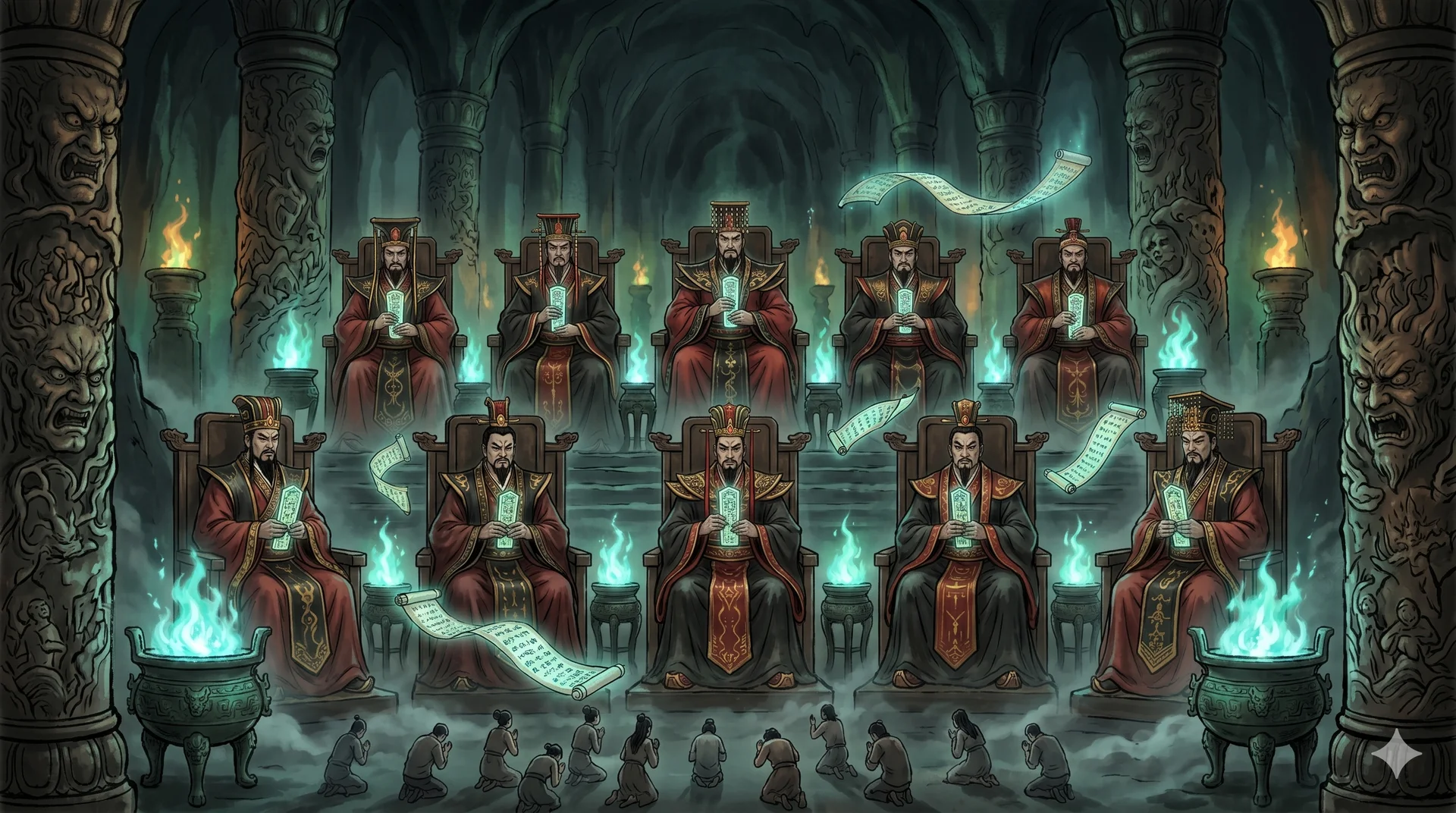
No figure in Chinese mythology operated in a vacuum, and Zhong Kui—the legendary Demon Queller—is no exception. Behind his fearsome reputation stands an entire bureaucratic apparatus: the Ten Courts of Yama, the underworld's supreme judicial authority. In the classic tale Zhan Gui Zhuan (The Demon-Quelling Chronicle), it is Yama himself who reviews Zhong Kui's life, finds him a man of unwavering integrity, and officially commissions him as the "Great God of Demon Quelling"—equipping him with the divine beast Baize as a mount and two supernatural lieutenants, Han Yuan and Fu Qu.
Without the Ten Kings' formal appointment, there would be no Zhong Kui as we know him. To understand these underworld judges is to understand where Zhong Kui's authority truly comes from—and why his demon-slaying campaign carries the weight of institutional legitimacy.
Origins: How an Indian Death God Became Ten Chinese Judges
From Yama to Yanluo Wang
The concept traces back to Yama, the Vedic lord of death first recorded in the Rigveda. Originally a celestial figure who guided the deceased toward paradise, Yama was said to rule the underworld alongside his twin sister Yami—he governed male spirits while she governed female ones, earning them the joint title "Twin Sovereigns."
When Buddhism absorbed Yama into its cosmology and carried the figure into China during the early centuries CE, something remarkable happened. Over the span from the Northern and Southern Dynasties through the Tang Dynasty, this single Indian deity underwent a thorough transformation. He was reborn as Yanluo Wang—and then split into ten distinct kings, each presiding over a separate court with a specialized portfolio.
This was not mere translation. It was a complete cultural reinvention.
The Scriptures That Codified the Ten Kings
The earliest systematic account of the Ten Kings appears in the Tang Dynasty apocryphal scripture Di Zang Shi Wang Jing (Sutra of Ksitigarbha and the Ten Kings). This text describes the bardo—the transitional state between death and rebirth—through which a soul must pass, appearing before each of the ten underworld courts in sequence.
But the version that truly shaped popular belief came centuries later: Yu Li Bao Chao (The Jade Record), attributed to a Daoist recluse known as Master Dan Chi. This morality text laid out the Ten Kings' names, jurisdictions, and subordinate hells in vivid, unforgettable detail. According to The Jade Record, the Ten Kings preside over Eight Great Hells, each surrounded by sixteen subsidiary hells—totaling 128 separate chambers of judgment (a figure often misremembered in popular culture as "Eighteen Layers of Hell").
Scholars have noted discrepancies between The Jade Record, the Buddhist sutra, and various Daoist canons—particularly regarding the ordering of the eighth and ninth courts. These inconsistencies are not errors but evidence of a living tradition that evolved differently across regions and sects.
The Ten Kings: Names, Courts, and Jurisdictions
A Court-by-Court Overview
According to the most widely circulated version from The Jade Record, the Ten Kings and their responsibilities are:
| Court | Title | Primary Jurisdiction |
|---|---|---|
| First | King Qinguang | Initial review of good and evil; virtuous souls sent directly to rebirth, the guilty forwarded to subsequent courts |
| Second | King Chujiang | The Great Hell of the Living; punishes those who maimed others, committed theft, or took lives |
| Third | King Songdi | The Black Rope Hell; punishes those who defied elders or incited lawsuits |
| Fourth | King Wuguan | The Combined Hell; punishes tax evaders and fraudsters |
| Fifth | King Yanluo | The Screaming Hell; punishes those who denied karma or slandered Buddhist teachings |
| Sixth | King Biancheng | The Great Screaming Hell; punishes the ungrateful, the resentful, and those who failed filial duties |
| Seventh | King Taishan | The Burning Agony Hell; punishes those who desecrated corpses or turned family members against each other |
| Eighth | King Dushi | The Great Burning Agony Hell; punishes the unfilial and those who sowed domestic discord |
| Ninth | King Pingdeng | The Avici Hell; punishes murderers, arsonists, and perpetrators of the gravest crimes |
| Tenth | King Zhuanlun | Final judgment; assigns souls to one of the Six Paths of Rebirth |
The Judgment Timeline: Why Chinese Funerals Last 49 Days
Popular tradition holds that a soul arrives at the First Court seven days after death. From there, it passes through each subsequent court at seven-day intervals—giving rise to the funeral custom known as "zuo qi" (making the sevens). Families hold memorial ceremonies on the seventh day, the fourteenth, the twenty-first, and so on through the forty-ninth day (seven sevens), followed by additional observances at the hundred-day mark, the first anniversary, and the third year.
Each ceremony is timed to coincide with the deceased's appearance before a particular underworld judge. The rituals—burning spirit money, chanting sutras, performing merit-making deeds—are believed to lighten the soul's karmic burden during each phase of judgment.
This is not superstition tacked onto theology. The funeral customs and the Ten Kings mythology are two sides of the same coin: the abstract machinery of cosmic justice translated into concrete, repeated acts of devotion.
The Underworld as Bureaucracy
The Ten Courts system is, at its core, a mirror image of China's imperial bureaucracy projected onto the afterlife. Ten kings function like ten regional magistrates, each with a defined jurisdiction. Beneath them serve city gods, earth gods, judge-officials, day-and-night patrol spirits, the ox-headed and horse-faced guards, the Black and White Impermanence, yaksha demon-soldiers, and countless other functionaries.
The entire underworld operates like a meticulously organized yamen—a government office with clear chains of command and standardized procedures.
This bureaucratic structure was not accidental. It reflected a deeply held conviction: justice must be procedural. In the living world, a case passes through multiple levels of courts and magistrates before reaching a final verdict. The afterlife worked the same way. Ten courts ensured that no soul would be condemned by a single judge's error or bias. Every verdict was the product of layered review.
A Pantheon Forged from Three Traditions
The Buddhist Foundation
The philosophical bedrock of the Ten Kings system comes from Buddhism: the law of karma and the cycle of rebirth through the Six Paths. Death is not an ending but a transition, and one's conduct in life determines where the soul goes next. This framework gave Chinese spirit worship something it had previously lacked—a coherent judicial logic for the afterlife.
The Daoist Superstructure
If Buddhism supplied the philosophy, Daoism supplied the institutional architecture. The detailed naming of kings, the cataloging of hells, the administrative hierarchies—these were largely Daoist creations. The Jade Record itself is a classic example of Daoist morality literature.
Daoism also wove the Ten Kings into China's existing pantheon of underworld deities. The Three Official Emperors (of Heaven, Earth, and Water), Dongyue Dadi (the Great Emperor of the Eastern Peak, associated with Mount Tai), and Fengdu Dadi (the Lord of the Northern Capital) were all integrated into a unified chain of command. The Great Emperor of the Eastern Peak was even identified as an incarnation of the Seventh Court's King Taishan—linking the Ten Kings directly to one of China's most ancient mountain cults.
The Folk Synthesis
The force that ultimately fused Buddhist doctrine, Daoist administration, and grassroots imagination into a single living tradition was the everyday practice of ordinary people. You did not need to read sutras or morality books to participate in the Ten Kings' justice system. You simply followed tradition: burn paper money on the seventh day, hire monks for the third-seventh ceremony, make offerings at the hundred-day mark. Through these acts, every family became a participant in the underworld's judicial process.
Zhong Kui and the Ten Kings: The Divine Appointment
Why Zhong Kui Needed Yama's Commission
In Zhan Gui Zhuan, Zhong Kui's soul arrives in the underworld after he dashes his head against the palace steps in despair over a denied examination result. The King of Hell reviews his life record and makes a crucial finding: Zhong Kui's failure was not a failure of talent but a failure of the examination system itself. The examiners had judged him by his appearance rather than his ability.
This scene is more than plot. It is a statement about legitimate authority. Zhong Kui does not declare himself a demon hunter. He does not receive a direct mandate from Heaven. Instead, his commission passes through the underworld's proper institutional channels—examined, verified, and ratified by Yama before being forwarded to the celestial court.
In Chinese cultural logic, even a ghost-quelling hero requires bureaucratic certification.
The Gifts That Made a Demon Queller
Yama did not simply give Zhong Kui a title. He assembled a complete operational team:
- Baize — the mythical beast that knows the true names and natures of all supernatural creatures, serving as Zhong Kui's mount and monster-identification system
- Han Yuan — a lieutenant whose name means "harboring unredressed grievance," embodying the power of injustice endured
- Fu Qu — a lieutenant whose name means "bearing wrongful suffering," embodying the strength born of unmerited hardship
These names are not incidental. Zhong Kui himself was a man of extraordinary talent denied recognition because of his ugliness, a loyal subject who received only contempt in return. Han Yuan and Fu Qu are living embodiments of his own story—his personal injustice transformed into supernatural fighting force.
The Bridge Between Worlds
The Ten Kings serve a vital structural role in the Zhong Kui mythos: they are the bridge between the living and the dead. Zhong Kui originates in the human world—a scholar from Mount Zhongnan. He dies in the human world. He receives his commission in the underworld. He returns to the human world to carry it out. His entire narrative arc shuttles between two realms, and the Ten Kings are the pivot point.
Without the underworld's judgment and investiture, Zhong Kui would remain nothing more than a wronged scholar who died tragically. With it, he becomes something far greater: a transcendent being who spans the boundary between life and death, authorized to act in both domains.
The Truth About the Eighteen Hells
A Popular Misconception Corrected
Ask almost anyone in China about the underworld, and you will hear about "Eighteen Layers of Hell." It is one of the most widely known elements of Chinese afterlife belief. Yet The Jade Record explicitly corrects this error: "People in the world say the underworld has eighteen layers of hell. This is wrong. In truth there are eight great hells... Beyond the eight great hells, each has sixteen subsidiary hells, plus the Blood Pool and the City of Those Who Died Wrongfully belonging to the respective courts. The total comes to one hundred thirty-eight hells."
Different scriptures give different counts. Buddhist texts describe Eight Great Hells with sixteen auxiliaries each (128 total). Daoist additions—the Blood Pool and the City of Wrongful Deaths—raise the count to 138. Over centuries of retelling, popular culture compressed this complex taxonomy into the simple, memorable figure of eighteen.
The Logic of Underworld Punishment
The punishments administered across the Ten Kings' hells follow a consistent principle: retribution mirrors the crime.
- Those who mutilated others in life find their own bodies dismembered in hell
- Those who enriched themselves through fraud are stripped of everything
- Those who killed with fire are consumed by flames
This principle of corresponding retribution is the Ten Kings system at its most intuitive—a cosmic guarantee that cruelty will be answered with proportionate suffering, and that no evil deed escapes accounting.
Cultural Legacy: From Temple Murals to Modern Gaming
Art and Literature Through the Centuries
The Ten Kings have been a fixture of Chinese visual and literary culture for over a thousand years. Tang Dynasty bianwen (transformation texts), Ming and Qing novels, temple murals, New Year woodblock prints—all feature the Ten Kings presiding over their shadowy courts. The legendary Tang painter Wu Daozi was said to have created an underworld mural so terrifying that viewers trembled at the sight, with the Ten Kings' stern visages at the heart of its power.
Even Journey to the West joins the conversation. When Sun Wukong storms the underworld and crosses out his own name from the Register of Deaths, all Ten Kings are depicted as terrified minor officials cowering before the Monkey King's chaos. This irreverent treatment reveals the complicated relationship between popular culture and the Ten Kings: reverence and humor coexisting in the same breath.
The Ten Kings in Contemporary Media
The Ten Courts of Yama remain one of the most recognizable elements of Chinese mythology in modern gaming, animation, and film. Japanese RPGs feature "Enma Dai-O" as a boss figure. Chinese-developed games invoke the Ten Underworld Kings as cosmic antagonists or quest-givers. The structure is endlessly adaptable—a bureaucratic framework that lends itself naturally to game design with its clear progression, distinct bosses, and escalating stakes.
For any future adaptation of the Zhong Kui mythos in interactive media, the Ten Kings are all but essential. Zhong Kui's relationship with the underworld, the origin of his demon-quelling mandate, and the dramatic potential of courtroom scenes in hell—none of it works without the Ten Courts.
Final Reflections
The Ten Courts of Yama represent one of the most elaborate and systematic constructs in all of Chinese supernatural belief. They are where Indian Buddhist karmic philosophy, Chinese Daoist institutional design, and the popular imagination's hunger for justice converge into a single, coherent vision of the afterlife.
In Zhong Kui's story specifically, the Ten Kings are far more than atmospheric world-building. They are the institutional foundation of his entire mission. Yama's commission grants him legitimacy. The gifts of Baize, Han Yuan, and Fu Qu give him operational capability. And the underworld's judicial framework provides the ultimate moral guarantee: every demon Zhong Kui destroys has already been confirmed as guilty through proper supernatural due process.
There is something profoundly Chinese about this arrangement. Even in the realm of ghosts and demons, power must flow through authorized channels. Even supernatural violence must be procedurally justified. The Ten Courts of Yama remind us that in Chinese cosmology, justice is never chaotic—it is systematic, layered, and meticulously administered.
The Ten Kings teach a lesson that echoes far beyond mythology: justice is not a single thunderbolt but a deliberative process. From the First Court's initial screening to the Tenth Court's final assignment, every soul receives a thorough hearing. And Zhong Kui—personally commissioned by these same underworld judges—became the living embodiment of that system's enforcement arm. In the underworld, judgment belongs to the Ten Kings. In the mortal realm, execution belongs to Zhong Kui.