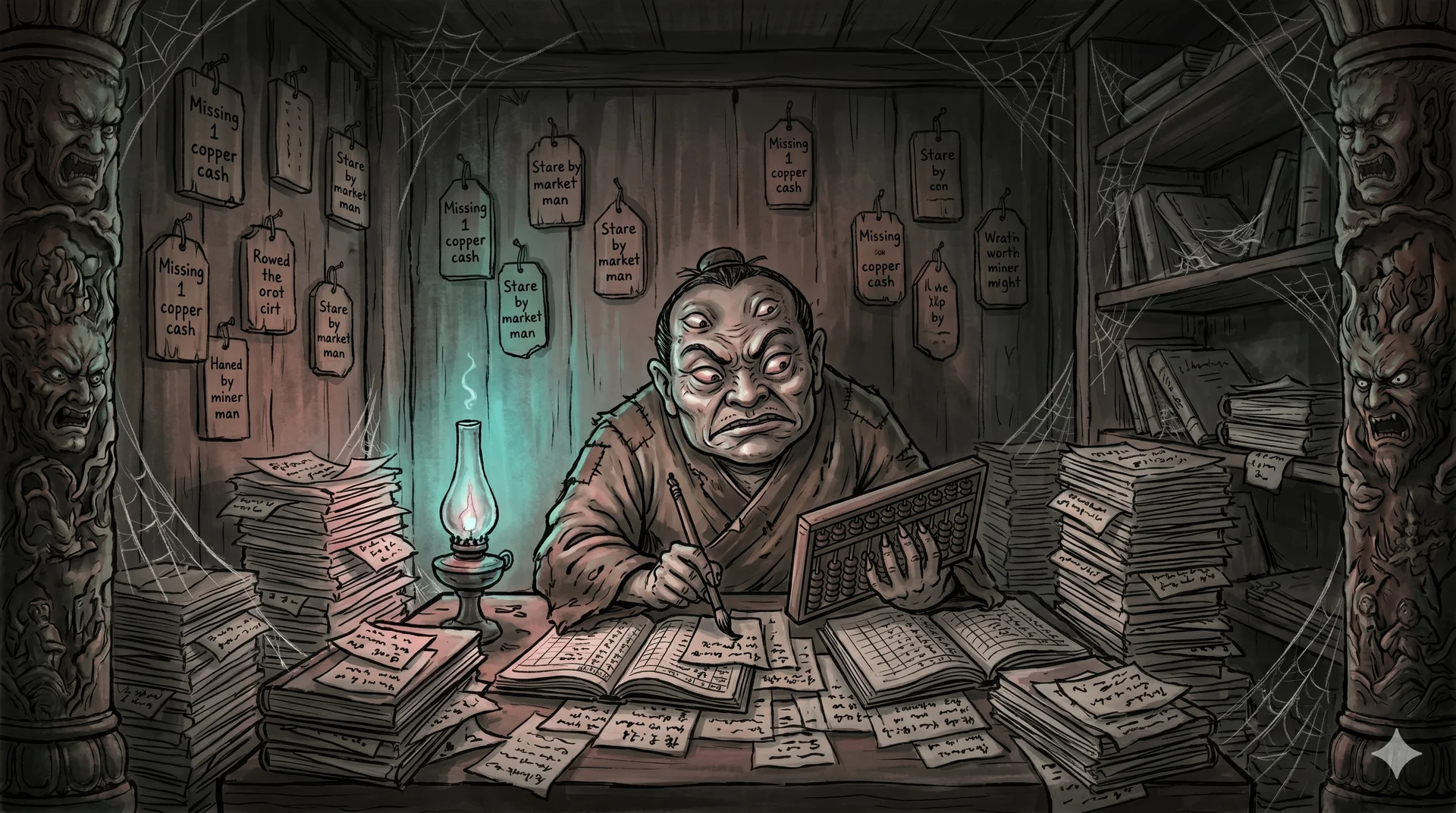
In Liu Zhang's Quelling the Demons (斩鬼传), every creature in the Demon Hunter's crosshairs is a human flaw given monstrous flesh. If the Xianlian Gui embodies shamelessness and the Huang Gui stands for deception, then the Wang'en Gui — the Ungrateful Demon — personifies what traditional Chinese morality regarded as perhaps the most chilling defect of character: the capacity to forget kindness, betray trust, and repudiate every debt of gratitude.
The chapter title from the novel's fifth episode says everything in seven devastating characters: "Forgetting a father's murder, he instead becomes the closest of friends." A man who should have pursued his father's killer to the ends of the earth instead clasps the murderer's hand in brotherhood. In a civilization built on filial piety and reciprocal obligation, this is not merely immoral — it is an abomination.
What Is the Wang'en Gui?
The Name That Condemns
In Chinese, wang'en (忘恩) is a compound of devastating clarity. The character wang (忘) means to forget, to let slip from memory. The character 'en (恩) denotes grace, favor, kindness received — and the obligation to repay it. Together, they form one of the most contempt-laden accusations in the Chinese moral vocabulary: to be wang'en fuyi — ungrateful and faithless — is to be stripped of one's humanity.
The Qing author Liu Zhang wielded this name with intent. In the Confucian ethical system that governed every dimension of Chinese social life, the concept of en — reciprocal gratitude — was not a vague courtesy but a structural pillar. As the Confucian classic The Book of Rites (Liji) stipulates, "Receiving a favor and failing to repay it is contrary to ritual propriety." The popular proverb captured it more viscerally: "A drop of water received in kindness should be repaid with a spring" (滴水之恩,当涌泉相报). Gratitude was not optional — it was the connective tissue of civilization.
The Wang'en Gui represents the complete destruction of that tissue. Liu Zhang's radical proposition is that the ungrateful person has ceased to be human and become a demon — a being that walks, talks, and eats among people but has hollowed out every bond of mutual obligation. Such a creature belongs not in society but on Zhong Kui's execution list.
A Demon Born of Moral Collapse, Not Supernatural Evil
Like all the "human-natured demons" in Quelling the Demons, the Wang'en Gui is not a monster with fangs and claws. It wears human clothes and moves through human society. Its evil is not physical violence but moral dissolution — the quiet, corrosive decision to treat gratitude as optional and loyalty as negotiable. This is what makes it so insidious and so infuriating. A murderer can be caught and punished. A thief can be exposed and restitution demanded. But the person who simply forgets what they owe — who smiles warmly at the benefactor they have abandoned, who shakes the hand of the man who killed their father — commits a crime that no statute addresses, yet which corrodes the foundation of every human relationship.
The Fifth Chapter: A Father's Murder Forgotten
The Story That Provokes Outrage
The fifth chapter of Quelling the Demons revolves around a narrative engineered to make every reader's blood boil. A man's father has been killed. Under both Confucian ethics and Qing law, a son in this position bears an absolute obligation: the blood debt must be avenged. The Confucian philosopher Mencius explicitly argued that avenging a parent's murder is not merely permitted but required — it is the highest expression of filial devotion (Mencius, Jin Xin II).
Yet this man does the opposite. He does not merely decline to pursue revenge — he actively befriends his father's murderer. The two become mo ni (莫逆) — sworn companions, inseparable brothers. The chapter title's bitter irony lies in the word pian (偏), meaning "perversely" or "willfully contrary." The relationship is not born of forgiveness but of something far worse: moral indifference so complete that the distinction between benefactor and enemy has simply ceased to matter.
Liu Zhang's Satirical Genius
Liu Zhang's narrative technique in this chapter is masterfully restrained. He does not stage dramatic confrontations or tearful reckonings. Instead, he presents the situation with a calm that makes it unbearable. The ungrateful man does not struggle with his conscience. He does not agonize over the choice between vengeance and peace. He simply moves on — and in moving on, reveals the true horror of ingratitude: it is not a passionate sin but a cold one. The ungrateful person does not feel hatred toward their benefactor; they feel nothing at all.
This emotional void is precisely what makes the Wang'en Gui so monstrous. As the philosopher Immanuel Kant later argued in The Metaphysics of Morals (1797), gratitude is not merely a virtue but a duty — the violation of which corrodes the entire moral community. Liu Zhang intuited the same principle two centuries earlier and dramatized it through supernatural fiction: when a person can sit down to drink with their father's killer, something has died in them that Zhong Kui's sword must put to rest.
Zhong Kui's Intervention
When Zhong Kui arrives in the fifth chapter, his mission is unambiguous: to sever this grotesque "friendship" and punish the ungrateful. For the Demon Hunter, the bond between the Wang'en Gui and its father's murderer is not evidence of broad-mindedness or Christian forgiveness — it is proof that the moral conscience has expired entirely. The Confucian tradition drew a sharp distinction between shu (恕, forbearance) and wang'en (忘恩, ingratitude). To forgive a repentant enemy might be noble; to befriend an unrepentant one is moral surrender.
Zhong Kui's sword does not hesitate. Its blade is reserved for those who have crossed the line from flawed humanity into demonhood — and the Wang'en Gui has vaulted over that line with cheerful indifference.
The Anatomy of Ingratitude: Three Layers of Moral Collapse
Liu Zhang's portrait of the Wang'en Gui is not a single brushstroke but a layered diagnosis. Ingratitude, as he conceives it, operates on three escalating levels:
Layer One: Severing the Past
The ungrateful person begins by forgetting where they came from and what they received. Every human life is built on a foundation of gifts — parental sacrifice, teacher's guidance, friend's loyalty, stranger's mercy. The Wang'en Gui erases this entire foundation. If a father's murder can be forgotten, what obligation cannot? If the greatest debt is disposable, every lesser debt is trivial. The ungrateful person does not merely neglect specific acts of kindness; they disconnect themselves from the entire narrative of their own life, becoming moral amnesiacs who owe nothing to no one.
Layer Two: Betraying Trust
Behind every act of en — every kindness given — lies an unspoken covenant of trust. The benefactor does not demand a contract or collect collateral. They extend help because they believe the recipient will remember and, when the moment comes, reciprocate. The Confucian virtue of xin (信, trustworthiness) governs this exchange. As Confucius himself declared in the Analects, "If a man lacks trustworthiness, I do not see what he is good for" (Analects 2:22). The Wang'en Gui does not merely fail to repay a specific favor; it shatters the entire system of trust that makes human cooperation possible. Every act of ingratitude makes the next act of generosity less likely, poisoning the well of social capital for everyone.
Layer Three: The Tyranny of Self-Interest
The final and most damning layer explains why the Wang'en Gui forgets: not from poor memory, but from calculated advantage. Maintaining a father's feud is costly, dangerous, and socially inconvenient. Befriending the murderer, by contrast, opens doors, creates alliances, and generates opportunities. On the scales of self-interest, the Wang'en Gui always tips toward profit.
This is what transforms ingratitude from a personal failing into a social pathology. When gratitude becomes a luxury that only the foolish afford, the entire incentive structure of society inverts. Those who honor their obligations are penalized; those who discard them are rewarded. Liu Zhang understood — with a clarity that anticipates modern game theory — that a society of Wang'en Gui would collapse into mutual predation within a generation.
Zhong Kui's Punishment: Forgetting Made Impossible
Poetic Justice as Narrative Principle
Liu Zhang's punishment of the Wang'en Gui follows the same poetic justice that structures every encounter in Quelling the Demons: each demon is destroyed by the very weapon it once wielded. The Flattery Demon perishes by deceit. The Shameless Demon is pierced through the face it thought invulnerable. And the Wang'en Gui — the creature whose signature power is forgetting — is condemned to remember everything forever.
Zhong Kui's punishment forces the ungrateful to confront every erased obligation, every abandoned loyalty, every kindness they chose to ignore. The debts they dismissed, the trust they betrayed, the father's murder they swept under the table — all of it returns with devastating clarity. The sentence is not merely physical destruction but a moral reckoning so absolute that forgetting becomes impossible.
This narrative strategy carries a pointed message: ingratitude may seem painless to the ingrate, but the universe keeps a ledger. What the ungrateful person wills themselves to forget, Zhong Kui's sword compels them to remember — if only in the instant before the blade falls.
The Cultural Significance of Demonizing Ingratitude
A uniquely Chinese Moral Horror
The elevation of ingratitude to demonic status reflects something distinctive about Chinese ethical thought. In Western literary tradition, from Dante's Inferno to Shakespeare's tragedies, betrayal and ingratitude are character flaws — terrible, yes, but fundamentally human. In Liu Zhang's novel, they cross a threshold into the supernatural. Ingratitude is not merely bad behavior; it is a force of spiritual corruption that demands divine intervention. Only Zhong Kui — a being sanctioned by heaven — possesses the authority to strike it down.
This distinction reveals the centrality of reciprocal obligation (bao, 报) in Chinese culture. The anthropologist Mayfair Yang, in her study Gifts, Favors, and Banquets (1994), demonstrated how the web of guanxi (relationships) and reciprocal exchange constitutes the fundamental architecture of Chinese social life. To betray a gift relationship is not merely to insult an individual — it is to vandalize the entire social order. Little wonder that Liu Zhang felt the transgression required nothing less than a demon hunter from beyond the grave.
Confucian Anxiety and Social Fragility
Liu Zhang's decision to place the Wang'en Gui in the fifth chapter — early in the novel, among the first demons Zhong Kui confronts — suggests he considered ingratitude among the most prevalent and urgent of social diseases. His logic is clear: a society in which people do not honor their debts, remember their benefactors, or avenge their parents is a society in which nothing holds. Before you can address hypocrisy, deceit, or pettiness, you must first establish that gratitude and loyalty are non-negotiable.
This anxiety was far from abstract. Qing Dynasty officialdom was rife with factionalism, patronage networks, and spectacular betrayals. Scholars who rose through the patronage of a mentor might repudiate him the moment a better offer appeared. Officials who owed their positions to a superior's recommendation might denounce that superior during a political purge. The Wang'en Gui was not a fantastical invention — it was a mirror held up to the corridors of power.
The Eternal Relevance of the Ungrateful Demon
Three centuries after Liu Zhang wrote Quelling the Demons, the Wang'en Gui remains achingly recognizable. The business partner who abandons a mentor the moment the wind shifts, the politician who renounces every principle that propelled them to office, the friend who disappears the moment you can no longer offer advantage — all are modern avatars of the Wang'en Gui, striding through boardrooms, parliaments, and social media feeds with the same cheerful amnesia that Liu Zhang immortalized.
The Demon Hunter's sword offers a consoling fantasy: that somewhere, a cosmic accountant is tallying the debts, and a divine enforcer stands ready to collect. But Liu Zhang's deeper insight is more sobering. Zhong Kui can slay the demon, but he cannot create gratitude where none exists. That responsibility — the stubborn, daily choice to remember what we owe — falls to each person alone.
The Wang'en Gui reminds us that gratitude is simultaneously the most fragile and most precious bond between human beings. It requires no legal contract to enforce, no institutional mechanism to maintain. The only force that sustains it is a stubborn refusal to forget — a quiet determination to honor what has been given, even when forgetting would be easier, cheaper, and more profitable. Zhong Kui's sword can punish the ungrateful, but it cannot make us grateful. That essential act of moral memory — the choice to remember — remains, as it has always been, a burden each conscience must carry alone.