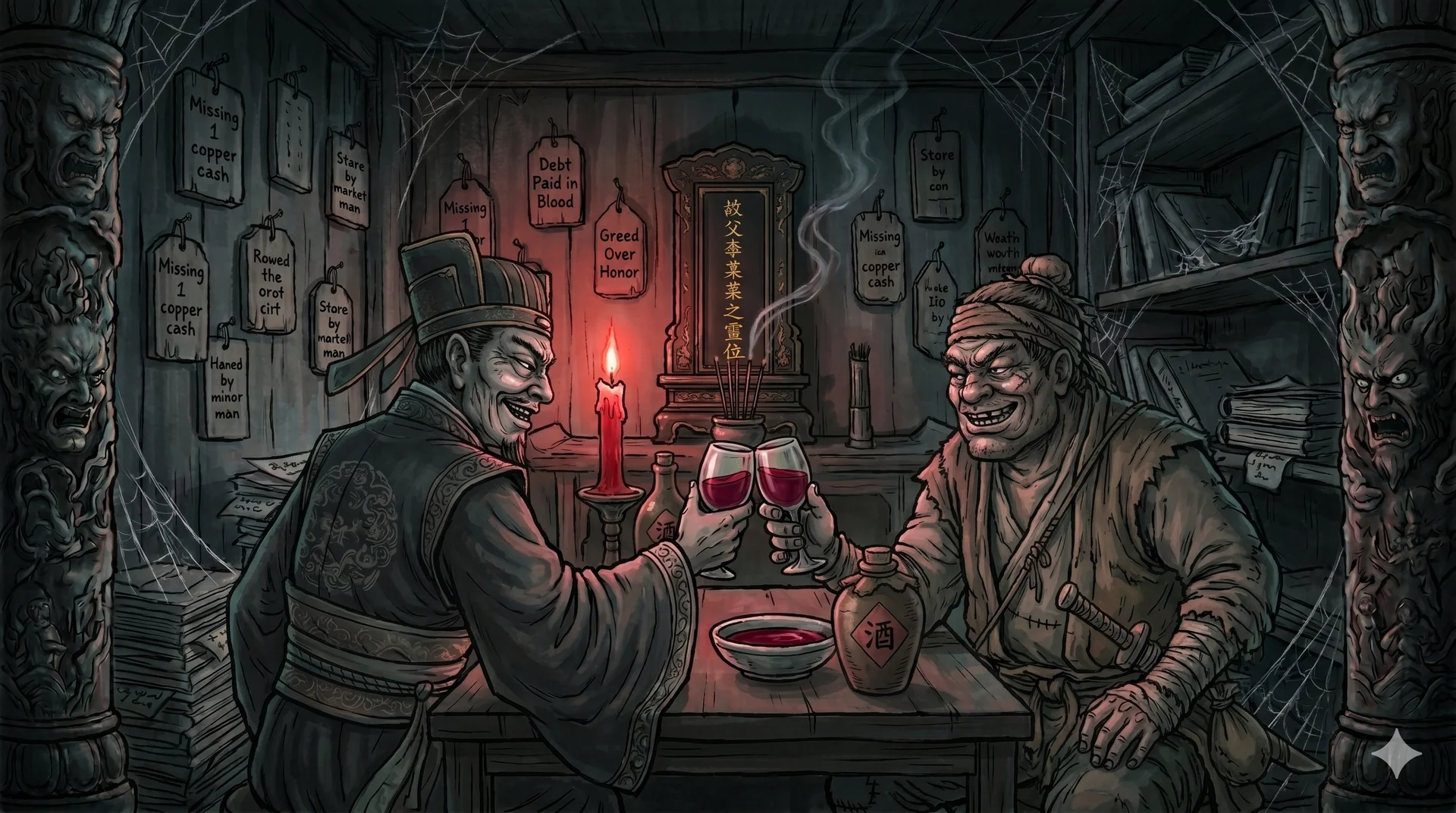
Among the rogues' gallery of spirits in Liu Zhang's Chronicle of Demon Slaying (斩鬼传), few are as quietly unsettling as Wocuo Gui — the Demon of Pettiness. Debuting in Chapter 4, this creature does not roar, scheme, or seduce. Instead, it nibbles away at the foundations of human relationships through relentless score-keeping, grudges over trivial slights, and a worldview poisoned by suspicion.
What makes Wocuo Gui remarkable is its ordinariness. Liu Zhang understood that the most corrosive evils are not always the most dramatic ones. While other demons in the novel embody recognizable vices — flattery, shamelessness, treachery — Wocuo Gui represents a moral failure so common that most people would hesitate to call it evil at all: the inability to let go.
What Is Wocuo Gui?
The Etymology of "Wocuo"
The term wocuo (龌龊) has undergone a fascinating semantic shift over the centuries. In classical Chinese, it originally described misaligned or crowded teeth — a physical sense of cramped irregularity. Over time, the word migrated from the dental to the moral register, coming to denote meanness of spirit, pettiness, and a cramped, small-minded outlook on life (Hanyu Da Cidian, vol. 12).
By the Ming-Qing period, when Chronicle of Demon Slaying was composed, wocuo had settled into its modern range of meanings: dirty, sordid, and above all, petty. Liu Zhang's genius was to seize on the moral dimension of this word and personify it as a demon — proving that small-mindedness is not merely a personality quirk but a spiritual affliction deserving of exorcism.
Core Characteristics of the Petty Demon
Wocuo Gui manifests across three interconnected behavioral layers:
- Material pettiness — An obsessive need to account for every fraction of advantage, treating even the most trivial exchange as a transaction that must be scrupulously balanced.
- Emotional grudge-holding — A forensic memory for past offenses, combined with a total inability to recall kindnesses. Every slight is filed away for future reference.
- Spiritual constriction — A fundamental inability to see the bigger picture, trapped in a self-referential loop of perceived injustices and imagined slights.
Wocuo Gui Among the Demon Hierarchy
Liu Zhang's novel presents a taxonomy of human vices disguised as supernatural creatures. Within this system, Wocuo Gui sits alongside the Flattery Demon (Zhou Gui) and the Shameless Demon (Xianlian Gui) as a triumvirate of social poisons. Each represents a different axis of everyday corruption:
- Zhou Gui embodies deception — the willingness to lie for social advantage.
- Xianlian Gui embodies shamelessness — the refusal to acknowledge social norms.
- Wocuo Gui embodies small-mindedness — the reduction of all experience to a ledger of debts and grievances.
Of the three, Wocuo Gui is the most insidious precisely because its behavior is so socially tolerated. People who hold grudges over minor incidents or obsessively track favors given and received are rarely condemned in the same breath as liars or frauds. Liu Zhang devotes an entire chapter to this demon because he recognized that what goes unchallenged causes the deepest damage.
Wocuo Gui in Chapter 4 of the Chronicle
The Banality of Pettiness
Unlike other demons in the novel, Wocuo Gui's entrance is conspicuously undramatic. There are no dark clouds, no eerie winds, no theatrical transformations. The demon's pettiness plays out through mundane episodes: arguing bitterly over a single copper coin, nursing resentment over an offhand remark for months on end, investing enormous emotional energy into trivial disputes that any reasonable person would dismiss.
This intentional flatness is one of Liu Zhang's most sophisticated literary choices. As the cultural historian Catherine Bell observed in her analysis of Chinese demonological literature, the most effective supernatural allegories are those that blur the line between the fantastic and the quotidian (Bell, 1992). By grounding Wocuo Gui in the texture of everyday life, Liu Zhang forces readers to confront an uncomfortable truth: the demon looks disturbingly like someone they know — or someone they are.
Zhong Kui's Dilemma
The demon hunter Zhong Kui's encounter with Wocuo Gui presents a unique challenge. When confronting Zhou Gui, Zhong Kui can deploy straightforward moral exposure — lies collapse under scrutiny. When facing Xianlian Gui, he can wield righteous force — shamelessness invites overwhelming opposition. But Wocuo Gui resists both strategies. Pettiness does not break any law. Small-mindedness violates no statute. Grudge-holding is not, by itself, a crime.
This places Zhong Kui in a state of frustration that is itself thematically revealing. The great demon-slayer, who can vanquish monsters and exorcise fiends, finds himself stymied by a spirit whose offenses are too minor to prosecute but too pervasive to ignore. The implication is clear: the most resilient evils are those that exist below the threshold of formal condemnation.
The Psychology of the Small-Minded
The Behavioral Profile
Through Wocuo Gui, Liu Zhang constructs a devastating psychological portrait of the petty individual. Three core behaviors define this profile:
Compulsive score-keeping. Wocuo Gui maintains an internal accounting system of breathtaking precision. Every favor is recorded, every slight catalogued, every interaction evaluated for signs of exploitation. This is not frugality or prudence — it is a compulsive need to ensure that one is never, ever taken advantage of, even when the stakes are negligible.
Selective memory for grievances. The demon possesses an uncanny ability to remember offenses from years earlier — a careless word spoken in passing, a perceived slight at a gathering, a favor given but not returned — while all positive experiences fade almost instantly. This asymmetric memory ensures that the world always appears hostile and ungrateful.
Chronic suspicion. Every act of kindness is parsed for hidden motives. Every silence is interpreted as concealment. Every success enjoyed by another is assumed to be ill-gotten. Wocuo Gui lives in a self-constructed world of conspiracies, where no gesture is innocent and no person is trustworthy.
Why Pettiness Qualifies as Evil
Classifying small-mindedness as a form of evil — as Liu Zhang explicitly does by making it a demon for Zhong Kui to slay — was a bold moral claim in Qing-era literature. Confucian ethics generally framed pettiness as a deficiency of character (xiaoren, the "small person") rather than active wickedness. Mencius distinguished between the junzi (exemplary person) and the xiaoren, but the latter was typically pitied or avoided, not exorcised (Mencius, 4A:26).
Liu Zhang elevates pettiness to the status of a spiritual disease requiring supernatural intervention. His argument, implied through the narrative, is that small-mindedness is not an isolated failing but a gateway vice. Left unchecked, it metastasizes into envy, active resentment, sabotage, and the systematic poisoning of social bonds. A single petty person can make an entire household miserable. A culture that tolerates pettiness produces a society built on mutual distrust.
Zhong Kui's Strategy: Magnanimity as Weapon
Defeating Smallness with Greatness
Zhong Kui's approach to Wocuo Gui follows the principle of yi da ke xiao — "using greatness to overcome smallness." Rather than engaging the demon on its own terms, disputing each grievance and rebutting each suspicion, Zhong Kui embodies the opposite qualities: open-handedness, moral grandeur, and a spirit too large to be troubled by petty concerns.
Zhong Kui himself is described as physically massive, morally uncompromising, and psychologically fearless. In the novel's symbolic economy, his sheer scale — of body, of courage, of vision — functions as an antidote to Wocuo Gui's constriction. The petty demon literally has nowhere to hide when confronted with genuine magnanimity.
Sunlight Against Shadow
The underlying metaphor is one of illumination. Wocuo Gui thrives in the shadows — the shadow of past offenses, the shadow of imagined conspiracies, the shadow of unspoken resentments. Zhong Kui's arrival brings light: openness, clarity, and the disinfecting power of moral transparency. In Chinese philosophical terms, this echoes the Confucian ideal of zheng (uprightness), which Confucius described as having a transformative effect on those around it (Analects, 12.19).
The message is both practical and spiritual: the most effective response to pettiness is not to fight it on its own terms but to outgrow it entirely.
The Universal Resonance of Wocuo Gui
Everyday Evil in Moral Philosophy
Wocuo Gui's enduring relevance lies in its confrontation with what modern moral philosophers call "banal evil" or "ordinary vice" — the kind of moral failure that is too common, too minor, and too socially accepted to generate outrage, yet cumulatively devastating in its effects. The 20th-century philosopher Simone Weil wrote extensively about how petty grudges and small acts of selfishness can aggregate into social catastrophes (Weil, 1952). Liu Zhang arrived at a similar insight nearly three centuries earlier, and encoded it in the figure of a demon.
What makes Wocuo Gui so philosophically productive is the way it shifts the boundary of what counts as evil. Most people can comfortably condemn murder, theft, and deception. Far fewer are willing to classify their own grudge-holding, score-keeping, or suspicion as a form of moral failure worthy of serious attention.
The Demon Within
The most provocative dimension of Wocuo Gui is its universality. Who has never obsessed over a trivial slight? Who has never kept a mental record of favors owed? Who has never interpreted an ambiguous gesture as a deliberate insult?
In this sense, Wocuo Gui is not primarily an external enemy for Zhong Kui to vanquish. It is an internal one — a mirror held up to the reader. The novel's deepest implication is that the most important demons to slay are not the ones lurking in dark forests but the ones nesting quietly inside every human heart. This interiorization of the demon-slaying narrative places Chronicle of Demon Slaying in a philosophical tradition shared with Buddhist mindfulness practices and Confucian self-cultivation, both of which emphasize the examination and correction of one's own moral blind spots.
Wocuo Gui teaches an uncomfortable lesson: the most widespread evil in the world may not be grand villainy but petty score-keeping. Grand crimes provoke resistance; small-mindedness provokes only resignation. By making pettiness itself a demon — and giving Zhong Kui the task of slaying it — Liu Zhang reminded his readers that the battle against evil begins not with identifying the monsters outside, but with recognizing the small, familiar, unsettlingly ordinary demons within.