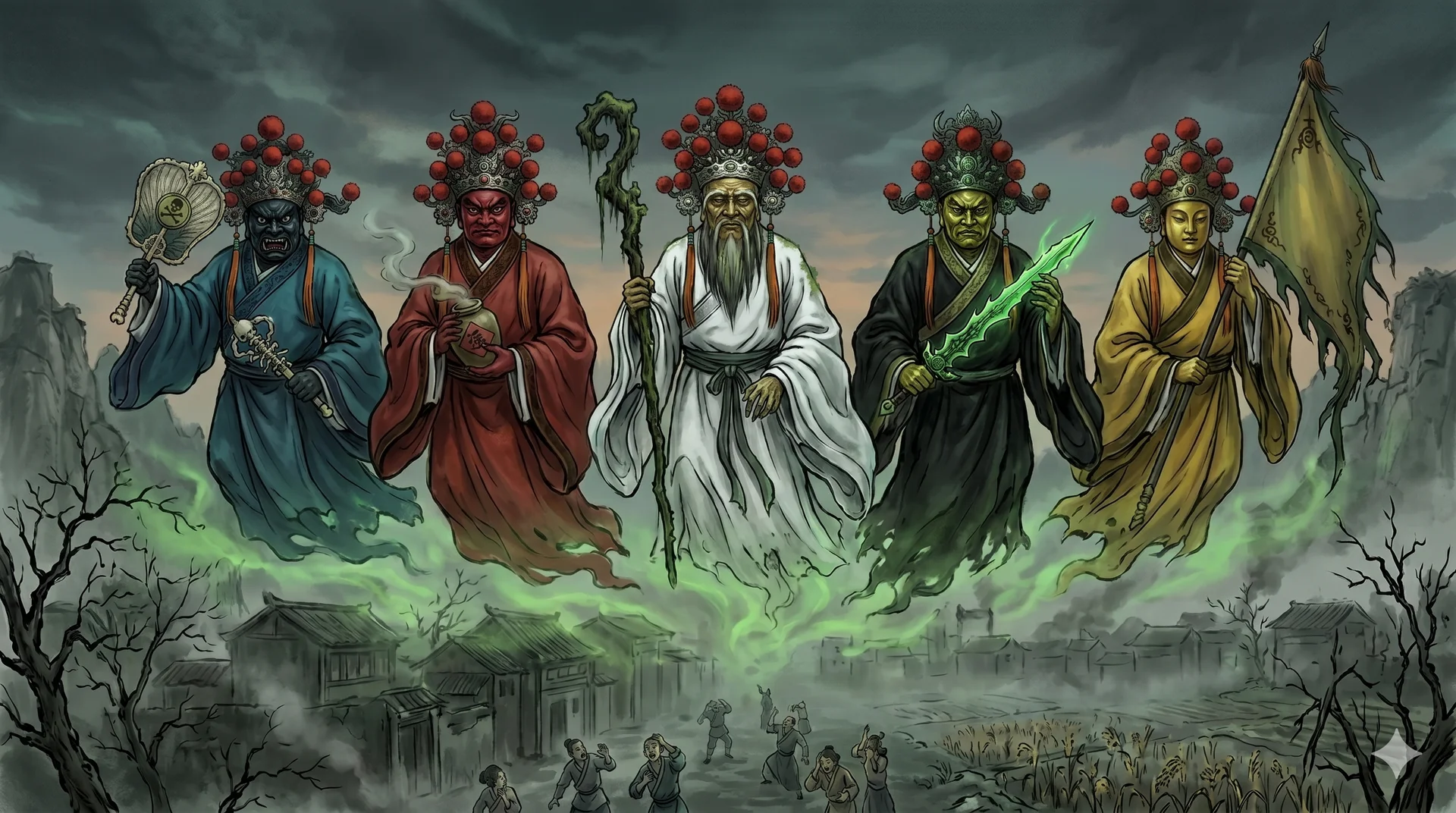
Among all the adversaries Zhong Kui faces in his demon-quelling career, none are more extraordinary than the Five Plague Gods (Wu Wen Shen, 五瘟神). Unlike ordinary demons that appear by chance, these five beings represent seasonal, cyclical, and fundamentally indestructible forces — the Plague of Spring Zhang Yuanbo, the Plague of Summer Liu Yuanda, the Plague of Autumn Zhao Gongming, the Plague of Winter Zhong Shigui, and the Chief Plague of the Center Shi Wenye.
What sets the Plague Gods apart from every other monster in Zhong Kui's rogues' gallery is their cosmic mandate. They are not rogue spirits running amok — they are heaven-appointed agents of disease, dispatched as part of the natural order itself. The comprehensive divine encyclopedia San Jiao Yuan Liu Sou Shen Da Quan (三教源流搜神大全, Comprehensive Compendium of the Origins of the Three Teachings and the Search for the Gods) records their nature plainly: epidemic disease is "sent down by Heaven and cannot be cured by any method." Against such foes, even Zhong Kui's sword has limits — his role shifts from executioner to guardian.
This article explores the origins of the Plague Gods, their place within the Five Elements cosmological framework, their complex relationship with Zhong Kui, and the folk traditions that have kept their memory alive for over two millennia.
The Origins of the Plague Gods: From Nameless Spirits to a Codified Pantheon
The Earliest Records of Epidemic Demons
China's earliest written accounts of disease spirits appear in the apocryphal classics known as wei shu (纬书, weft texts). The Li Ji Ming Zheng (礼稽命征), a now-lost Han-era apocryphon preserved in later quotations, records a foundational myth:
"The Emperor Zhuanxu had three sons who died young and became epidemic demons. One dwells in the Jiang River and is the Demon of Malaria. One dwells in the Ruo River and is the Demon of Wangliang [a type of water monster]. One dwells in the corners of human dwellings, startling young children, and is the Demon of Childish Frights."
This passage traces the origin of disease spirits to the premature deaths of sons of the legendary Emperor Zhuanxu — one of the Five Emperors of high antiquity. Each demon governs a specific category of illness: malaria from rivers, nightmares and hallucinations from deep waters, and childhood convulsions from the dark corners of homes. The Jin-dynasty scholar Gan Bao included the same legend in his celebrated Sou Shen Ji (搜神记, Records of the Search for the Supernatural), Chapter 16, helping preserve it for posterity.
Zhao Gongming and Zhong Shiji: The First Plague Demons With Names
By the Jin dynasty (265–420 CE), disease spirits began to acquire personal identities. Sou Shen Ji, Chapter 5, preserves a remarkable story about a court official named Wang You who fell gravely ill. A spectral visitor arrived claiming to be a subordinate of Zhao Gongming. Wang You learned that "this year the state has a great undertaking; three generals have been dispatched and distributed across the realm to carry out conscription." Two of the three had already been named — Zhao Gongming and Zhong Shiji (the courtesy name of Zhong Hui, the notorious Three Kingdoms-era general). Each commanded tens of thousands of ghosts and had been sent "down to take people."
Two details make this account especially significant. First, Zhao Gongming's original identity was that of a disease-spreading ghost king who harvested human souls — a stark contrast to his later persona as the beloved Martial God of Wealth. His transformation from plague demon to deity of prosperity remains one of the most dramatic identity shifts in the entire history of Chinese religion.
Second, Zhong Shiji is the courtesy name of Zhong Hui (钟会), a real historical figure — a brilliant but treacherous Wei general who participated in the conquest of Shu Han in 263 CE before launching a failed rebellion. Casting a historical traitor as a plague demon reflects the ancient Chinese belief that those who committed great sins in life would return as malevolent spirits after death. Intriguingly, in the later Five Plague Gods system, the Winter Plague is named "Zhong Shigui" (钟仕贵) — phonetically close enough to "Zhong Shiji" (钟士季) that scholars have suggested they may be the same figure, distorted through centuries of oral transmission.
The Codification of the Five Plague Gods
The embryonic form of the five-plague system began to emerge during the Northern and Southern Dynasties period. The Liang-dynasty Daoist master Tao Hongjing referenced five directional spirits governing the underworld in his Zhen Gao Xie Chang Qi (真诰协昌期, Declarations of the Perfected, Section on Harmonious Prosperity), though only Zhao Gongming was named.
By the late Northern and Southern Dynasties, the Daoist scripture Tai Shang Dong Yuan Shen Zhou Jing (太上洞渊神咒经, Supreme Scripture of the Abyssal Divine Incantations), Chapter 11, listed seven plague deities: Liu Yuanda, Zhang Yuanbo, Zhao Gongming, Li Gongzhong, Shi Wenye, Zhong Shiji, and Shao Dufu. The names of the five core plague envoys were already in place, though two extra figures had not yet been pruned from the list.
The final canonical form crystallized in the Southern Song dynasty, recorded in the Daoist ritual manual Wu Shang Xuan Yuan San Tian Yu Tang Da Fa (无上玄元三天玉堂大法, Supreme Method of the Jade Hall of the Three Heavens) compiled by the Daoist priest Lu Shizhong:
| Direction | Element | Plague God | Disease Domain |
|---|---|---|---|
| East | Wood | Liu Yuanda | Malignant wind disorders |
| South | Fire | Zhang Yuanbo | Heat-toxin illnesses |
| West | Metal | Zhao Gongming | Transmissible qi disorders |
| North | Water | Zhong Shiji | Virulent poison diseases |
| Center | Earth | Shi Wenye | Ulcers, boils, and abscesses |
Emperor Wen of Sui and the Imperial Canonization
The San Jiao Yuan Liu Sou Shen Da Quan records a pivotal event in plague-god history. In the sixth month of the eleventh year of the Kaihuang reign (approximately 591 CE), five powerful warriors materialized in the sky above the capital, hovering three to five zhang above the ground, each wearing a robe of a different color and carrying a distinctive object. The court astronomer Zhang Juren submitted his interpretation:
"These are the Five Directional Warriors. In heaven they are the Five Ghosts; on earth they are the Five Plagues. They are called the Five Plague Gods: the Plague of Spring Zhang Yuanbo, the Plague of Summer Liu Yuanda, the Plague of Autumn Zhao Gongming, the Plague of Winter Zhong Shigui, and the Chief Plague of the Center Shi Wenye. Their appearance portends epidemic disease among the people — this is heaven-sent seasonal illness."
When Emperor Wen asked how the pestilence might be treated, Zhang Juren replied with stark honesty: "These are agents who carry out heaven's diseases. There is no method to cure what they bring." That year, the populace died in great numbers. The Emperor responded by establishing shrines and, on the twenty-seventh day of the sixth month, issuing an edict that ennobled each of the five warriors as a general — the green-robed warrior became the General of Manifest Holiness, the red-robed warrior the General of Manifest Response, the white-robed warrior the General of Sympathetic Resonance, the black-robed warrior the General of Sympathetic Completion, and the yellow-robed warrior the General of Sympathetic Awe.
Later, a Daoist immortal known as the Kuangfu Perfected One — identified with a hermit of Mount Lu — visited the shrine and subdued the Five Plague Gods, taking them as his own subordinates. This detail carries a crucial implication: however terrifying the plague spirits may be, they are ultimately controllable forces that a sufficiently powerful master can command.
The Five Elements Cosmology: Why Plague Is Structured Into the Universe
Why Five? The Logic Behind the Number
The number of plague gods is anything but arbitrary — it maps precisely onto the ancient Chinese Five Elements (wu xing, 五行: Wood, Fire, Metal, Water, Earth) and the Five Directions (wu fang, 五方: East, South, West, North, Center). This correspondence weaves epidemic disease into the very fabric of cosmic order.
In the traditional Chinese worldview, every phenomenon in nature could be classified and understood through the Five Elements system. Disease was no exception — outbreaks in different seasons and regions had fundamentally different characteristics:
Spring (East · Wood) — As nature awakens, wind-borne illnesses surge. The life-giving east wind can equally carry "malignant wind." The Spring Plague God Liu Yuanda commands myriads of ghosts to spread wind-related disorders.
Summer (South · Fire) — The season of blazing heat brings intestinal infections and heat-toxin diseases. The Summer Plague God Zhang Yuanbo directs his ghostly legions to disseminate febrile and inflammatory conditions.
Autumn (West · Metal) — The season of withering and decay sees respiratory diseases spike. The Autumn Plague God Zhao Gongming oversees the spread of "contagious qi" — transmissible respiratory afflictions.
Winter (North · Water) — The bitter cold ushers in severe infections of every kind. The Winter Plague God Zhong Shiji unleashes virulent poison diseases.
Center (Earth) — Earth occupies the center and governs all four directions. The Central Plague God Shi Wenye spreads ulcers, boils, and suppurating infections — conditions that strike regardless of season and afflict every region.
Plague as Natural Phenomenon: Rationalizing the Irrational
Fitting epidemic disease into the Five Elements and Five Directions framework was, at its core, an attempt to make rational sense of catastrophe. Plagues were not random punishments from capricious spirits — they were the predictable consequences of imbalances in the cosmic system. When Wood energy surges beyond its proper bounds, spring brings virulent wind plagues. When Fire energy blazes unchecked, summer spawns heat-toxin epidemics.
While this explanation falls far short of modern epidemiology, it carried a profoundly empowering implication: plagues could be anticipated and prevented. If disease arose from elemental imbalance, then restoring balance — through dietary adjustments, changes in living conditions, seasonal rituals, and behavioral modifications — could mitigate or even avert the next outbreak.
Zhong Kui and the Plague Gods: Guardianship, Not Execution
The Tradition of Hanging Zhong Kui Images to Ward Off Plague
In Chinese folk religion, suspending a painted image of Zhong Kui above the doorway ranks among the most important anti-plague measures. The practice took hold during the Tang dynasty and persists in many communities today. The logic is straightforward: Zhong Kui is the True Lord of Demon Quelling, capable of slaying any spirit — plague gods included.
Historical texts confirm the use of Zhong Kui imagery as a protective talisman against epidemic disease. The tradition even traveled across the sea: Japan's "Kaku Daishi" amulets — images of the monk Jie Daishi (Gen-san) depicted in demonic form as a protective charm — show clear influence from the Chinese Zhong Kui plague-warding custom.
From Slaying to Repelling: A Different Strategy for a Different Enemy
Zhong Kui's standard approach to demons is ruthless annihilation — tearing them apart, devouring them, erasing them from existence. But against the Plague Gods, his role shifts to repulsion and protection. This change reflects the fundamentally different nature of plague spirits:
Plague Gods are part of the heavenly order. "Sent down by Heaven, incurable by any method." Epidemic disease is woven into the natural cycle — to destroy the Plague Gods entirely would mean dismantling the balance of the cosmos itself.
Plagues are cyclical. Every year, spring, summer, autumn, and winter each bring their characteristic diseases. No single demon queller can stand guard at every village gate forever. The practical solution is to establish protective mechanisms — hanging images, conducting rituals — rather than attempting a permanent kill.
Plague can be "sent away." Chinese folk tradition includes "Sending Off the Plague God" ceremonies, in which the deity is symbolically placed aboard a paper boat and set adrift on a river or carried to the open sea. This is not destruction — it is negotiation. The message is: go elsewhere, go far away, go somewhere you will do no harm to this community.
Mao Zedong's "Farewell to the Plague God"
The Five Plague Gods made a high-profile reappearance in modern Chinese culture through Mao Zedong's 1958 poem "Song Wen Shen" (送瘟神, Farewell to the Plague God), composed in the regulated-verse form. The occasion was the reported eradication of schistosomiasis in Yujiang County, Jiangxi Province. Mao wrote:
"Green waters and blue mountains are wasted in vain — even the legendary physician Hua Tuo was helpless against this tiny parasite! A thousand villages choked with weeds, their people wasted by disease; ten thousand households left desolate, ghosts singing in the emptiness. ... The heavens are joined by the Five Ranges as silver hoes descend; the earth shakes as the Three Rivers echo with the swing of iron arms. I ask you, Plague Lord — where do you think you can go now? Paper boats and bright candles burn their light to the sky."
The line "I ask you, Plague Lord — where do you think you can go now?" directly invokes the ancient folk tradition of sending away the Plague God. The difference is that in the modern era, the forces banishing pestilence are no longer Daoist talismans and Zhong Kui's sword — they are modern medicine and public health infrastructure.
Zhao Gongming: The Most Dramatic Identity Transformation in Chinese Divine History
From Plague Demon to God of Wealth
Among the Five Plague Gods, Zhao Gongming's post-plague career is by far the most remarkable. From the Jin dynasty through the Song, he was a figure of dread — a ghost king who harvested souls through pestilence. Then the Ming-dynasty novel Feng Shen Yan Yi (封神演义, Investiture of the Gods) reinvented him entirely: Zhao Gongming became an immortal cultivator dwelling on Mount Emei, who after death was canonized as the "Golden Dragon,如意, Orthodox Unity, Dragon-Tiger, Mysterious Altar True Lord" — better known to common folk as the Martial God of Wealth.
The journey from soul-stealing plague demon to benevolent deity of prosperity may be the single most dramatic career change in the history of Chinese religion. Some scholars have proposed that this metamorphosis reflects a deeper philosophical insight about the relationship between wealth and disease — both are forces beyond individual control, both operate in cyclical patterns, and both reshape human communities on a massive scale. At the level of the supernatural, perhaps prosperity and pestilence are simply two faces of the same cosmic force.
Regional Variations in Plague God Worship
Fujian and Taiwan: The Five Great Emperors of Blessing and the Wang Ye Cult
In mainland China, particularly in Fujian province, the Five Plague Gods are venerated under the honorific title "Wu Fu Da Di" (五福大帝, Five Great Emperors of Blessing). In Taiwan, plague-god worship evolved into the distinctive Wang Ye Qian Sui (王爷千岁, Princes of a Thousand Years) system. The five most revered princes — Chi, Zhu, Li, Wu, and Fan — are collectively known as the "Five府千岁" (Five Manor Princes) and stand among the most widely worshipped folk deities in Taiwan.
What makes the Taiwanese Wang Ye tradition remarkable is its moral inversion: the princes are not disease-spreading villains but self-sacrificing saviors who suffer on behalf of humanity. According to legend, the Wang Ye were noble and righteous men in life who chose to drink poisoned wine and smear toxins upon their own bodies, willingly absorbing the plague that would have devastated the populace.
The trajectory from "malevolent disease-spreading ghost" to "compassionate deity who suffers for the people" parallels Zhao Gongming's transformation from plague demon to wealth god — both reflect the complex, ambivalent relationship Chinese folk religion maintains with catastrophe: acknowledging its terrible power while searching for moral meaning that makes suffering somehow bearable.
Japan: Yakubyogami and the Demon-Form Abbot
Japan developed its own plague-spirit tradition, known as Yakubyogami (疫病神, Disease Deities). Japanese anti-plague rituals included the Chinokusai (镇花祭, Flower-Quelling Festival), designed to prevent plague spirits from scattering across the land, and the Michiie-sai (道饩祭, Road-Feeding Festival), which offered hospitality to disease deities at boundary roads to persuade them to turn back before entering the capital.
Perhaps most striking is the legend of the monk Gen-san (Jie Daishi, also known as Ryogen) of Mount Hiei's Enryaku-ji temple. According to tradition, he transformed himself into a fearsome demon in order to drive away the plague spirits — a strategy of "using terror to defeat terror" that mirrors Zhong Kui's own approach with uncanny precision.
Conclusion
The Five Plague Gods represent one of the most systematically sophisticated pantheons in Chinese folk religion. By encoding humanity's oldest and deepest fear — epidemic disease — into the Five Elements and Five Directions cosmological matrix, they transformed incomprehensible catastrophe into something that could be named, categorized, and confronted.
In Zhong Kui's demon-quelling world, the Plague Gods occupy a singular position. Zhong Kui can slay every demon under heaven, yet he cannot annihilate the Plague Gods — because plague is inseparable from the cosmic order. His dominance over them takes the form of guardianship and repulsion rather than execution — and this is precisely the wisdom that Chinese folk tradition offers for confronting epidemic disease: do not seek total eradication, but build steadfast defenses; do not cower before catastrophe, but raise walls against it.
From Emperor Wen of Sui building shrines and ennobling generals, to Mao Zedong composing poetry to bid the Plague Lord farewell, from Zhong Kui images guarding doorways to modern public health systems saving millions, the Five Plague Gods have borne witness to the Chinese people's millennia-long struggle against epidemic disease. The Plague Gods endure — but so does Zhong Kui, and so does the conviction he represents: that the living world is worth protecting.
The Five Plague Gods remind us that some forms of evil cannot be uprooted — they come with the seasons and move with the cosmos. But what cannot be uprooted can still be resisted. A painting of Zhong Kui pinned above the doorframe, a paper boat and bright candles burning against the night sky — humanity's weapons against plague have always been, and will always be, the same: an unyielding refusal to surrender.