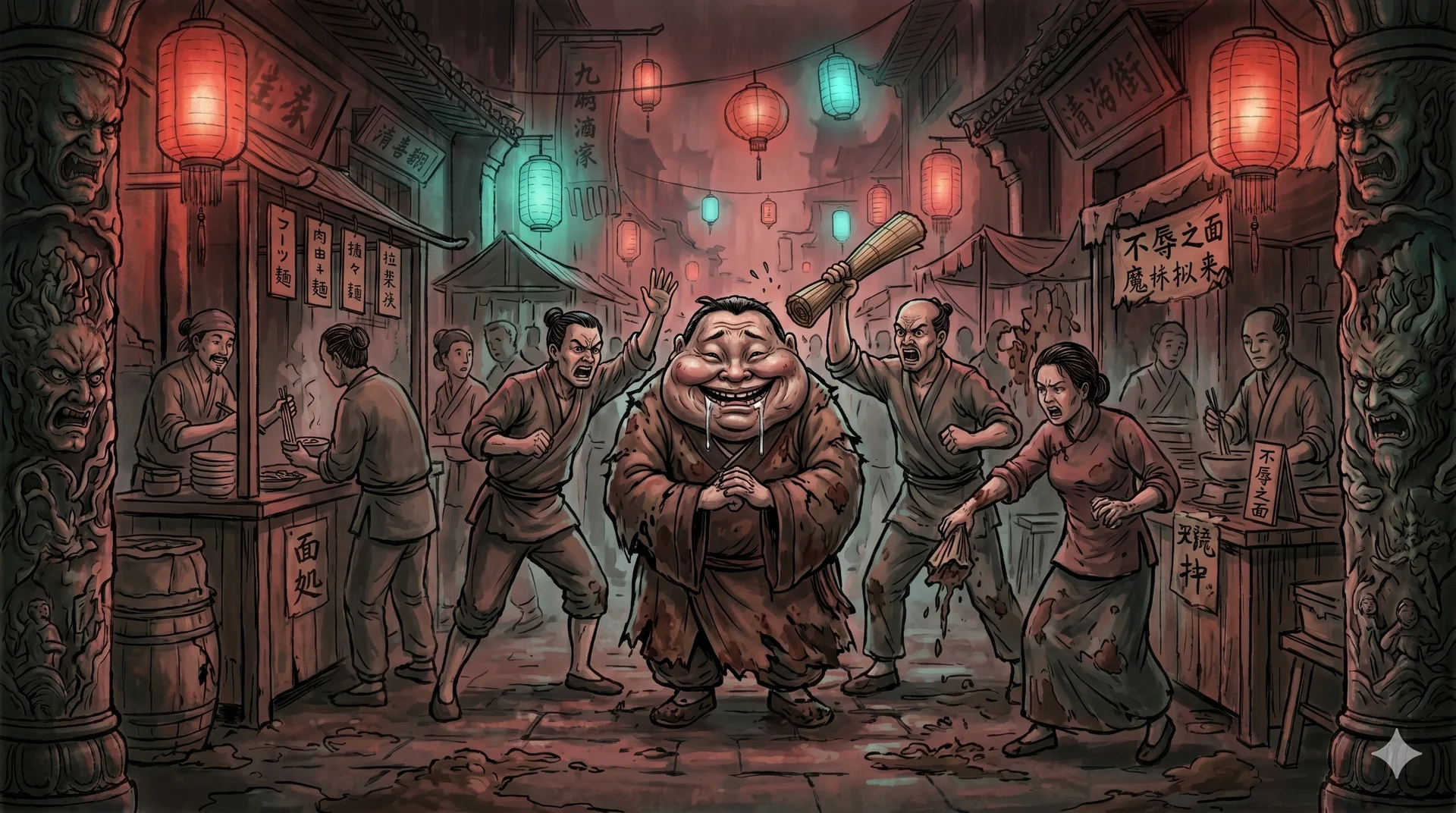
Among the pantheon of "human-natured demons" in the Qing Dynasty masterpiece Quelling the Demons (斩鬼传), the Xianlian Gui — literally the "Drooling-Faced Ghost" — stands apart as one of the most indelible and socially resonant creatures. It personifies the shameless rogue: the irrepressible scoundrel who grins through every rebuke, returns after every expulsion, and treats indignity itself as a tactical advantage. The name alone paints a vivid portrait — a figure with saliva dangling from curled lips, a fawning smile etched across an unblinking face, and absolutely no trace of embarrassment in its eyes.
What Is the Xianlian Gui?
Decoding the Name: "Drooling Face" as Moral Diagnosis
In Chinese, the compound xianlian (涎脸) carries a precise cultural charge. The character xian (涎) originally denotes drool or saliva, but extends metaphorically to covetousness and insatiable greed. The character lian (脸) means face or countenance. Together, they form a devastating epithet for someone so brazen that they seem to lack skin altogether — a person who drools over what they want and wears a sycophantic grin to get it, utterly immune to humiliation.
The Qing author Liu Zhang chose this name with surgical precision. In traditional Chinese society, "face" (mianzi) and a sense of shame (lian) functioned as twin pillars of moral order. As the Confucian philosopher Mencius famously argued, the sense of shame is what distinguishes humans from beasts (Mencius, Gong Sun Chou I). To be bu yao lian — literally "not wanting face" — meant one had exited the moral community entirely, freeing oneself to pursue any end by any means. The Xianlian Gui is the living, drooling embodiment of that exit.
Where the Xianlian Gui Fits in the Demon Hierarchy
Within the taxonomy of Quelling the Demons, the Xianlian Gui belongs to the category of character flaws incarnate. Unlike demons born from specific transgressions — theft, murder, deceit — this creature springs from a deep-rooted personality defect. Compared to the Zhen Gui (Flattery Demon), whose sin is hypocrisy, the Xianlian Gui's shamelessness is rawer and more aggressive. Compared to the Wochuo Gui (Petty-Minded Demon), whose smallness is inward, the Xianlian Gui's audacity is outwardly bullying.
It occupies the middle band of the "human-natured demon" spectrum — not terrifying like a great villain, yet more viscerally loathsome than a minor nuisance. It represents precisely the type most commonly encountered and most difficult to vanquish in daily life: the relentless rogue.
The Xianlian Gui in Chapter Three of Quelling the Demons
Entrance and Mannerisms
The Xianlian Gui makes its formal appearance in Chapter Three of Quelling the Demons. Liu Zhang renders it as a creature of impossibly thick skin — a figure who cannot be deterred by rejection, ridicule, or even physical violence. No matter how decisively it is dismissed, it returns wearing the same ingratiating smile. Far from feeling shame, it seems to thrive on it.
The novel's descriptive passages achieve a pitch-black comedy. After being publicly humiliated, the Xianlian Gui instantly rearranges its features into a mask of flattery. After being driven away, it reappears moments later as though nothing happened. After being caught in a lie, it fabricates a fresh one without a flicker of guilt. The "drool" in its name is not merely physical — it seeps into every expression, every word, every calculated gesture.
Zhong Kui's Frustrating Confrontation
The Xianlian Gui presents Zhong Kui with a unique strategic problem. The difficulty lies not in the demon's power but in its absolute shamelessness. Zhong Kui's two primary weapons — his moral authority and his martial prowess — prove strangely ineffective. When the Demon Hunter glares with righteous fury, the Xianlian Gui beams back and attempts friendly conversation. When Zhong Kui raises his sword, the creature scampers away only to return seconds later, grinning.
This standoff delivers the chapter's sharpest satirical insight: moral authority, the traditional Chinese instrument for confronting evil, is useless against someone who has abandoned the moral framework entirely. Righteousness can overcome wrongdoing, but it falters before brazenness.
The Anatomy of Shamelessness: Three Defining Traits
Trait One: Complete Absence of Shame
Under normal circumstances, a person who is rejected or ridiculed experiences embarrassment and withdraws. The Xianlian Gui feels nothing of the kind. It possesses no concept of "face" and no sensitivity to disgrace, allowing it to return endlessly after each dismissal. As the sociologist Erving Goffman observed in his landmark study Interaction Ritual (1967), social interaction depends on participants maintaining mutual face. When one party systematically refuses to do so, the entire interaction order collapses — which is precisely the Xianlian Gui's advantage.
Trait Two: A Chameleon's Repertoire of Faces
The Xianlian Gui does not present one fixed countenance to the world. Instead, it adapts its expression moment by moment to suit its audience and circumstances. It flatters the powerful and bullies the weak. It praises you to your face and exploits you behind your back. Its "drooling face" is not a single mask but a shape-shifting arsenal — a face for every occasion, deployed with the instinct of a born manipulator.
Trait Three: Weaponized Shamelessness
Crucially, the Xianlian Gui's behavior is not born of stupidity. It is a deliberate strategy. The creature understands that decent people tend to yield to rogues — not because they cannot fight, but because they consider it beneath them. The ancient proverb "A gentleman avoids the petty man" (junzi yuan xiaoren) encodes precisely this dynamic. The Xianlian Gui exploits it ruthlessly, converting the moral refinement of its opponents into a tactical weakness. Shamelessness becomes not a failing but a weapon.
Han Sima, Fu Xianfeng, and the Strategy to Pierce Thick Skin
The Failure of Conventional Righteousness
Zhong Kui does not vanquish the Xianlian Gui alone or easily. His advisor Han Sima (the "Sima of Injustice") attempts reasoned persuasion — and the demon welcomes his words with a cheerful smile. His vanguard General Fu (the "General of Burden") tries brute intimidation — and the Xianlian Gui flees, then returns unperturbed. The episode's bitter irony is that justice and strength together prove momentarily helpless against sheer audacity.
This narrative beat would have resonated powerfully with Qing readers. In a society governed by Confucian propriety, the rogue who refused to play by any rules occupied an almost untouchable position. Legal redress was often unavailable against those who committed no major crime but made daily life unbearable through petty extortion and relentless nuisance.
The Arrow That Pierced the Impervious Face
The breakthrough comes when Zhong Kui resorts to a weapon laden with symbolic weight: the arrow. In Chinese cultural tradition, the arrow represents straightness and sharpness — qualities diametrically opposed to the crookedness and dullness of shamelessness. When Zhong Kui's arrow strikes the Xianlian Gui's face, it punches through even the thickest skin, dramatizing the principle that righteous precision can puncture any wall of brazenness.
The scene ranks among the most memorable in all of Quelling the Demons. However thick the Xianlian Gui's face, however impenetrable its mask, Zhong Kui's divine arrow finds its mark. The implicit message: the shameless may prosper temporarily, but justice, sharp and straight, will always find its target.
Teamwork Against the Unconquerable Rogue
It is worth noting that the victory over the Xianlian Gui is a collaborative effort. Han Sima devises the plan, General Fu executes the assault, and Zhong Kui delivers the decisive arrow. This tripartite cooperation carries a quiet lesson: dealing with the shameless requires wisdom to understand them, courage to confront them, and decisiveness to finish them — all three in concert.
Cultural Significance: The Dark Mirror of "Face" Culture
When Abandoning Shame Becomes an Advantage
The Xianlian Gui's deepest cultural significance lies in its function as the dark mirror of China's "face" culture. Traditional Chinese society placed enormous weight on reputation, dignity, and the sense of shame. The Confucian program of self-cultivation began with zhichi — knowing shame — and treated shamelessness as the hallmark of moral death.
The Xianlian Gui exposes a structural vulnerability in this system: those who completely abandon the rules of face gain an asymmetric advantage over those who play by them. Decent people, constrained by propriety, behave themselves; rogues, freed from all constraint, run rampant. This is the phenomenon the economist Fred Hirsch later termed the "tyranny of the unprincipled" — and Liu Zhang diagnosed it three centuries earlier through the medium of supernatural fiction.
A Demon for All Seasons
The Xianlian Gui's satirical power has not dimmed in the three hundred years since Liu Zhang put brush to paper. The coworker who brazenly claims credit for another's work, the online troll who thrives on confrontation and never concedes defeat, the debtor who owes money without remorse and dodges every demand — all are modern heirs to the Xianlian Gui's legacy.
Zhong Kui's arrow offers a timeless injunction: moral persuasion alone is insufficient against the shameless. One must respond with something sharp and decisive. Kindness is not a license for capitulation, and integrity is not an excuse for retreat. Against the Xianlian Gui, only Zhong Kui's arrow will do — a single, righteous, penetrating strike.
The Xianlian Gui teaches an enduring lesson: the most dangerous adversary is not the distant predator but the leech that attaches itself to you. A person who has abandoned all shame achieves a paradoxical invincibility — you cannot shame someone who recognizes no shame. Zhong Kui's arrow piercing that thick face was more than a demon-slaying; it was a declaration that shamelessness carries a price and that brazenness will, in the end, meet its reckoning.