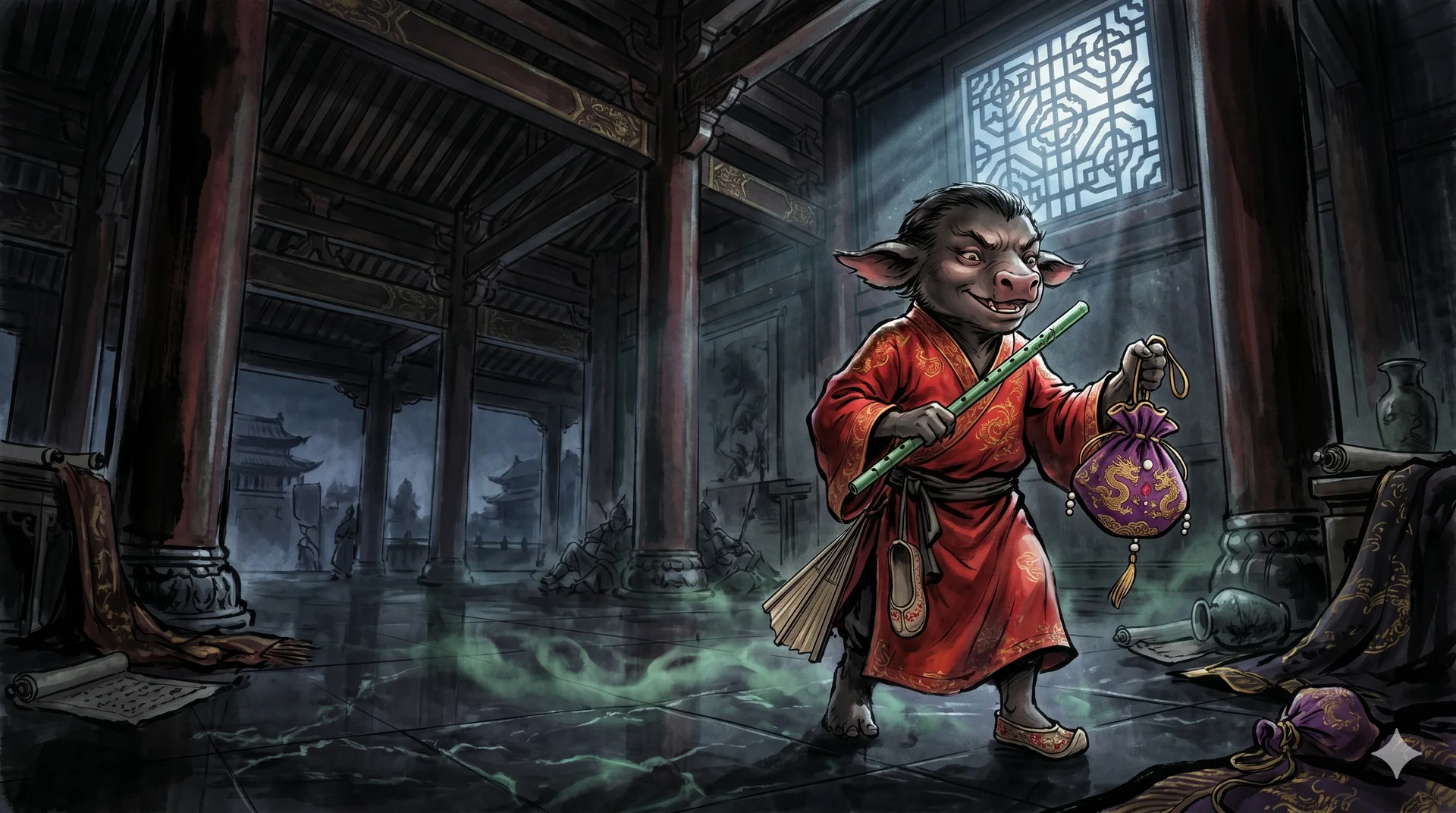
In the vast mythology of Zhong Kui, China's legendary demon hunter, one ghost stands at the very beginning of it all. His name is Xuhao (虚耗) — a minor demon whose brazen theft from the Emperor of China himself triggered the awakening of the greatest exorcist in Chinese folklore. Ripped in half and devoured alive, Xuhao earned a grim distinction: the very first demon slain by Zhong Kui after his return from the dead.
But Xuhao is far more than a footnote in someone else's story. This ghost of emptiness and ruin carries a symbolism that runs deep through Chinese culture — a living embodiment of theft, sabotage, and the slow erosion of human happiness.
What Does "Xuhao" Mean? A Name That Tells Its Own Story
In Chinese demon lore, names are rarely arbitrary, and Xuhao is a perfect example. The name breaks down into two characters that together define the ghost's entire purpose:
Xu (虚) — "void" or "emptiness." Xuhao steals through the void, plucking objects out of thin air as casually as a child playing a game. Not a burglar who breaks down doors, but a thief who reaches into nothingness itself and takes what he wants.
Hao (耗) — "consume," "deplete," or "ruin." This is the darker half. Xuhao doesn't just steal possessions — he transforms joy into sorrow. A bride falls ill on the eve of her wedding. A house burns down just as its owner passes the imperial exams. A newborn child develops a fever on the very day of its one-month celebration.
When confronted by Emperor Xuanzong in the famous dream, Xuhao introduced himself with astonishing insolence: "I am called Xuhao. 'Xu' means I steal from the void as if playing a game. 'Hao' means I consume people's happiness and turn their celebrations into grief."
It remains one of the most memorable self-introductions in all of Chinese supernatural literature — a demon who not only admits his nature but seems genuinely proud of it.
The Appearance of Xuhao: A Portrait of Absurdity
The earliest written description of Xuhao comes from the Tang Dynasty text Nianxia Suishi Ji (辇下岁時记, Records of Seasonal Customs in the Capital), a chronicle of life and folklore in Chang'an, the imperial capital. According to this source, Xuhao cuts a deeply unsettling figure:
- A crimson robe — Red is the color of joy and celebration in Chinese culture. Worn by a demon whose entire purpose is destroying happiness, it becomes a cruel parody.
- An ox's nose — The ox symbolizes diligence and strength in agrarian China. On Xuhao's face, it suggests a mocking inversion of virtue, perhaps hinting at arcane abilities.
- One shoe on, one shoe tucked at the waist — The most bizarre detail. One interpretation holds that the bare foot keeps him grounded in the human world while the stashed shoe means he can slip back into the void at any moment. Another reads the asymmetry as pure chaos — Xuhao's very existence is an insult to order.
- A bamboo fan tucked into his belt — Fans are traditionally associated with scholars and refinement. In Xuhao's hands, this cultured accessory becomes a tool of disruption.
Every element of Xuhao's appearance is a contradiction. He wears the color of weddings while engineering tragedies. He carries the mark of beasts on a humanoid face. He dresses as if getting dressed were a joke no one else understands. This is deliberate — Xuhao is a demon whose essence is disharmony, and his body reflects it.
The Dream of Emperor Xuanzong: How It All Began
A Sick Emperor and a Fateful Night
During the Kaiyuan era of the Tang Dynasty (713–741 CE), Emperor Xuanzong — also known as Tang Minghuang — returned to his palace after military maneuvers at Mount Li and fell gravely ill with malaria. His imperial physicians tried every remedy they knew, but the fever and chills refused to break. One hazy, moonlit night, exhausted beyond measure, the Emperor finally drifted into a deep sleep.
What came next was no ordinary dream. In the mythological tradition surrounding Zhong Kui, this was a moment of divine orchestration — the mechanism by which the greatest demon hunter in Chinese legend would be summoned back to the world of the living.
The Thief in the Throne Room
In the dream, Xuanzong watched helplessly as a small demon crept into his bedchamber. It wore a red robe, had the nose of an ox, walked with one bare foot and one shoe dangling from its waist — unmistakably Xuhao. The ghost swiped the Emperor's beloved jade flute from the imperial desk, then scampered over to the sleeping quarters of the Precious Consort Yang Guifei and stole her purple sachet of rare incense.
But Xuhao didn't flee. Instead, he ran circles around the grand hall, tossing the flute and sachet into the air, juggling them, cackling with delight. The audacity is staggering — a minor demon, alone in the most powerful man's bedroom in the world, playing catch with the Emperor's treasures and his favorite concubine's intimate belongings.
The Boast That Sealed His Fate
Xuanzong, furious, demanded the creature identify itself. Far from cowering, Xuhao grinned and delivered his now-legendary self-introduction — the speech about stealing from the void and consuming human happiness. The Emperor's rage peaked at those two words: "as if playing a game" (如戏). To Xuhao, robbing the Son of Heaven was child's play.
This was more than theft. It was a direct insult to imperial authority, a declaration that the highest power in the land meant nothing to a minor spirit of chaos.
Enter Zhong Kui
Just as Xuanzong was about to call for his palace guards, a blinding flash of gold split the dreamscape. A towering figure crashed down from above — a massive demon in a soft-winged scholar's cap, a blue robe, and formal court boots. Before Xuanzong could speak, the giant seized Xuhao, gouged out both eyes with his fingers, tore the smaller ghost in half with his bare hands, and devoured the remains.
Shaken, the Emperor asked the fearsome being who he was. The giant knelt and replied:
"I am Zhong Kui, a scholar from Mount Zhongnan who placed first in the imperial examinations. In the Wude years of the former dynasty, I was denied my degree because of my ugly face. In despair, I smashed my head against the palace steps and died. The late emperor, moved by my loyalty, granted me a green robe for my burial. I have sworn to rid Your Majesty's world of every demon of emptiness and ruin."
With that oath, the great saga of Zhong Kui the demon hunter officially began — and Xuhao became its first casualty.
Why Zhong Kui Is the Perfect Nemesis for Xuhao
The relationship between Zhong Kui and Xuhao is not random. It follows a deep philosophical logic rooted in Chinese thought.
Xuhao's power comes from the void — he operates in emptiness, steals through nothingness, reduces happiness to nothing. He is, in essence, the demon of absence.
Zhong Kui is his exact opposite: the champion of substance. A real scholar who earned real honors. A loyal subject whose integrity was unshakeable. A physical powerhouse who fights with fists, fingers, and raw bodily force — not with spells or incantations, but with undeniable, tangible violence.
Consider how Zhong Kui kills Xuhao. He doesn't use a sword or a talisman. He tears the ghost apart with his hands and eats it — the most visceral, physical, meat-and-bone method imaginable. A demon made of emptiness is destroyed by the most concrete, bodily act possible. It's not just a victory of strength. It's a philosophical annihilation. Solidity obliterates void. Presence devours absence.
There's also a narrative elegance to Xuhao being the first opponent. He's annoying enough to deserve death, yet weak enough to pose no real challenge. Zhong Kui, newly returned from the dead, needs a proving ground — and Xuhao hands him the perfect opportunity. In literary terms, Xuhao is the opening act that establishes the hero's power before the real battles begin.
The Symbolism of the "Small Ghost"
Xuhao is consistently described as a "small ghost" (小鬼) — small in body and small in ambition. He doesn't scheme to overthrow heaven or annihilate humanity. He pilfers trinkets and ruins parties. His villainy is petty, almost comical.
This stands in sharp contrast to the demons Zhong Kui faces later in texts like Zhan Gui Zhuan (斩鬼传, The Legend of Demon-Slaying) — creatures like the Flattering Demon, the Shameless Demon, the Liar Demon, and the Lust Demon. These are "great demons" born from deep flaws in human nature. Xuhao, by comparison, represents only surface-level malice: stealing things and spoiling moods.
Yet this smallness carries its own wisdom. Xuhao reminds us that not all evil arrives with dramatic thunder. Some of it creeps in quietly, steals small pleasures, and converts moments of joy into lingering unease. The most insidious harm isn't always the most spectacular — sometimes it's the slow, invisible drain on happiness that does the deepest damage.
Folk Traditions: How the Chinese Drove Away Xuhao
Firecrackers and the Banishment of Void
After the Tang Dynasty, Xuhao's legend bled into real-world New Year customs. The same Nianxia Suishi Ji that records Xuhao's appearance also describes people lighting bamboo firecrackers at year's end — the explosive cracks were meant to terrify Xuhao and keep him away from homes during the vulnerable transition between old year and new.
This practice eventually merged with the broader Chinese firecracker tradition during Lunar New Year. While modern celebrants think of fireworks as festive noise-making, their oldest supernatural function was defensive: startling away minor spirits like Xuhao who might steal the household's good fortune just as the calendar turns.
Hanging Zhong Kui's Portrait
From the Tang Dynasty onward, Chinese households adopted the practice of hanging images of Zhong Kui at the threshold of each new year. The logic was straightforward and rooted directly in the Xuanzong dream: if Zhong Kui could destroy Xuhao in the Emperor's dream, his painted image could surely frighten the demon away from ordinary homes.
This "image-based exorcism" forms an interesting contrast with the Baize Tu (白泽图) tradition, where knowing a demon's true name is enough to neutralize it. The Baize approach runs on knowledge; the Zhong Kui approach runs on raw intimidation. Together, wisdom and strength form the twin pillars of Chinese supernatural defense.
Xuhao in Modern Culture: From Myth to Mascot
In contemporary retellings — films, animation, video games, and web novels — Xuhao almost always appears as the opening antagonist in Zhong Kui's story. His three-beat narrative structure (arrive, steal, get eaten) is clean, dramatic, and instantly memorable, making him the perfect introduction to a longer mythological saga.
Modern adaptations tend to lean into Xuhao's comedic potential. A small demon snatching a flute, grabbing a perfume sachet, and sprinting around a throne room whooping with glee is inherently funny. His cocky declaration that robbing the Emperor is "just a game" adds a layer of absurd humor. In what is otherwise a dark and violent mythology, Xuhao provides rare moments of levity.
Some contemporary interpretations have even recast Xuhao as a kind of tragicomic figure — a small-time operator who picked the wrong victim on the wrong night and accidentally triggered the birth of China's greatest demon hunter. It's hard not to feel a twinge of sympathy for a ghost whose only real mistake was being entertaining enough to get noticed.
Xuhao's Modern Metaphor: The Ghost in the Machine
Strip away the supernatural packaging, and Xuhao's nature maps eerily onto modern anxieties. "Stealing through the void" sounds a lot like digital identity theft — data snatched from invisible networks by unseen hands. "Converting celebrations into grief" is a fair description of what online harassment does when it floods someone's moment of achievement with cruelty and jealousy.
Seen this way, Zhong Kui's destruction of Xuhao reads less like a medieval ghost story and more like a timeless allegory: the refusal to let emptiness and malice drain away what is real and meaningful. The ancient Chinese didn't have the internet, but they understood the human impulse to tear down others' joy — and they created a myth about obliterating it.
Conclusion
Xuhao occupies a singular position in China's vast menagerie of ghosts and demons. Not the most powerful. Not the most ancient. Not the most terrifying. Yet without Xuhao's midnight raid on the imperial bedchamber, there would be no Emperor's rage. Without the Emperor's rage, no golden light from heaven. Without that light, no Zhong Kui. And without Zhong Kui, no thousand-year tradition of demon-slaying lore that continues to inspire art, literature, and popular culture across East Asia and beyond.
Xuhao's petty evil gave birth to Zhong Kui's grand justice. His crimson robe, ox nose, bare foot, and bamboo fan remain frozen in that moonlit Tang palace dream — a portrait of absurd malevolence that has outlasted empires. His legacy is a quiet reminder that even small, seemingly harmless acts of theft and sabotage deserve to be answered with force. Because the slow draining of happiness — the conversion of celebration into sorrow — is not a trivial harm. It is, in fact, the most common and corrosive form of evil there is.
Xuhao's story tells us something worth remembering: the most hateful creatures are not always the ones who confront you with armies and flames. Sometimes they are the ones who tiptoe in when you're sleeping and steal your joy, one small piece at a time. Zhong Kui's hands, reaching out to tear that thief apart, represent something universal — the human refusal to let emptiness win.