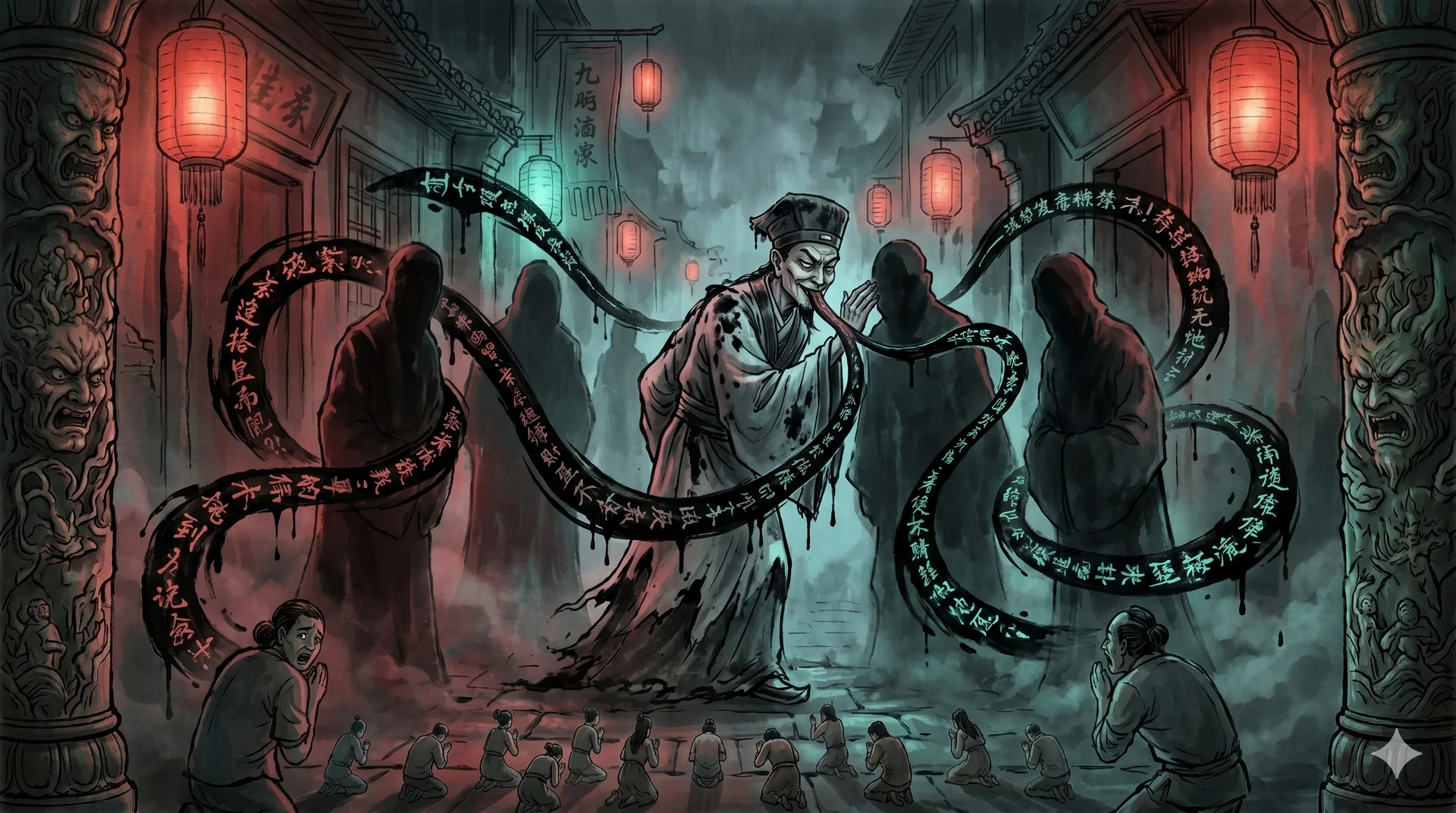
In the Qing dynasty satirical novel Zhan Gui Zhuan (Execution of Demons, 斬鬼傳) by Liu Zhang, the demon hunter Zhong Kui returns to the mortal realm with a singular mission: to vanquish no ordinary monsters, but demons born from the darkest corners of human nature. Zhou Gui — the Demon of Fabrication — holds the distinction of being the very first of these human-natured demons that Zhong Kui encounters. It personifies dishonesty, rumor-mongering, and the manipulative art of sowing discord through lies.
The appearance of Zhou Gui at the opening of the narrative is deeply symbolic. Its defeat establishes the novel's central allegory: every demon Zhong Kui slays represents a moral failing that infects human society. After Zhou Gui comes a procession of other human-natured demons — the Shameless Demon, the Filth Demon, the Liar Demon — each painting another stroke on a vast canvas of human vice.
Who Is Zhou Gui?
The Meaning Behind the Name
The character zhou (诌) means to fabricate, to invent falsehoods, to speak recklessly without basis. The name Zhou Gui leaves no ambiguity about its nature: it thrives on lies and wields rumor as its primary weapon. Among the rogues' gallery of demons in Zhan Gui Zhuan, Zhou Gui is neither the fiercest nor the most terrifying. Yet it may well be the most familiar — because the dishonesty it represents pervades everyday social interaction.
Liu Zhang's decision to place Zhou Gui as Zhong Kui's first opponent reveals a sharp moral insight. The evil of spreading rumors and stirring up trouble may seem trivial compared to grander villainy, but its consequences run deep. A single irresponsible lie can fracture trust between friends, tear apart families, and plunge communities into chaos. By making rumor the very first demon to fall beneath Zhong Kui's blade, Liu Zhang declares that purging dishonesty is the essential first step toward cleansing society of all vice.
The First of the Human-Natured Demons
Unlike traditional ghosts of Chinese folklore — restless spirits of the dead, mountain goblins, or river monsters — Zhou Gui is not a supernatural creature in the conventional sense. It is a walking embodiment of a specific human flaw: the compulsion to fabricate and spread falsehoods. The central premise of Zhan Gui Zhuan holds that the collective vices of humanity coalesce into demons that parasitize the mortal world, growing stronger with each act of malice. Zhong Kui's mission is to hunt them down one by one.
As the inaugural human-natured demon, Zhou Gui sets the tone for the entire novel. This is not a fantasy adventure about battling monsters — it is a mirror held up to society, reflecting its ugliest habits through the distorted lens of demonology.
Zhou Gui's Role in Zhan Gui Zhuan
Appearance and Demeanor
Zhou Gui appears early in Zhan Gui Zhuan, presenting itself as a silver-tongued figure gifted with the art of persuasion. It specializes in concocting elaborate stories from thin air, planting contradictory messages among different groups of people, and engineering misunderstandings that escalate into open conflict. Notably, Zhou Gui possesses no monstrous fangs, no ghastly claws, no terrifying visage. Its only weapon is a tongue — and that, the novel suggests, is the most dangerous weapon of all.
The demon's technique of fabrication is disturbingly sophisticated. Zhou Gui does not tell crude, obvious lies. Instead, it weaves narratives that are half-true, laced with just enough factual detail to seem credible. It embellishes minor incidents into major scandals and tailors its falsehoods to the anxieties and desires of each listener. Every person who hears Zhou Gui's whispers walks away convinced they have learned the truth.
Zhong Kui's First Encounter
As Zhong Kui descends to the mortal realm — accompanied by his lieutenants, the wronged Han Yuan (含冤司馬) and the aggrieved Fu Qu (負屈將軍) — the first adversary they meet is Zhou Gui. The demon attempts to mislead the party with honeyed words and artful deceptions, but Zhong Kui's righteous perception pierces through every lie. Under the penetrating gaze of uncompromising integrity, Zhou Gui's fabrications crumble instantly.
This encounter carries a clear moral lesson: when confronted with genuine righteousness, deceit cannot stand. Rumor flourishes only in the shadows of credulity and complacency.
The Portrait of a Rumormonger
How Rumors Operate
Through Zhou Gui, Liu Zhang paints a remarkably precise portrait of how real-world rumormongers operate. Although the author wrote in an era long before digital communication, the mechanisms of rumor he identified remain strikingly consistent across centuries. Zhou Gui's art of fabrication can be broken down into three core tactics:
First, grasping at fragments of truth. Zhou Gui never invents stories entirely from nothing. Instead, it takes a sliver of fact — an overheard conversation, a partial observation — and inflates it with fabricated detail, giving the rumor a veneer of plausibility.
Second, customizing the lie for each audience. Zhou Gui adjusts its narrative depending on who is listening, exploiting each person's particular fears and prejudices. Every listener receives a version of the story calibrated to feel like revelation.
Third, fanning the flames of conflict. Zhou Gui excels at shuttling between opposing parties, feeding each side distorted information about the other, transforming minor disagreements into full-blown feuds — all while the demon watches from the sidelines, growing stronger on the chaos it has created.
The Real-World Inspirations
Liu Zhang likely modeled Zhou Gui on the rumormongers who plagued Qing dynasty society: the gossiping busybodies of the marketplace, the sycophantic courtiers who whispered slander to destroy rivals, and the envious scholars who spread calumny against their peers. None of these figures needed to resort to physical violence. A few well-placed rumors could accomplish what a sword never could — ruin a reputation, destroy a family's fortune, or end a promising career overnight.
How Zhong Kui Vanquishes Zhou Gui
Righteousness Overcomes Deceit
Zhong Kui's method of defeating Zhou Gui follows the classical Chinese philosophical principle that righteousness inherently overcomes evil. The demon draws its strength from the spread of lies — the more people believe its fabrications, the more powerful it becomes. Conversely, when truth shines through and the lies are exposed, Zhou Gui weakens and collapses. Zhong Kui travels through the land, systematically dismantling every falsehood Zhou Gui has planted, leaving the demon with nowhere to hide.
Though the battle against Zhou Gui occupies only a brief portion of Zhan Gui Zhuan, its significance reverberates throughout the novel. The encounter establishes the ground rules: Zhong Kui's war is not against physical monsters, but against the moral corruption that afflicts the human spirit. To slay Zhou Gui is to sever the root of rumor itself.
The Deeper Symbolism
The death of Zhou Gui symbolizes the triumph of honesty over hypocrisy. Yet Liu Zhang's deeper insight lies in what happens next: even after Zhou Gui falls, other demons of deceit continue to appear throughout the novel. The implication is sobering. Fabrication and dishonesty are chronic diseases of human civilization. No single act of purification can eradicate them permanently. Eternal vigilance is the price of an honest society.
Zhou Gui in the Modern World
The Demon of the Information Age
Viewed through a contemporary lens, Zhou Gui feels more relevant than ever — perhaps even prescient. In the age of the internet, the speed and scale at which rumors propagate would have been inconceivable to a Qing dynasty author. Yet the fundamental mechanism remains unchanged. Paid trolls, clickbait outlets, and unscrupulous influencers who weaponize misinformation are, in essence, modern avatars of Zhou Gui.
Consider the tactics that dominate social media manipulation: cherry-picked screenshots presented out of context, deceptively edited video clips, sweeping generalizations built from isolated incidents, and coordinated campaigns designed to manufacture outrage. These are the same techniques Zhou Gui perfected centuries ago — scaled up, digitized, and deployed at a speed Liu Zhang could never have imagined, but fundamentally unchanged in nature.
Zhong Kui's Sword in the Digital Era
If Zhou Gui stalks the internet today, what form should Zhong Kui's sword take? Fact-checking organizations, independent investigative journalism, and debunking platforms all serve as modern incarnations of the demon hunter's blade. But the most important weapon against the Demon of Fabrication may be the one each person carries within: the capacity for independent thought, the discipline to question what seems too convenient to be true, and the determination to seek out facts rather than settle for narratives.
Three centuries ago, Liu Zhang dreamed up a demon born from humanity's compulsion to lie. That demon still walks among us. The battle against Zhou Gui has never truly ended.
Zhou Gui teaches us that the most insidious evil is not the violence that strikes in daylight, but the whisper that poisons in the dark. A single rumor can destroy without a trace, and one skilled fabricator can plunge an entire community into chaos. Zhong Kui strikes down Zhou Gui first because — among all the demons born from human nature — deception is the gateway. Until lies are broken, truth can never be reached.