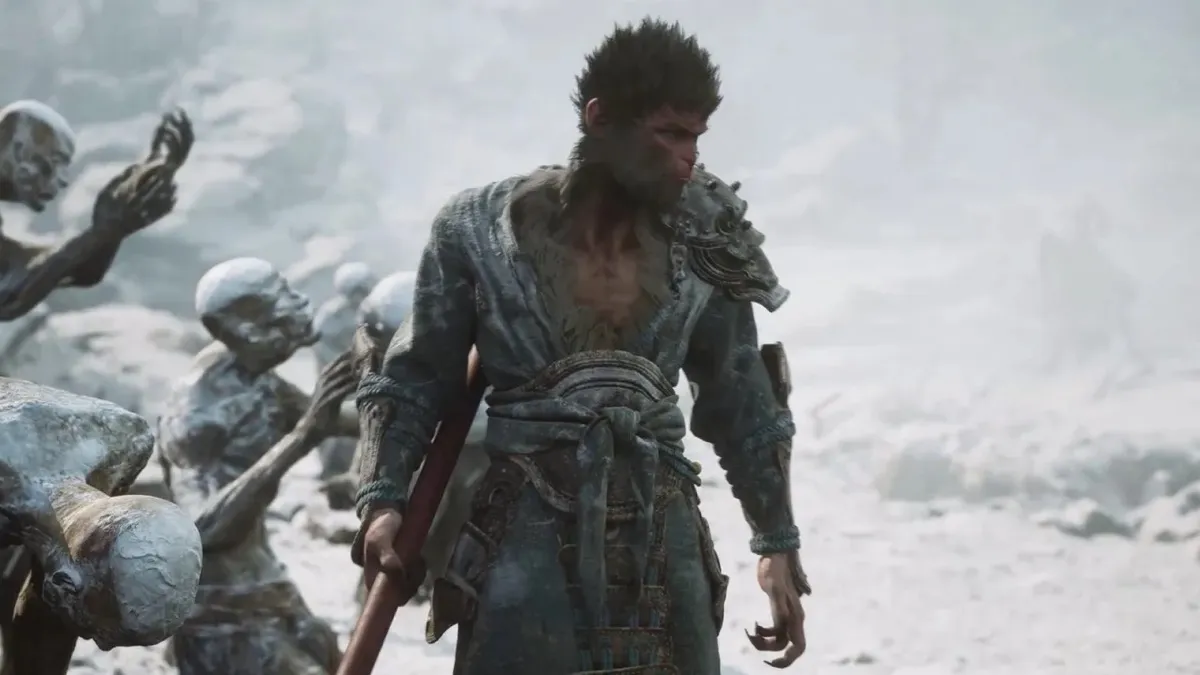
Black Myth no longer belongs to a single Monkey King.
When Game Science unveiled Black Myth: Zhong Kui on August 20, 2025, the studio redefined "Black Myth" from a standalone title into a lasting franchise brand. The journey from Wukong to Zhong Kui signals a bold attempt to construct an interconnected gaming universe spanning China's most iconic mythological figures. Yet what makes this transition truly fascinating is that the differences between the two projects may be far more revealing than their similarities.
This article provides a systematic, multi-dimensional comparison — covering source material, narrative themes, visual design, gameplay mechanics, and long-term franchise strategy. An important caveat: Black Myth: Zhong Kui remains in very early development. Where analysis draws on limited official information and informed speculation, this is clearly indicated.
Source Material: Classical Novel vs Folk Tradition
Black Myth: Wukong — Adapting a Literary Masterpiece
The creative foundation of Black Myth: Wukong is unmistakable: Wu Cheng'en's Journey to the West (Xiyou Ji, 西游记), one of the Four Great Classical Novels of Chinese literature, composed during the Ming dynasty. Over centuries, this narrative has spawned a vast cultural afterlife — from the beloved 1986 CCTV television adaptation to Stephen Chow's A Chinese Odyssey film duology, from Game Science's own Hundred-Armed God of War (Asura, 斗战神) to countless fan creations. The mythos surrounding the Monkey King carries extraordinary cultural capital.
This choice offers clear advantages: near-universal recognition within the Chinese-speaking world, deeply beloved character archetypes, and a fully realized cosmological framework. The challenge, however, was equally obvious — how do you stand out among hundreds of existing adaptations? Game Science's answer was "dark deconstruction." Rather than faithfully recreating the pilgrim's progress, the game reframes the journey through the eyes of the "Destined One" (天命人), interrogating whether the quest for Buddhist scriptures represents enlightenment or entrapment.
Black Myth: Zhong Kui — Assembling a Folk Mosaic
Zhong Kui presents an entirely different creative challenge. Unlike the Monkey King, Zhong Kui has no single canonical text to serve as a source blueprint. His legend is scattered across folk traditions, Daoist scriptures, Ming-Qing vernacular fiction, and regional opera — from Shen Kuo's account of Emperor Xuanzong's fever dream in the Dream Pool Essays (Mengxi Bitan, 梦溪笔谈), to Liu Zhang's episodic novel Quelling the Demons (Zhan Gui Zhuan, 斩鬼传), to the ceremonial "Zhong Kui Dance" (跳钟馗) still performed in parts of rural China. The Ghost Catcher's identity is plural and fluid.
This "no unified canon" condition cuts both ways for a game studio. On one hand, the absence of a fixed narrative framework grants tremendous creative freedom — the writers can craft an original storyline without contradicting any sacred text. On the other hand, the team must distill a coherent dramatic arc from an enormous body of disparate folk material, much of it contradictory.
Art Director Yang Qi captured the distinction succinctly: "Tales of gods and demons are thrilling, of course, but strange and supernatural legends should hold their own fascination." The shift is from shenmo xiaoshuo — the grand "gods-and-demons" novel tradition — to zhiguai — the eerie "tales of the strange" tradition. The former is sweeping and magnificent; the latter is intimate and uncanny.
Narrative Themes: Defying Fate vs Confronting Inner Demons
Wukong — Freedom and Rebellion
At the heart of Black Myth: Wukong lies the journey of the Destined One — a narrative about rebelling against a predetermined fate and pursuing radical individual freedom. The word "Black" (黑) in the title itself signals this subversion, casting doubt on the orthodox interpretation of the pilgrimage: Was the westward journey truly a path to spiritual awakening, or merely another form of bondage?
This thematic choice is perfectly aligned with Sun Wukong's cultural DNA. The Great Sage Equal to Heaven was never a compliant figure. His enduring appeal lies precisely in his defiance of celestial authority and his unquenchable thirst for liberty.
Zhong Kui — Identity and Redemption (Speculative)
Based on the official tagline — "External demons are easy to banish; inner demons are hard to subdue" (外鬼易除,内鬼难伏) — and the internal logic of Zhong Kui's mythology, Black Myth: Zhong Kui will likely orbit around questions of identity and self-redemption.
The Zhong Kui legend is, at its core, a story about rejection. A brilliant scholar is denied his rightful place in the imperial examination system solely because of his monstrous appearance. Humiliated and driven to suicide, he is posthumously deified as the King of Ghosts — and entrusted with protecting the very world that cast him out. This profound internal contradiction provides a far darker and more introspective narrative foundation than Wukong's outward-facing rebellion.
If Wukong's question is "How do I break free from my chains?" then Zhong Kui's question is "How do I face the demons within myself?" — the former looks outward, the latter turns inward.
Visual Design: Two Aesthetic Worlds
Wukong's Visual Language
Helmed by Art Director Yang Qi, Black Myth: Wukong established a visual identity rooted in classical Chinese aesthetics, seamlessly blended with cutting-edge photorealistic rendering. From the resplendent golden halls of the Heavenly Court to the desolate sweep of the Flaming Mountains, from meticulously reconstructed Tang-dynasty architecture to towering, screen-filling yaoguai beasts, Wukong's art direction delivers excellence on both the epic and the intimate scale.
Zhong Kui's Likely Visual Direction (Speculative)
The shift in subject matter almost certainly demands a transformation in visual tone. Several directions can be anticipated:
Color Palette Shift: If Wukong's chromatic signature is "gold and crimson" — evoking celestial splendor and volcanic fury — then Zhong Kui's palette will likely gravitate toward "indigo and black": his iconic blue robe, the pallor of the Underworld, moonlit landscapes, and deep shadow. Yang Qi's remark about the appeal of zhiguai aesthetics hints at a darker but equally seductive visual identity.
Environmental Design: The world of Journey to the West is defined by earthly landscapes and heavenly palaces. Zhong Kui's domain, by contrast, is expected to feature vast subterranean spaces — the Ten Courts of Hell (十殿阎罗), the Ghost Gate (鬼门关), the Yellow Springs Road (黄泉路), and the Bridge of Helplessness (奈何桥). Above-ground environments may lean toward abandoned villages, crumbling mountain shrines, and moonlit wastelands — spaces saturated with supernatural dread.
Character Design: Wukong bestiary emphasizes celestial beings and demon lords, with designs tending toward the magnificent and ornate. Zhong Kui's rogues' gallery — drawn from the vast taxonomy of Chinese ghost lore — is likely to favor the grotesque and the metamorphic. Classical Zhong Kui tales feature an extraordinary variety of spectral antagonists, potentially yielding enemy designs even more diverse than those in Wukong.
Classical Painting Influences: Zhong Kui's legend has a unique relationship with visual art. According to tradition, Emperor Xuanzong commissioned the legendary painter Wu Daozi (吴道子) to create the first portrait of Zhong Kui after seeing him in a dream. The game may incorporate ink-wash (shuimo, 水墨) visual elements, introducing an artistic texture distinctly different from its predecessor.
Gameplay Mechanics: What Will Change and What Will Stay
Confirmed Common Ground
The official FAQ confirms that Black Myth: Zhong Kui "will remain a standard single-player ARPG, following the same business model." At the structural level, then, the two titles share a common backbone.
Likely Divergences (Speculative)
Combat System: Wukong's combat revolves around the Ruyi Jingu Bang (the magical staff) and the Seventy-Two Transformations, emphasizing close-quarters combat and form-shifting. Zhong Kui traditionally wields a sword, suggesting a combat system potentially built around blade techniques. Furthermore, Zhong Kui's legendary command of "80,000 ghost soldiers" could introduce a unique summoning or squad-command mechanic — not transformation, but domination.
Exploration Mechanics: Zhong Kui's liminal position between the worlds of the living and the dead may enable a dual-world exploration system. Players could shift freely between the mortal realm and the Underworld, each governed by different rules, populated by different enemies, and concealing different puzzles.
Progression System: Wukong's growth centers on spell acquisition and transformation mastery. Zhong Kui's progression may instead revolve around escalating exorcism abilities — advancing from dispelling minor wandering spirits to confronting fearsome Ghost Emperors. Simultaneously, Zhong Kui's encyclopedic knowledge of spectral entities could form a "demon codex" collection mechanic, rewarding players for investigating the lore behind every ghost they encounter.
Yang Qi's Evolution: From Pilgrim to Ghost Hunter
As Game Science's Art Director and co-founder, Yang Qi is the creative soul behind the Black Myth franchise's visual identity. From Asura through Black Myth: Wukong, he devoted over a decade to interpreting the world of Journey to the West through a gaming lens.
Speaking after the Zhong Kui announcement, Yang Qi expressed a palpable sense of creative relief: "A group of old companions has been working on Journey to the West material for more than a decade. Perhaps it's exactly the right time to try something different." For any artist, the creative fatigue that accumulates from long immersion in a single subject matter is real. But more importantly, the Zhong Kui mythos offers Yang Qi an entirely new canvas for artistic expression.
From a visual design perspective, Zhong Kui's world unlocks darker aesthetic possibilities than anything in the Wukong corpus. The eerie architecture of the Underworld, the contorted forms of the damned, the liminal landscapes where yin and yang collide — all of this could inspire Yang Qi to deliver a visual experience that feels genuinely fresh and startlingly original.
The Franchise Play: Why Two Black Myths Matter
From Title to Brand
The rebranding of the studio's social media accounts from "Black Myth: Wukong" to simply "Black Myth" was a decision with far-reaching strategic implications. It signals that Black Myth has evolved from a single game into a durable series brand — a label that can encompass any number of Chinese mythological protagonists.
Toward a Chinese Mythology Gaming Universe
Looking further ahead, the Black Myth franchise could become the gaming world's answer to the Marvel Cinematic Universe — but built from China's mythological heritage rather than Western comic books. Game Science may eventually bring figures like Nezha (哪吒), Erlang Shen (二郎神), Guan Yu (关羽), and Mazu (妈祖) under the same franchise umbrella.
Naturally, the viability of this grand vision depends entirely on whether Black Myth: Zhong Kui can sustain the momentum established by its predecessor. In the games industry, franchise-building is the ultimate commercial strategy — it ensures predictable revenue streams and compounds brand equity with every installment. Game Science clearly understands this calculus.
One Monkey King and one Ghost King — when Yang Qi said it was time to "try something different," he may not have fully grasped that he was launching the most ambitious franchise-building experiment in Chinese gaming history. Black Myth no longer belongs to Wukong alone. It belongs to the vast, starlit sky of Chinese mythology itself. And Zhong Kui — the Demon Queller who has stood silently on doorframes for a thousand years — is finally about to step into his own spotlight.