The Ghost-Catching God Steps Onto the Stage
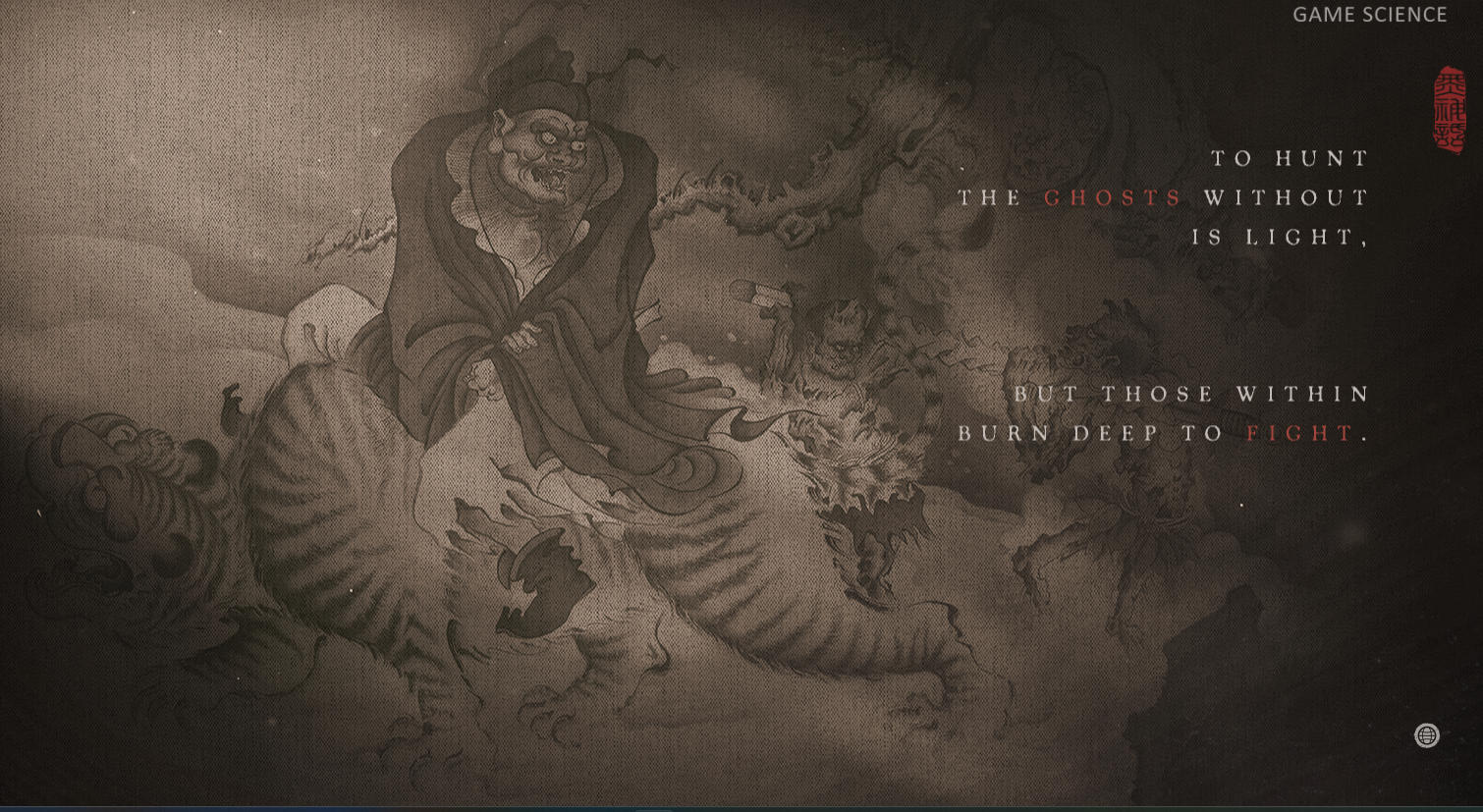
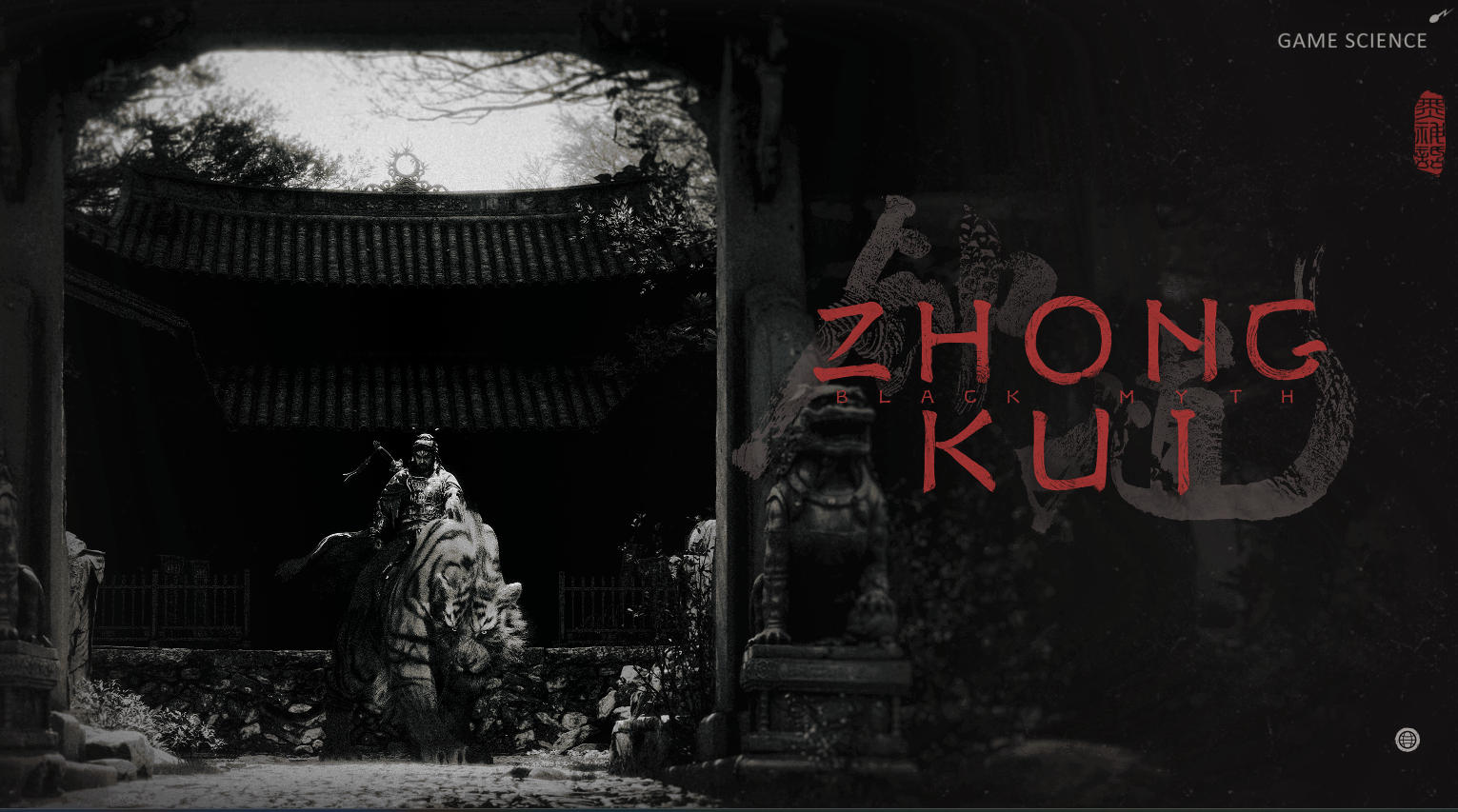
On August 20, 2025, Geoff Keighley leaned into the microphone at Gamescom Opening Night Live and delivered a single sentence that set the entire venue on edge: "a ghost-catching god who wanders between Hell and Earth." Behind him, the first CG teaser for Black Myth: Zhong Kui began to roll — no gameplay, just three concept art pieces and one bilingual tagline:
"To hunt the ghosts without is light. But those within burn deep to fight."
Coming off Black Myth: Wukong, Game Science swapped the Monkey King for the most feared demon hunter in Chinese folk religion. Where Wukong's DNA was rebellion against heaven's authority, Zhong Kui's story reaches somewhere darker — the ghosts inside a person are always harder to kill than the ones in the wild.
The Yin-Yang Dual World: One Sky, Two Realities
Yang
Yin
The most loaded concept art in the teaser is the Yin-Yang dual-world comparison. Two panels share nearly identical composition — distant peaks, an old village, a stone bridge, a creek. Then you shift your gaze from the Yang world to the Yin, and the placid surface cracks. Tree branches twist into human faces. The creek runs crimson. Skeletons lie scattered along empty paths. Worst of all are the translucent parasitic spirits draped across rooftops, crawling along tiles like oversized insects.
The game-design implication is hard to miss: a realm-switching mechanic where players explore the Yang world and flip into the Yin to reveal hidden demons and buried clues. Zhong Kui straddles both domains — he holds the title of Underworld Judge but carries imperial authority to hunt ghosts among the living. As Duan Chengshi recorded in his Miscellaneous Morsels from Youyang (Youyang Zazu), the Tang dynasty was full of accounts where the boundary between living and dead thinned at specific places. A protagonist with one foot on each side is a narrative gamble that pays off the moment you see those two panels.
What makes the Yin world unsettling is Game Science's artistic restraint. They avoided the horror playbook of desaturating everything and bathing scenes in red. Instead, the Yin world retains much of the Yang world's brightness, but details are wrong in ways that crawl under your skin. A bridge that looks fine in Yang has something crouching beneath it in Yin. This "uncanny brightness" is more disturbing than straightforward darkness.
The Bestiary Painting: Four Folklore Ciphers in One Frame
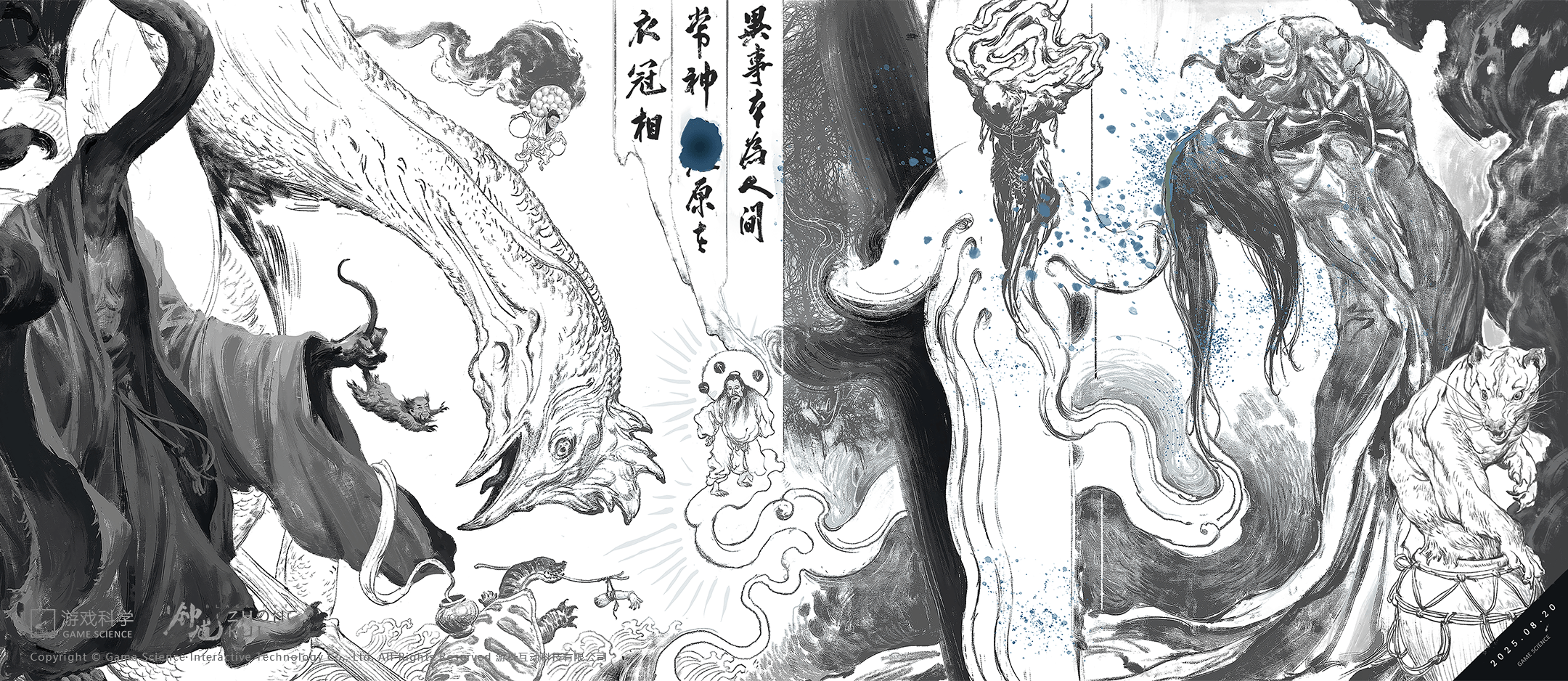
The second concept art is a densely packed bestiary illustration featuring four supernatural creatures, each traceable to a specific strain of Chinese folklore.
The Giant Rooster — Primal Force That Drives Back the Dark
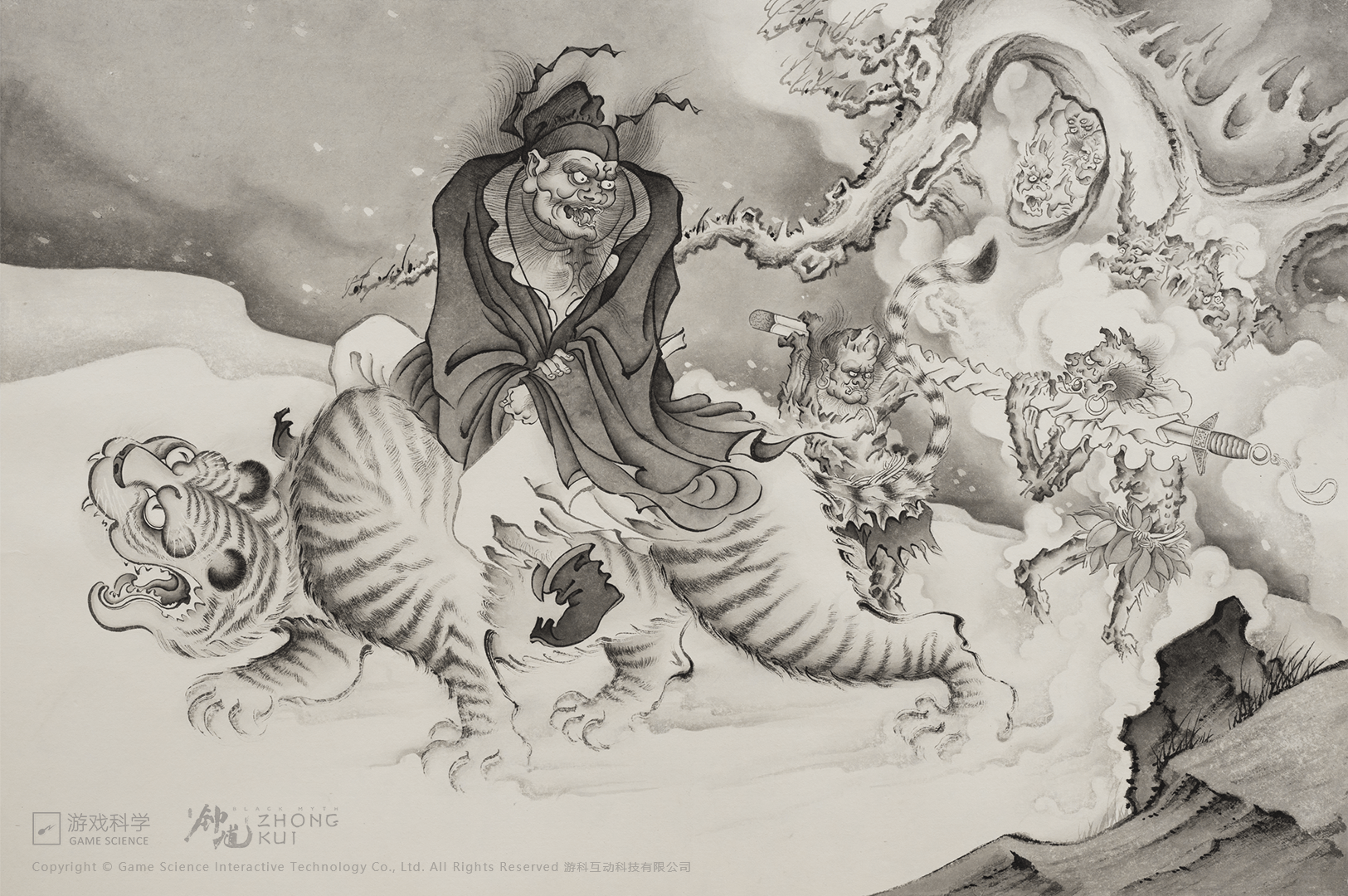
The largest creature in the frame is a rooster the size of a house, standing upright at the village edge, its comb burning like a bonfire. Chinese folk tradition holds that a rooster's crow at dawn forces all yin energy to retreat — ghosts, demons, and wandering spirits must return to wherever they came from. In Journey to the West, chapter 55, the demon scorpion is ultimately defeated not by Sun Wukong's staff but by the Maori Star Lord appearing in his true form as a giant rooster. The rooster's presence in the Yin-Yang concept art almost certainly signals a day-night cycle mechanic where crowing pushes back Yin-world corruption, making time management a core gameplay pillar.
The Spirit Turtle Holding a Severed Arm — A Broken Guardian's Obsession
A spirit turtle clutches a severed human arm in its jaws, and the image radiates narrative tension. The turtle is one of the Four Auspicious Creatures, a symbol of longevity and protection. But the severed arm shatters that reading — someone fought here and lost badly. The turtle refuses to let go of the arm, and that refusal reads as obsession: guarding what is already gone. In Chinese strange-tale literature, the most common origin story for any supernatural entity is exactly this kind of unresolved attachment. A guardian who cannot accept failure becomes something other than what it was.
The Corpse Cicada — Parasitic Horror From the Strange-Tale Tradition
A massive cicada clings to a human figure's back, its mouthparts driven deep into the spine. The cicada carries a dual symbolism in Chinese culture — it represents transformation and rebirth, which is why Han dynasty nobles were buried with jade cicadas on their tongues. But strange-tale literature is equally full of insects burrowing into human bodies and assuming control. Ji Xiaolan records an account in his Notes from the Thatched Abode of Close Observations (Yuewei Caotang Biji) of a creature entering a person's back and manipulating their movements. The Corpse Cicada is almost guaranteed to manifest as a mind-control mechanic — NPCs who appear normal may secretly be ridden by these parasites, and only Zhong Kui's yin-yang vision can tell the difference. That loops straight back to the teaser's tagline: the ghosts you cannot see from the outside are the most dangerous.
The White Rat on a Sealed Jar — Keeper of What Should Stay Buried
A white rat perches atop a clay jar sealed with yellow Daoist talismans. The rituals of sealing, guarding, and unsealing spirit vessels follow strict protocols in Daoist liturgical practice — you do not simply remove a talisman and walk away. The rat's expression in the concept art is knowing, almost sly, as though it is fully aware of what the jar contains and is choosing not to tell you. This has side-quest trigger written all over it: the white rat will either guide or mislead the player into breaking a seal, releasing either an ally or something considerably worse.
The Qingfeng Sword: Heavy Steel Over Elegant Blade Work
The third concept piece showcases Zhong Kui's weapon — a colossal broadsword with a blade covered in talismanic inscriptions. The edge is thick and wide, the overall silhouette closer to a Tang-dynasty Modao (a type of heavy two-handed infantry blade) or even a ceremonial Gudu (bone-mace) than to anything you would call a traditional jian.
If this weapon controls as heavy as it looks, Game Science is making a deliberate statement about combat philosophy. Wukong's Golden Staff was about agility — light, fast, endlessly transformable. Zhong Kui's broadsword is about crushing authority. Every swing carries the weight of a judge's verdict. The Taoist text Supreme Cavern Abyss Incantation Scripture (Taishang Dongyuan Shenzhou Jing) records the injunction that "he who wears the sword and walks the world, all ghosts shall flee from his path." If the talismanic inscriptions on the blade correspond to different enchantments or spell categories, the combat system could revolve around swapping sword seals — choosing the right inscription for the right type of demon, turning each encounter into a judgment call as much as a fight.
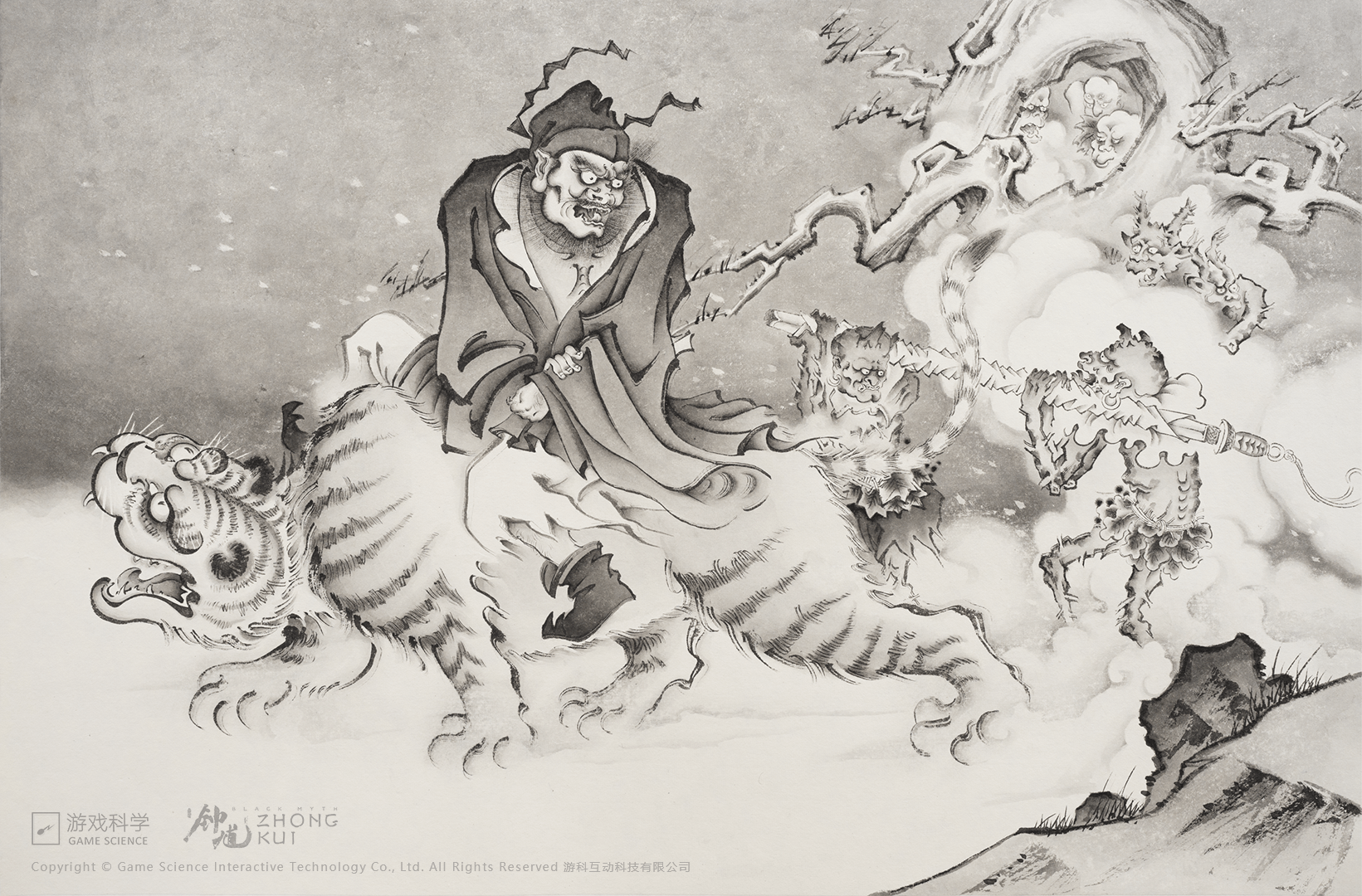
The Tiger Mount — Why Not a Baize?
Game Science's choice of mount for Zhong Kui is a tiger, and the more you think about it, the more deliberate it feels. The obvious candidate would have been the Baize — a mythical beast that knows the true nature of every demon and spirit in existence. A Baize mount for a ghost-hunting god would be narratively tidy.
But Game Science went with the tiger. In Chinese cosmology, the tiger is the embodiment of lethal force. The White Tiger governs the western celestial quadrant and presides over warfare and destruction. In folk practice, tiger imagery is used specifically to counter ghosts — children wear tiger-head hats and tiger-head shoes because tigers kill spirits, not outsmart them. The Baize represents wisdom; the tiger represents violence. If Wukong's journey was about the cleverness needed to defy fate, Zhong Kui's journey is about the courage needed to face the darkness inside yourself — not through cleverness, but through the willingness to strike without hesitation.
Six Words That Reveal Everything
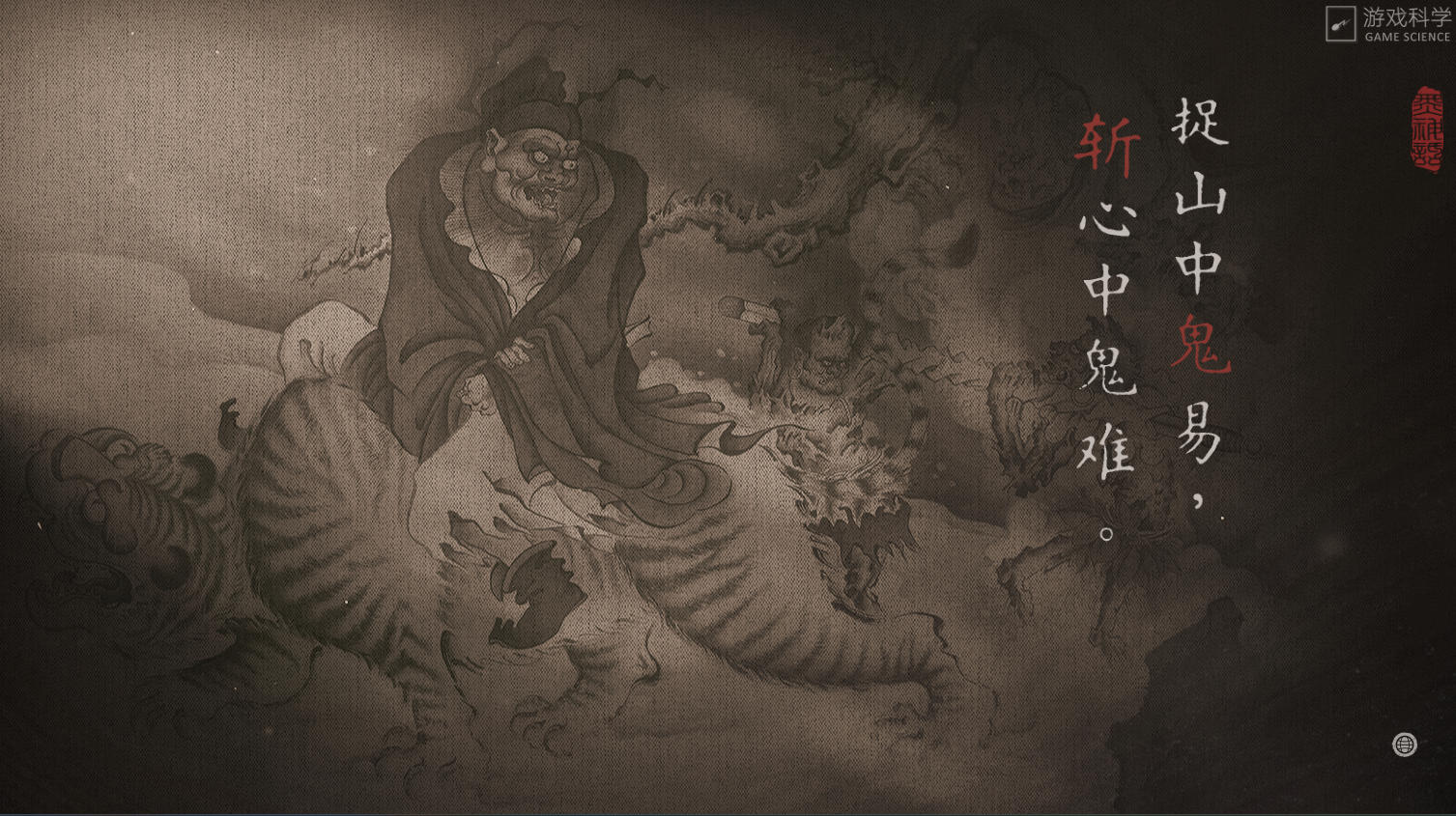
The Chinese tagline runs six characters: "Outer ghosts are easy to banish; inner ghosts are hard to subdue." The parallel structure compresses an enormous amount of meaning into a tiny space. "Outer ghosts" are the tangible demons you can cut down with a sword or seal with a talisman. "Inner ghosts" work on two levels: the darkness within the protagonist himself, and the demons hiding among ordinary people, wearing human faces.
The English rendering handles the duality with real craft. "Light" does double duty as "easy" and as "illumination." "Burn deep" suggests something consuming you from the inside, forming a direct counterpoint to the surface brightness of "light." The two versions are not translations of each other — they are parallel compositions, each exploiting the possibilities of its own language.
Zhong Kui's origin story makes this tagline cut deeper. In folk tradition, he was a brilliant scholar who killed himself after being denied his rightful position at court due to his grotesque appearance. The emperor later granted him the title of Ghost-Catching Judge as posthumous compensation. A man who died from injustice now hunts demons for a living — and the question the teaser forces you to ask is whether he is hunting ghosts at all, or chasing the one ghost he can never catch: his own unresolved rage. Game Science proved with Wukong that they can handle the existential weight of a mythological hero's identity crisis. With Zhong Kui, they are reaching for something rawer. A ghost catcher who cannot stop being haunted by himself is not a power fantasy — it is a tragedy wearing action-game clothing.
Three concept paintings and one sentence. Not a single frame of gameplay. And somehow that is enough to keep an entire community theorizing for a year straight.