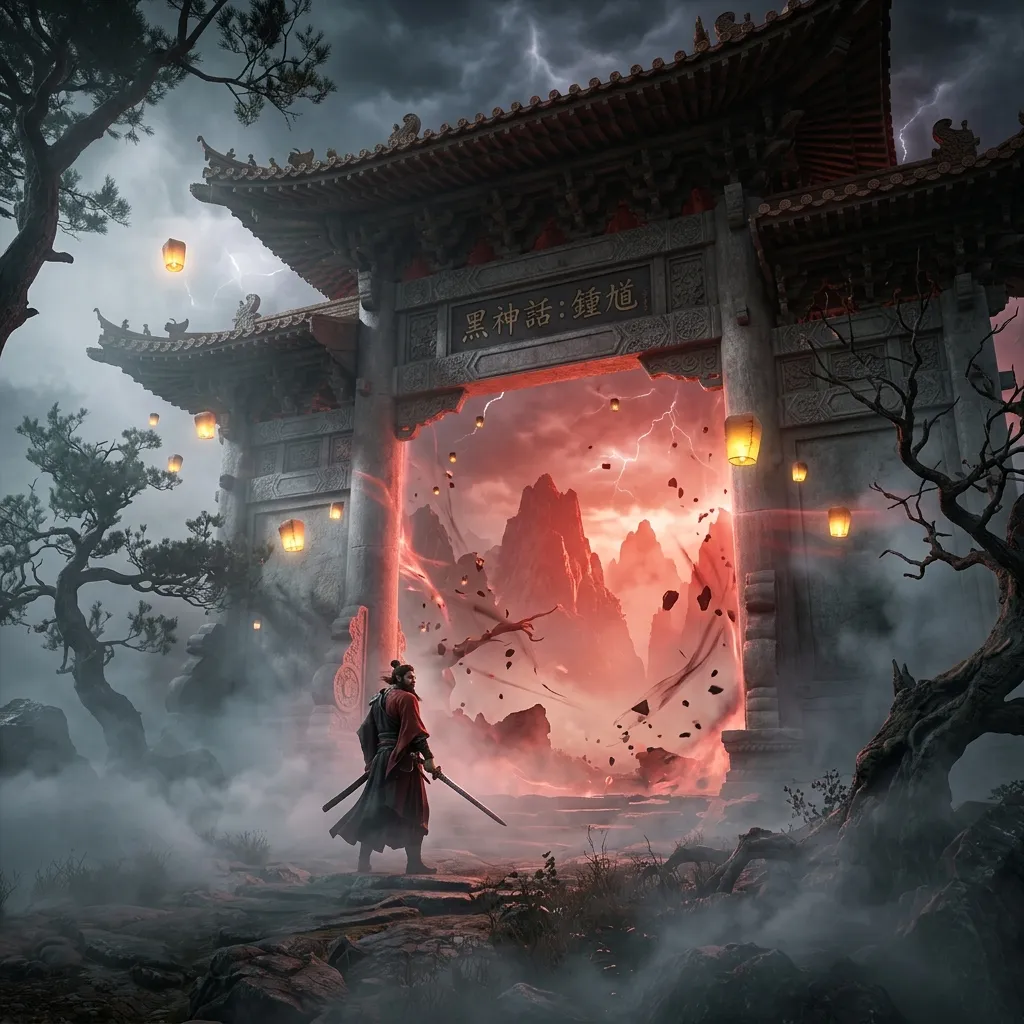
Zhong Kui is arguably the most recognizable demon-quelling deity in all of Chinese folk religion. For over a thousand years, his fearsome image — glowering eyes beneath a bristling beard, robed in blue, a sword forever drawn — has watched over doorways and family shrines across the Chinese-speaking world. Yet the universe that surrounds this "True Lord Who Repels Demons" (Qu Mo Zhen Jun, 驱魔真君) runs far deeper than anything a New Year's print could capture. It stretches from a Tang emperor's fever dream all the way down to the bureaucratic labyrinths of the Chinese Underworld, and from a scholar's tragic suicide on the palace steps to a sprawling bestiary of ghosts that double as mirrors of human vice.
How might Game Science mine these narrative veins? And what kind of world might they build around the tantalizing tagline, "External ghosts are easy to banish; inner demons are hard to subdue"? This article undertakes a systematic analysis of Zhong Kui's mythological tradition and its game-adaptation potential. An important caveat: because the project is in extremely early development, everything below — except where explicitly labeled as official — is reasoned speculation grounded in established myth and publicly available clues.
The Game-Adaptation Potential of Zhong Kui's Mythology
A Dual Identity: Between Human and Ghost
The single most compelling narrative asset in the Zhong Kui legend is the protagonist's layered identity. In the most influential version of the origin story — recorded in early Ming compilations drawing on Tang and Song oral traditions — Zhong Kui was a brilliant scholar from Zhongnan Mountain who earned the top score in the imperial examinations, only to be stripped of his zhuangyuan (狀元, first-place laureate) title by the emperor simply because of his repulsive appearance. In fury and shame, he dashed his head against the palace steps and died. The underworld bureaucracy, recognizing the injustice, posthumously enfeoffed him as the "True Lord Who Repels Demons," granting him authority to patrol the boundary between the living and the dead at the head of eighty thousand ghost soldiers (Johnson, 1989, The Ghost Festival in Medieval China).
This tripartite identity — mortal scholar, wronged ghost, and deified protector — maps almost perfectly onto the kind of layered protagonist that modern action-RPGs favor. He hunts ghosts, yet he himself is a ghost. He guards the human realm, yet he harbors its deepest grievance. Compared to Wukong, whose arc centers on rebellion and liberation, Zhong Kui's core conflict runs in a more introspective direction: how does a person rejected by the world find the will to defend it? That question aligns precisely with the theme of "inner demons."
Eighty Thousand Ghost Soldiers: An Infinite Enemy Design Pipeline
The tradition that Zhong Kui commands eighty thousand ghost troops is not merely a colorful detail — it is, from a game-design perspective, a virtually limitless bestiary. Daoist demonology and Chinese folk tradition classify the dead into dozens of categories: the hanged ghost (diaosi gui, 吊死鬼), the drowned ghost (shui gui, 水鬼), the vengeful ghost (yuan gui, 冤鬼), the starving ghost (e gui, 餓鬼), and many more, each with its own behavioral patterns, taboos, and vulnerabilities (Teiser, 1994, The Scripture on the Ten Kings and the Making of Purgatory).
Even richer is the literary tradition of Liu Zhang's (刘璋) Zhan Gui Zhuan (斬鬼傳, "The Tale of Ghost-Slaying"), a Qing-era novel in which the "ghosts" Zhong Kui hunts are not literal spirits but personifications of human failings — the Liar, the Lecher, the Gambler, the Miser, the Snob. Should Game Science draw on this tradition, the result would be enemy encounters that are mechanically diverse and thematically resonant at the same time.
The Narrative Heart: "External Ghosts Are Easy to Banish; Inner Demons Are Hard to Subdue"
Three Layers of Interpretation
The game's tagline — "外鬼易除,内鬼难伏" (wai gui yi chu, nei gui nan fu) — invites interpretation on at least three levels:
Layer One — The Character Level: As the True Lord Who Repels Demons, dispatching external threats is Zhong Kui's professional forte. But confronting his own unresolved trauma — the injustice, the self-loathing, the bitterness — may be the real trial. Has the resentment he carries become an "inner ghost" of its own?
Layer Two — The Thematic Level: The game may advance a philosophical proposition familiar from both Buddhist psychology and Daoist inner alchemy: the true demons are not external specters but the greed, jealousy, and fear that fester inside every human heart. This reading dovetails perfectly with Liu Zhang's technique of allegorical ghost-slaying, where each slain "ghost" represents a conquered vice.
Layer Three — The Plot Level: "Inner ghost" (nei gui, 内鬼) could also be a concrete narrative concept — a character who appears as an ally or companion but is secretly working against the protagonist. Plot twists of this kind are common enough in game storytelling, but layered atop Zhong Kui's mythology they would carry a distinctly Chinese cultural charge.
A Narrative Pivot from Black Myth: Wukong
Where Black Myth: Wukong followed a "Destined One" on an outward journey of rebellion and self-discovery, a Zhong Kui game built around the "inner demon" thesis would turn the camera inward — darker, more psychological, more preoccupied with what lurks beneath the surface. This shift aligns with the stylistic move Yang Qi (Game Science's art director) has described as "from gods and demons to strange tales" (从神魔到志怪). The classical shenmo xiaoshuo (god-demon novel) tradition, exemplified by Journey to the West, concerns itself with the conquest of external obstacles — the eighty-one tribulations on the road to India. The zhiguai (志怪, "accounts of the strange") tradition, by contrast, is fascinated by the uncanny and the invisible, by the fear that the real monster may be the one looking back from the mirror.
The Mythological Framework: What the Underworld Might Look Like
The Chinese Hell — A Bureaucratic Labyrinth
Zhong Kui's established role as a wanderer between Hell and the mortal realm makes it almost certain that the Underworld (Diyu, 地獄) will be a core setting. Traditional Chinese cosmology imagines the afterlife as a vast, rigorously hierarchical bureaucracy (Eberhard, 1967, Guilt and Sin in Traditional China):
- The Ten Kings of Hell (Shi Dian Yanluo, 十殿閻羅): Ten magistrates, each presiding over a separate court, judging a different category of deceased souls. From King Qinguang of the First Court to King Zhuanlun of the Tenth, each ruler possesses a distinct method of judgment and a unique domain.
- The Five Ghost Emperors (Wu Fang Gui Di, 五方鬼帝): Sovereign guardians of the five cardinal directions within the ghost realm, each commanding spirits associated with a specific quadrant.
- Magistrates and Enforcers (Pan Guan and Gui Chai, 判官與鬼差): The administrative machinery of the Underworld, including the celebrated Judge Cui, the Black and White Impermanence (Hei Bai Wuchang, 黑白無常), and Ox-Head and Horse-Face (Niu Tou Ma Mian, 牛頭馬面).
- The Eighteen Levels of Hell (Shi Ba Ceng Diyu, 十八層地獄): Punitive zones calibrated to the severity of each soul's transgressions.
If Game Science renders this system in full, players could find themselves navigating a subterranean world of staggering scale — with each King's court serving as a major boss encounter or narrative hub, and the Eighteen Levels functioning as progressively deeper dungeon tiers.
The Border Between the Living and the Dead
Another hallmark of Zhong Kui's legend is his ability to pass freely between the mortal world and the Underworld. This almost certainly suggests a dual-world mechanic: players might shift between the yang (陽, living) realm and the yin (陰, ghostly) realm, each governed by different physics, different enemies, and different rules of engagement.
In Chinese folk belief, the membrane between the two realms is thinnest in liminal spaces — abandoned temples, unmarked graves, crossroads, dried-up wells. These locations, already loaded with atmospheric potential, could serve as traversal points in the game. Playing as Zhong Kui, who sees both worlds simultaneously, would grant the player a distinctive "dual-vision" perspective absent from most dark-fantasy titles.
A Shared Universe with Black Myth: Wukong?
Connected Worlds or Common Roots?
The official FAQ states that Black Myth: Zhong Kui and Black Myth: Wukong share "the same foundation of ancient Chinese mythology and folk legend." Does this imply a shared fictional universe?
Strictly speaking, Zhong Kui does not appear in Wu Cheng'en's Journey to the West (Xi You Ji, 西遊記). However, the novel's tenth chapter contains a vivid sequence in which Emperor Taizong of Tang tours the Underworld, complete with detailed descriptions of the Ten Kings' courts and the River of Forgetfulness. If Game Science were building a connected universe, Wukong's own Underworld excursion — where he crossed out his name from the Register of the Dead — could overlap with Zhong Kui's jurisdiction.
The more probable scenario, however, is that the two games share cultural DNA and brand identity while telling independent stories. As the studio put it: "Let us first move ourselves, and then we will serve it to you."
Brand-Level Unification
From a brand-strategy standpoint, several signals point toward an overarching Black Myth franchise: the social-media handle was renamed from "Black Myth: Wukong" to simply "Black Myth," and official communications have promised to "ensure Wukong players feel right at home." This unified brand posture suggests cross-title worldbuilding touches — Easter eggs, visual callbacks, perhaps shared lore — even if the games occupy separate narrative tracks.
Zhan Gui Zhuan as a Possible Narrative Scaffold
The Structure of Liu Zhang's "Ghost-Slaying Tale"
Of all the literary sources available to Game Science, the Qing-dynasty novel Zhan Gui Zhuan (Zhan Gui Zhuan, 斬鬼傳) by Liu Zhang may be the single most relevant. Written in chapter-based (zhanghui, 章回) form, it follows Zhong Kui — newly enfeoffed as the "Great God Who Exterminates Demons" — as he tours the mortal world accompanied by two lieutenants, Han Yuan (含冤, "Harboring Grievance") and Fu Qu (负屈, "Carrying Injustice"), plus a bat-spirit transformed into a Fortune General. Together they hunt down a rogues' gallery of allegorical ghosts, each embodying a specific human weakness: deceit, lust, gambling, miserliness, snobbery, and more.
This "ghosts-as-human-vices" conceit resonates powerfully with the tagline "external ghosts are easy to banish; inner demons are hard to subdue" — because every ghost Zhong Kui faces is, symbolically, an inner demon made flesh.
How It Might Translate into Gameplay
If Game Science uses Zhan Gui Zhuan as a narrative blueprint, several design patterns suggest themselves:
- Each category of "ghost" could anchor a self-contained level or boss encounter, with its own visual identity, combat mechanics, and moral parable.
- The backstory of each ghost could unfold through environmental storytelling, revealing a cautionary tale about the human failing it personifies.
- The final "boss ghost" may not be an external adversary at all, but Zhong Kui's own inner demon — a confrontation with the rage and self-hatred he has carried since the palace steps.
- Han Yuan, Fu Qu, and the bat-spirit Fortune General could appear as companion characters, assist mechanisms, or narrative foils.
Naturally, all of this remains speculative. Game Science has earned a reputation for bold reinterpretation — their treatment of Journey to the West was anything but conventional — and their reading of Zhong Kui's legend may surprise everyone.
From a talisman brushed onto a doorframe to a ghost king striding across the boundary between life and death, the Zhong Kui myth has been reshaped and enriched for over a millennium. Now that task passes to Game Science. Their challenge is not merely to convert folklore into game narrative but to use the riddle of "inner demons" to redefine what an ancient myth can mean in a modern medium. In that sense, every storyteller who has ever shaped the Zhong Kui legend — from Liu Zhang to the Tang-dynasty painter Wu Daozi, from anonymous New Year's printmakers to the designers at Game Science — is a ferryman on the same long river of narrative.
References
- Eberhard, W. (1967). Guilt and Sin in Traditional China. University of California Press.
- Johnson, D. (1989). "The Ghost Festival in Medieval China." Princeton University Press.
- Teiser, S. F. (1994). The Scripture on the Ten Kings and the Making of Purgatory in Medieval Chinese Buddhism. University of Hawaii Press.
- Liu Zhang (刘璋). Zhan Gui Zhuan (斬鬼傳). Qing Dynasty.
- Wu Cheng'en (吴承恩). Journey to the West (Xi You Ji, 西遊記). Ming Dynasty.