Every year on the fifth day of the fifth lunar month, China celebrates Duanwu — the Dragon Boat Festival. Most people know it for dragon boat races, zongzi rice dumplings, and the poet Qu Yuan. But woven through centuries of tradition is a deeper, darker thread: the ritual expulsion of evil.
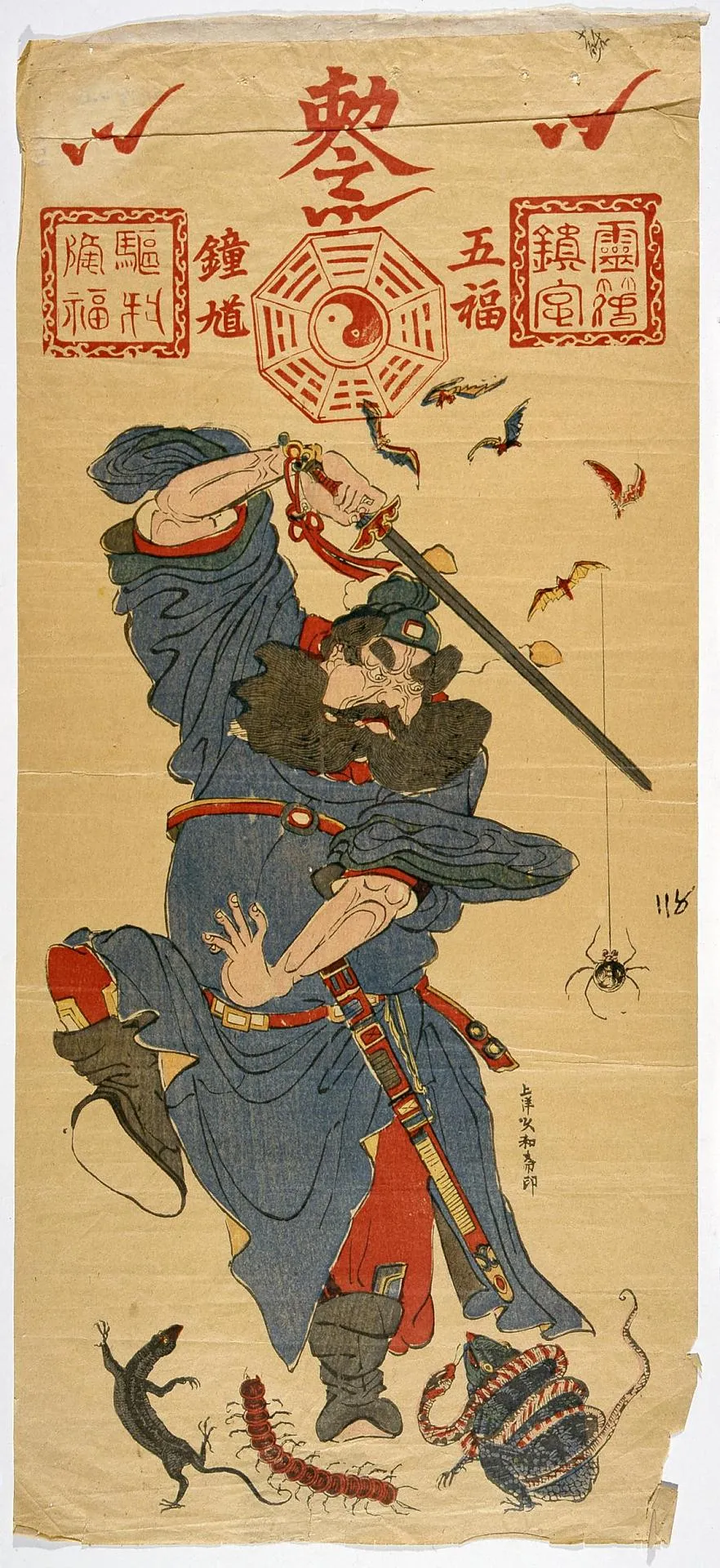
Of all the protective measures tied to this festival, one stands above the rest — hanging a painting of Zhong Kui, the Ghost Catcher. According to Fucha Dunchong's Yanjing Suishiji (Records of Beijing Yearly Customs), an Qing-era gazetteer: "When the Duanwu Festival arrives, the shops sell paintings on yellow paper stamped with vermilion seals — images of the Celestial Master, of Zhong Kui, or talismans against the Five Poisonous Creatures. The people of the capital rush to buy them and paste them on their central doors to ward off evil."
This was no fringe superstition. For over a thousand years, families across China treated Zhong Kui's image as a household necessity during the fifth month. How did a scholar-turned-demon-hunter become so tightly bound to this festival? The answer lies in ancient Chinese attitudes toward a month they considered genuinely dangerous.
The Poisonous Month: Why the Fifth Lunar Month Needed a Protector
To understand why Zhong Kui became the patron spirit of Duanwu, you first need to understand why the fifth lunar month terrified people in the first place.
The "Toxic Month" in Chinese Cosmology
In traditional Chinese belief, the fifth lunar month earned the grim titles of "Poisonous Month" (毒月, Duyue) and "Evil Month" (恶月, Eyue). The fifth day of the fifth month was the worst of all — the "evil day within the evil month," when malevolent energy reached its annual peak.
This was not pure superstition. It had a basis in lived experience. The fifth lunar month falls in midsummer. The heat arrives suddenly and fiercely. Venomous creatures — snakes, scorpions, centipedes, geckos, and toads, collectively known as the Five Poisons (五毒) — become active. Epidemics and infectious diseases spread fastest during this period. In an era before antibiotics and germ theory, the fifth month really was one of the deadliest times of the year.
Every Duanwu custom — hanging sweet flag (calamus) over doorways, wearing fragrant sachets, drinking realgar wine, tying five-color silk threads around children's wrists — served a single purpose: neutralizing the miasma of the fifth month.
Zhong Kui's Designated Festival
This is where Zhong Kui enters the picture. Among all the spirits in the Chinese pantheon, Zhong Kui holds a special distinction: his ritual observance falls on the Dragon Boat Festival.
This placement was deliberate. In the same way that the Kitchen God presides over the year-end sacrifices and the God of Wealth claims the fifth day of the first month, Zhong Kui was assigned as the Duanwu Festival's专属守护 — its designated protector. The logic was elegant: the month with the heaviest concentration of evil energy required the most powerful evil-suppressing deity.
From New Year's Eve to Duanwu: A Gradual Migration
Zhong Kui was not always a Duanwu figure. During the Tang and Song dynasties, he was far more closely associated with New Year's Eve. The Dunhuang manuscript Chuxi Zhong Kui Qu Nuo Wen (New Year's Eve Zhong Kui Exorcism Text) is a ritual document specifically for year-end ceremonies. Tang dynasty emperors distributed Zhong Kui paintings to their ministers as part of the New Year celebrations.
But by the Ming and Qing periods, Zhong Kui's "home base" had shifted almost entirely to Duanwu. The Ming-era author Shi Xuan recorded in Jiujing Yishi (Remnants of the Old Capital) that "on New Year's Eve within the forbidden palace, every gate received new spring couplets and a silk painting of Zhong Kui." That single line turned out to be one of the last documented cases of New Year's Zhong Kui customs. By the Qing dynasty, hanging Zhong Kui at Duanwu had completely replaced the earlier New Year's tradition.
Why the shift? The most likely explanation is practical. New Year's Eve already had a thick layer of apotropaic customs — spring couplets, firecrackers, staying up all night to guard the household. Duanwu, by contrast, sat at the peak of the "Poisonous Month" with a more urgent and specific need for supernatural protection. Zhong Kui was simply reassigned to where his services were needed most.
Hanging Zhong Kui at Duanwu: A Tradition from Palace to Marketplace
The Ming Imperial Palace: Silk Paintings of the Demon Hunter
The Ming court maintained an official system for displaying Zhong Kui images. Shi Xuan's Jiujing Yishi records that palace artisans produced silk paintings of Zhong Kui for every palace gate during the year-end — not cheap paper prints, but refined works of art rendered on fine fabric. These paintings were replaced annually, as routinely as modern households update their calendars.
This detail reveals something important: by the Ming dynasty, Zhong Kui images had become a standardized "seasonal commodity" within the imperial household, with dedicated production workflows and institutional demand.
Qing Dynasty Literati: The Zhong Kui Salon
By the Qing era, displaying Zhong Kui paintings at Duanwu had evolved from a court ritual into a literary fashion. The Qing scholar Ruan Yuan documented the extraordinary Duanwu gatherings hosted by the Ma brothers — Ma Yueguan and Ma Yuelu — in his Guangling Shishi (Poetic Affairs of Guangling):
"On every Duanwu Festival, their halls, studios, and pavilions were hung with paintings of Zhong Kui. No two were alike. Every painting was by a pre-Ming master — none bore the brush of the current dynasty. It was a magnificent sight."
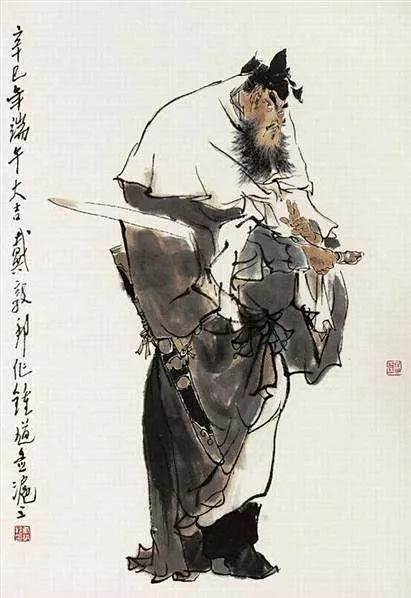
The Ma brothers turned their home into a curated gallery of Zhong Kui art every fifth month. The paintings were all antiques, executed by masters of earlier centuries. The phrase "no two were alike" is telling. Zhong Kui had been painted so many times, in so many styles — glowering with fury, wobbling drunkenly, brandishing a sword with lethal precision, or gazing out with unexpected gentleness — that no single image could contain him.
This variety was the signature of a living, evolving belief. A rigid, formulaic deity would have produced rigid, formulaic paintings. Zhong Kui inspired the opposite.
The Popular Market: Rushing to Buy Protection
If the palace and the literati represented the high end of the Zhong Kui economy, ordinary city dwellers showed its true mass-market scale.
The Yanjing Suishiji described Beijing's Duanwu painting market with vivid detail: shops displayed images of Zhong Kui and the Celestial Master on yellow paper stamped with red seals. Talismans against the Five Poisons hung for sale. Beijing residents "rushed to purchase them" — the Chinese phrase 争相购买 implies competitive, almost frantic buying — and pasted them on their central doors.
This was not optional decoration. It was as essential as buying spring couplets for Chinese New Year. The Zhong Kui trade supported legions of painters, block-cutters, and street vendors, forming an entire seasonal economy that peaked every fifth month.
Zhong Kui Within the Duanwu Protective System
Zhong Kui paintings did not exist in isolation. They were part of a comprehensive, multi-layered defense system against the evils of the fifth month.
The Five Auspicious Plants of Duanwu
The foundation of Duanwu protection rested on the "Five Auspicious Plants of Tianzhong" (天中五瑞):
- Calamus (菖蒲, changpu): Shaped like a sword. Known as "the calamus blade that cuts through a thousand evils."
- Mugwort (艾草, aicao): Symbolized "a hundred blessings." Its strong scent repelled insects.
- Pomegranate blossom (石榴花): The root had insect-repelling properties.
- Garlic (蒜头): Its pungent aroma warded off harmful influences.
- Ixora / dragon boat flower (龙船花): A summer-blooming plant symbolizing vitality and resilience.
Families bundled these plants and hung them over doorways. More ambitious households shaped the mugwort into human figures or tigers — "mugwort people" and "mugwort tigers" — merging protective function with decorative charm.
Where Zhong Kui Fit In
Within this system, Zhong Kui occupied the central position. The arrangement typically followed a clear logic: protective plants hung from the doorframe around the edges, while the Zhong Kui painting was pasted on the door panel itself. The plants formed a perimeter defense; Zhong Kui provided decisive, overwhelming force at the center.
In some regions, a painted image of the Five Auspicious Plants served as a substitute for the actual greenery. This points to a deeper truth: Zhong Kui's image had become so thoroughly symbolic that it could absorb and represent the entire Duanwu protective system in a single visual composition.
Zhong Kui and the Five Poisons
The other major threat of the fifth month was the Five Poisonous Creatures — snakes, scorpions, centipedes, geckos, and toads. People fought back with layered strategies: they painted images of the Five Poisons and stabbed needles through them (symbolically killing them), embroidered Five Poison patterns onto children's clothing ("fighting poison with poison"), or painted the character 王 ("king," representing a tiger) on children's foreheads with realgar wine.
Zhong Kui's role in this fight was distinctive. Needle-stabbing and tiger-head markings were defensive measures — they turned evil back on itself. Zhong Kui was an offensive force. He did not merely block poison at the threshold. He went out, hunted it down, and destroyed it. That主动性 — that willingness to pursue and confront — was what set Zhong Kui apart from every other element in the Duanwu toolkit.
The Artistic Tradition of Duanwu Zhong Kui Paintings
The demand for Zhong Kui images at Duanwu generated one of the most distinctive painting traditions in Chinese art history. From the Tang dynasty onward, virtually every major painter tried his hand at Zhong Kui, making him one of the most frequently depicted figures in the entire Chinese visual canon.
Wu Daozi: The Painter Who Set the Standard
The legendary Tang dynasty painter Wu Daozi is credited as the originator of the Zhong Kui painting tradition. According to the famous story, Emperor Xuanzong dreamed of a fierce, ugly scholar who tore a demon apart and ate it. The next morning, he summoned Wu Daozi and asked him to paint what the emperor had seen. Wu Daozi picked up his brush and produced an image of such terrifying vitality that Xuanzong declared it identical to his dream.
Whether or not the story is historically accurate, Wu Daozi established the visual template that defined Zhong Kui for all subsequent centuries: the bristling beard, the glaring eyes, the tattered blue robe, the broken hat, the drawn sword. Every Zhong Kui painting that followed was, in some sense, a variation on Wu Daozi's original vision.
Gong Kai: Zhongshan Outing — Terror Meets Humor
The Song-Yuan transition painter Gong Kai created one of the most celebrated Zhong Kui compositions in art history: Zhongshan Chunyou Tu (Outing from Mount Zhong), also known as Zhong Kui Gives His Sister in Marriage. The scroll depicts Zhong Kui traveling in a procession with his sister, surrounded by a motley crew of subjugated demons carrying his sword, wine jars, and baggage. Some demons are even carrying smaller demons.
What makes the painting remarkable is its tone. The monsters are simultaneously eerie and comical — their expressions are absurd, their postures animated, their situation ridiculous. You feel uneasy and amused at the same time. Gong Kai's composition launched the "outing" subgenre of Zhong Kui paintings, inspiring countless imitations across subsequent dynasties.
Festival-Specific Zhong Kui Paintings
From the Ming and Qing periods onward, painters developed a specialized genre: Duanwu Zhong Kui paintings created explicitly for the Dragon Boat Festival. These works incorporated Duanwu iconography directly into the composition — bats (a homophone for "fortune" in Chinese), the Five Poisonous Creatures (shown being subdued), calamus and mugwort (establishing the seasonal setting). These paintings served a dual purpose: genuine works of art that were also functional talismans, pasted on household doors to protect the family through the dangerous fifth month.
Two Traditions, One Purpose: Why Zhong Kui and Duanwu Belong Together
The Dragon Boat Festival and Zhong Kui worship began as two independent protective traditions. Duanwu was rooted in temporal defense — performing protective rituals at a specific, dangerous moment in the yearly cycle. Zhong Kui worship was rooted in spiritual defense — relying on a particular deity's power to drive out evil.
When these two systems merged, the result was far more powerful than either could have been alone:
- Duanwu gave Zhong Kui a fixed ritual calendar. Once a year, on the fifth day of the fifth month, every household needed him. This guaranteed his relevance across centuries.
- Zhong Kui gave Duanwu a human face. The festival's protective rituals were no longer abstract actions — "hang mugwort," "drink realgar wine." They became a story: invite the Ghost Catcher into your home.
The deeper logic is psychological. People needed more than a method. They needed a hero. Methods can be replicated mechanically, but heroes inspire emotional investment. When a family pasted a Zhong Kui painting on their door, they were not simply executing a ritual procedure. They were welcoming a trusted guardian — a figure who had suffered injustice in life, yet chose to spend his afterlife protecting the living.
That, perhaps, is the real reason Zhong Kui and the Dragon Boat Festival remained inseparable for a millennium. In a month believed to be saturated with evil, people needed a protector who was both terrifying to demons and deeply sympathetic to human suffering. Zhong Kui — the scholar who was wronged, the ghost king who chose duty over bitterness, the demon hunter whose ugliness concealed an unshakable sense of justice — was the perfect match.
Sources & Further Reading:
- Fucha Dunchong, Yanjing Suishiji (Records of Beijing Yearly Customs) — Qing-era Duanwu painting market
- Shi Xuan, Jiujing Yishi (Remnants of the Old Capital) — Ming palace Zhong Kui silk paintings
- Ruan Yuan, Guangling Shishi, Vol. 7 (Poetic Affairs of Guangling) — Ma brothers' Duanwu Zhong Kui salon
- Shen Kuo, Mengxi Bitan (Dream Pool Essays), Supplement — Emperor Xuanzong's dream of Zhong Kui
- Dunhuang Manuscript: Chuxi Zhong Kui Qu Nuo Wen (New Year's Eve Zhong Kui Exorcism Text) — Tang dynasty ritual text
- Zhang Yue, Xie Ci Zhong Kui Ji Liri Biao (Memorial Thanking the Emperor for Bestowing Zhong Kui Painting and Calendar) — Tang court distribution system
- Liu Yuxi, Wei Li Zhongcheng Xie Zhong Kui Liri Biao (Memorial on Behalf of Regional Inspector Li, Thanking for Zhong Kui Painting and Calendar)
- Gong Kai, Zhongshan Chunyou Tu (Outing from Mount Zhong) — Song-Yuan Zhong Kui painting
- Jiang Nainan, "The Evolution and Cultural Significance of the 'Zhong Kui Marries Off His Sister' Story"
- Zhang Bing and Zhang Yuzhou, "The Development of the Zhong Kui Story as Seen Through the Dunhuang Manuscript 'New Year's Eve Zhong Kui Exorcism Text,'" Dunhuang Research, Issue 1, 2008