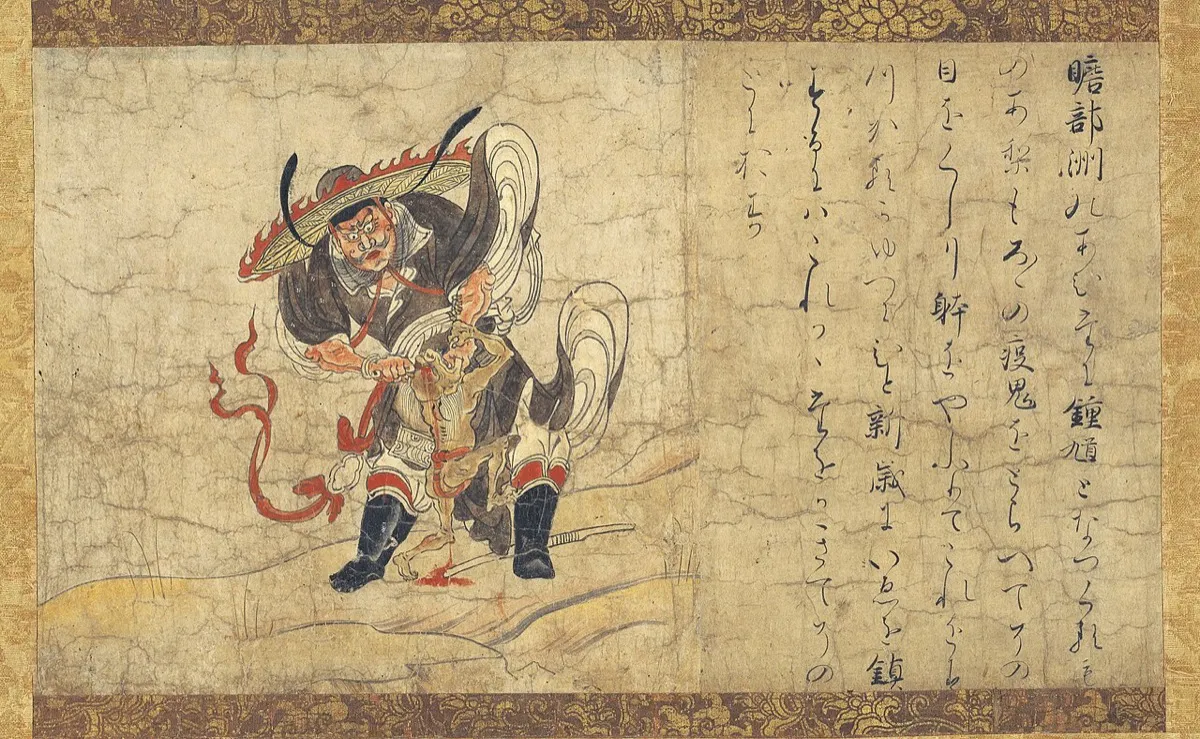
The legend of Zhong Kui spread across the Sinic cultural sphere to Japan, Korea, Vietnam, and beyond. Yet among all these "overseas Zhong Kuis," Japan's version is by far the richest, the strangest, and the most unexpected.
Why unexpected? In China, Zhong Kui is a ghost — a deified one, certainly, but forever bound to the underworld, the netherworld courts, and the business of exorcism. In Japan, however, Zhong Kui (pronounced Shōki in Japanese) was absorbed into the esoteric Onmyodo tradition, mounted on the rooftops of Kyoto townhouses, cast as a regular character in Children's Day dolls, and even became the face of a moth repellent brand. This degree of everyday secular integration outstrips anything the Chinese original ever achieved.
How Zhong Kui Crossed the Sea to Japan
The Earliest Image: A Heian-Era National Treasure
No one can pinpoint the exact date Zhong Kui first arrived in Japan, but one crucial piece of physical evidence survives: a Zhong Kui painting housed in the Hekija-e (Exorcism Paintings) collection at the Nara National Museum. Created sometime between the late Heian and early Kamakura periods — the twelfth century — it stands as the oldest known Zhong Kui image in Japan.
This means that by the 1100s at the latest, visual representations of Zhong Kui had already reached Japanese shores. Given the volume of cultural traffic between Tang-Song China and Japan — diplomatic missions, Buddhist monks crisscrossing the East China Sea, merchant trade routes — it is quite plausible that Zhong Kui arrived during the Tang or Northern Song dynasty alongside other elements of Chinese religion and art.
Three Likely Channels of Transmission
Historians generally point to three probable channels:
Tang Dynasty Missions and Monks. The principal conduit of Sino-Japanese exchange. The story of Emperor Xuanzong dreaming of Zhong Kui had already been widely circulated during the Tang era, making it entirely plausible that monks or envoys carried the tale east.
The Painting Trade. Wu Daozi's iconic Zhong Kui composition had become a standardized visual template by the mid-Tang. Such paintings could easily have traveled with other trade goods to Japanese markets.
Daoist and Onmyodo Texts. Written records casting Zhong Kui as a demon-quelling deity may have been absorbed into Japanese Onmyodo alongside other Daoist canonical works.
The Japanese Shoki Legend: Remarkably Faithful to the Chinese Original
Japan's Version of the "Dream of Zhong Kui"
The Shoki legend as recorded in Japanese sources hews closely to the Chinese account. The story goes like this:
Xuanzong, the sixth emperor of Tang, fell gravely ill with a fever — identified specifically as malaria. In the depths of his delirium, he dreamed that small demons were wreaking havoc in his palace. Suddenly, a massive demon descended from the sky, seized the mischief-makers, and devoured them whole. When the emperor asked his savior's identity, the giant replied: "I am Zhong Kui of Zhongnan County. I failed the imperial examinations during the Wude era and took my own life in shame. But the founding emperor gave me an honorable burial, and I have come to repay that kindness."
This narrative tracks almost perfectly with the version preserved in Shen Kuo's Mengxi Bitan (Dream Pool Essays, 1088). The only minor discrepancies are that the Japanese telling refers to the emperor by his temple name "Xuanzong" rather than the colloquial "Minghuang," and it emphasizes the disease as gyo — the Japanese reading for malaria.
From New Year's Eve to the Double Fifth: A Calendar Shift That Happened in China First
Japanese sources record an important detail about the ritual calendar: from Xuanzong's reign onward, courtiers were given Zhong Kui paintings on New Year's Eve, and families would paste the images on their doors as protective talismans. During the Song dynasty, Zhong Kui paintings appeared in the great Nuo exorcism ceremonies held at year's end. By the late Ming and early Qing, the custom of hanging Zhong Kui images during the Dragon Boat Festival had taken root.
This timeline matters. It demonstrates that the shift from "year-end exorcism" to "Double Fifth plague prevention" was not a Japanese invention — it was a transformation that occurred within China itself. Japan simply inherited both calendar nodes intact.
Shoki Traditions Unique to Japan
The Rooftop Zhong Kui: Guardian of Kyoto's Townhouses
This is the most singular and captivating dimension of Japanese Zhong Kui culture.
Walk through the historic streets of Kyoto — or anywhere across the Kinki and Chubu regions — and you may spot small clay figures, ten to twenty centimeters tall, perched on the eaves of traditional kyomachiya townhouses. These are Shoki statues, and their origin is explained by a vivid local legend:
Once upon a time, a pharmacy on Sanjo Street in Kyoto installed an elaborate oni-gawara — a demon-faced ridge-end tile — on its roof. Soon after, the family living across the street fell mysteriously and gravely ill. People concluded that the oni-gawara was bouncing malicious energy back across the street and into the neighbor's home. Someone commissioned a figure of Zhong Kui — a being more powerful than any demon — and placed it on the ailing family's roof. The illness vanished.
From that incident, the custom of installing Shoki figures on rooftops spread throughout Kyoto and beyond. The cultural logic is telling: in Japanese folk belief, Zhong Kui is stronger than demons. He exists specifically to counter the power of oni — and in the Japanese context, oni are not merely ghosts of the dead but a category of fearsome supernatural creature closer to yokai. Zhong Kui's protective function was thereby upgraded to an even more potent form of exorcism.
Shoki as a Children's Day Doll
By the late Edo period — the nineteenth century — the Kanto region had begun incorporating Shoki into the tradition of Gogatsu Ningyo, the warrior dolls displayed for the Boys' Festival on the fifth day of the fifth month. These dolls typically depict armored samurai heroes, embodying courage and martial virtue. Shoki's inclusion in their ranks signals that he had achieved the same cultural stature as Japan's legendary warriors.
The contrast with China is revealing. Chinese families hang Zhong Kui paintings for the Dragon Boat Festival; Japanese families display Zhong Kui dolls. The medium differs, but the function is identical — plague prevention and demon deterrence at the height of summer.
Shoki Shrine: Japan's First Dedicated Zhong Kui Sanctuary
In December 2013, within the grounds of the Wakamiya Hachimangu shrine in Kyoto's Higashiyama district, Japan's very first Shoki Shrine was formally consecrated. The event marked the moment when Zhong Kui graduated from "folk apotropaic symbol" to "official Shinto institution."
Zhong Kui in the Onmyodo Pantheon
In Japan, Zhong Kui was classified among the exorcism deities of Onmyodo — a distinctly Japanese religious system that fused Chinese yin-yang and five-elements cosmology with native Shinto practice. Within the Onmyodo framework, Shoki was believed capable of overcoming Hoso-gami, the deity of smallpox. This meant that in the Japanese belief system, Zhong Kui was not merely a ghost catcher but a divine countermeasure against epidemic disease — a medical as well as spiritual function.
The Painting Tradition: From Copying to Creation
The Muromachi Shoki Boom
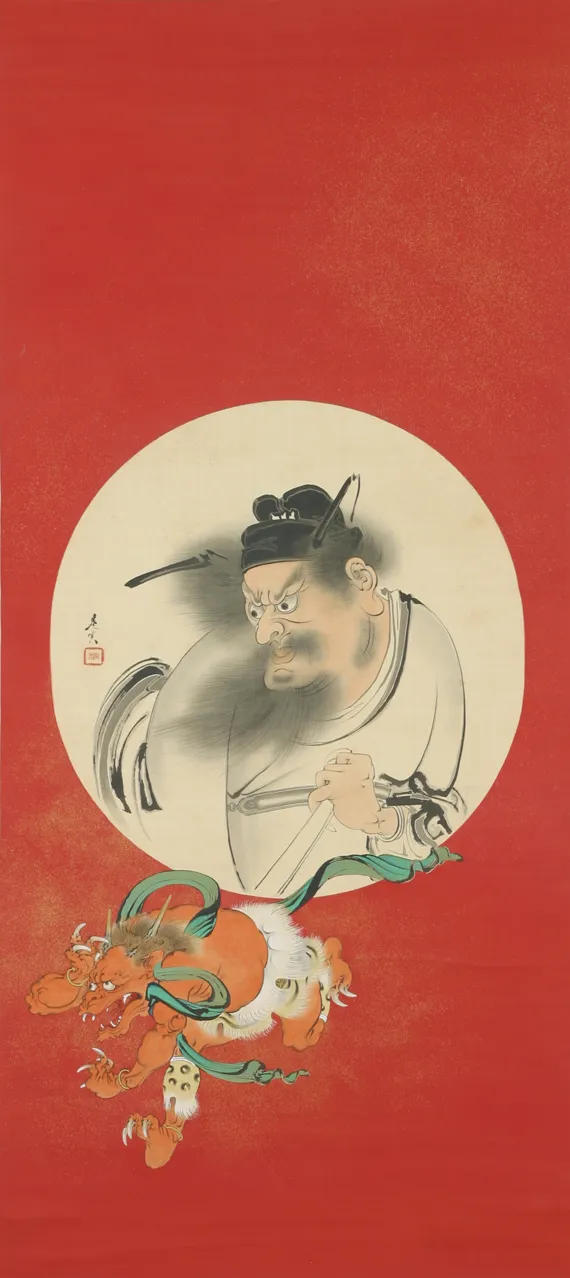
From the Muromachi period (1336–1573) onward, Zhong Kui became a major subject in Kanga — Japanese painting in the Chinese style. Early works largely reproduced Chinese compositional models, but over time Japanese artists developed a distinctive Shoki iconography of their own.
Masterpieces of Japanese Shoki Painting
The Japanese art-historical record includes a remarkable number of Shoki-themed works:
- Katsushika Hokusai — Shoki Riding a Lion. The great ukiyo-e master depicted Shoki astride a lion rather than the traditional tiger or the mythical baise beast.
- Tsukioka Yoshitoshi — Shoki Catching a Demon in a Dream, from the series Shinkei Sanjurokkasen (New Forms of Thirty-Six Ghosts). Yoshitoshi recreated Xuanzong's famous dream with hallucinatory intensity.
- Kawanabe Kyosai — Shoki. A bold, vigorous treatment by the Meiji-era master.
- Okumura Masanobu — Portrait of Shoki. An early example of Edo-period ukiyo-e treatment.
- Dai Jin (Chinese painter, but his work circulated widely in Japan) — Shoki Coming Down from the Mountain, fifteenth century.
Diversification of the Image
Early Japanese Shoki paintings relied heavily on Wu Daozi's compositional template. But as narrative versions of the Zhong Kui story — such as the Ming-era novel Zhong Kui Quanzhuan (Complete Tales of Zhong Kui) — gained popularity, visual variations multiplied: Shoki on horseback, Shoki surrounded by auspicious symbols, Shoki in dynamic combat poses. These images spread across East Asia alongside plague-prevention customs.
Japanese painters, while inheriting the Chinese visual tradition, created numerous localized variants — Shoki paired with Japanese yokai, Shoki wearing Japanese armor, and other imaginative hybrids.
Zhong Kui's Name in Japanese History
"The Shoki of Echigo": Saito Tomonobu
During the Sengoku period, the renowned warlord Saito Tomonobu earned the nickname "Echigo no Shoki." The implication was clear: like Zhong Kui, Tomonobu was fiercely upright, incorruptible, and implacable toward evil. The fact that a Chinese demon-quelling deity could serve as a flattering descriptor for a Japanese samurai is itself proof of how deeply the Shoki figure had been absorbed into Japanese culture.
Shoki Battle Standards: Honda Tadakatsu and Maeda Toshiie
Two of the most celebrated generals of the Sengoku era — Honda Tadakatsu and Maeda Toshiie — both used Shoki imagery on their battle standards and jinbaori surcoats. To fly a Zhong Kui banner in combat was to invoke exorcism and certain victory. Here Shoki had shed every trace of his Chinese association with the underworld and become a pure emblem of triumph and supernatural protection.
The Type 2 Fighter "Shoki"
During World War II, the Imperial Japanese Army's Ki-44 single-seat fighter aircraft was officially designated "Shoki." Naming a warplane after a demon slayer carried an obvious symbolism: shooting down enemy aircraft was tantamount to vanquishing demons. This remains the most extreme militarization of the Zhong Kui symbol in modern history.
Zhong Kui in Contemporary Japan
Fujisawa Camphor: A 127-Year-Old Shoki Brand
In 1897, the Meiji-era product Fujisawa Shono (Fujisawa Camphor) — a moth repellent for clothing — launched with Shoki as its trademark. The product is still on sale today. Shoki's image has been the brand's face for over 127 consecutive years. In China, Zhong Kui exorcises ghosts. In Japan, he exorcises moths. It is a brilliant piece of cultural translation.
Iwami Kagura: Shoki as Living Performance
Iwami Kagura, the sacred dance-drama tradition of Shimane Prefecture, includes "Shoki" among its signature repertoire pieces. This means Zhong Kui is not merely a static image or a written legend — he is a living, breathing performance art in contemporary Japan, echoing China's own Tiao Zhong Kui Nuo opera tradition.
Shoki Temple and the Shoki Orchid
- Shoki-ji — A Buddhist temple in Matsuyama, Ehime Prefecture, that enshrines Zhong Kui as its principal deity. This represents Buddhism's absorption of the Zhong Kui cult.
- Shokiran (Calanthe reflexa) — A species of orchid whose flower bears an uncanny resemblance to Zhong Kui wearing a black lacquered cap. The demon queller's influence has reached into botany itself.
China and Japan Compared: Two Paths for One Demon Queller
| Dimension | Chinese Zhong Kui | Japanese Shoki |
|---|---|---|
| Core Function | Exorcising ghosts, protecting the home | Repelling evil, preventing plague, driving away insects |
| Religious Home | Daoism — titled Cifu Zhenzhai Shengjun (Lord Who Bestows Blessings and Secures the Home) | Onmyodo, Shinto |
| Visual Forms | New Year prints, door paintings, Nuo opera | Rooftop tiles, Children's Day dolls, battle standards |
| Literary Tradition | Zhan Gui Zhuan (Tale of Ghost Slaying), Ping Gui Zhuan (Tale of Pacifying Ghosts), and other novels | No independent novel tradition |
| Degree of Secularization | Moderate — mainly festival customs | Extreme — moth repellent brands, fighter plane nicknames |
| Modern Survival | Nuo opera, Dragon Boat Festival customs | Rooftop figures, Children's Day dolls, Iwami Kagura |
The Chinese Zhong Kui narrative is vast — spanning from Tang dynasty legend through Qing dynasty novels, with an enormous body of literature. Japan's Shoki, by contrast, has far less narrative depth. Yet Japan took Zhong Kui's everyday functional presence to heights the Chinese tradition never reached. He is not only in temples and on stages but on rooftops, on product packaging, and on military hardware.
This may reveal a universal principle of cross-cultural transmission: when a cultural symbol enters a foreign land, it tends to shed its original narrative complexity but acquire entirely new practical applications. Zhong Kui's transformation from "Great Demon Slayer" to "all-purpose anti-evil, anti-insect utility symbol" is a textbook case.
In the winter of 2013, within the quiet precincts of Wakamiya Hachimangu shrine in Kyoto's Higashiyama district, Japan's first Shoki Shrine was quietly consecrated. From a Heian-era exorcism painting to a twenty-first-century Shinto sanctuary, Zhong Kui had spent nearly a millennium completing his naturalization in Japan. The story itself is almost as improbable as his own legend: a scholar who failed his exams and died in shame somehow became a guardian deity revered across the sea for a thousand years.