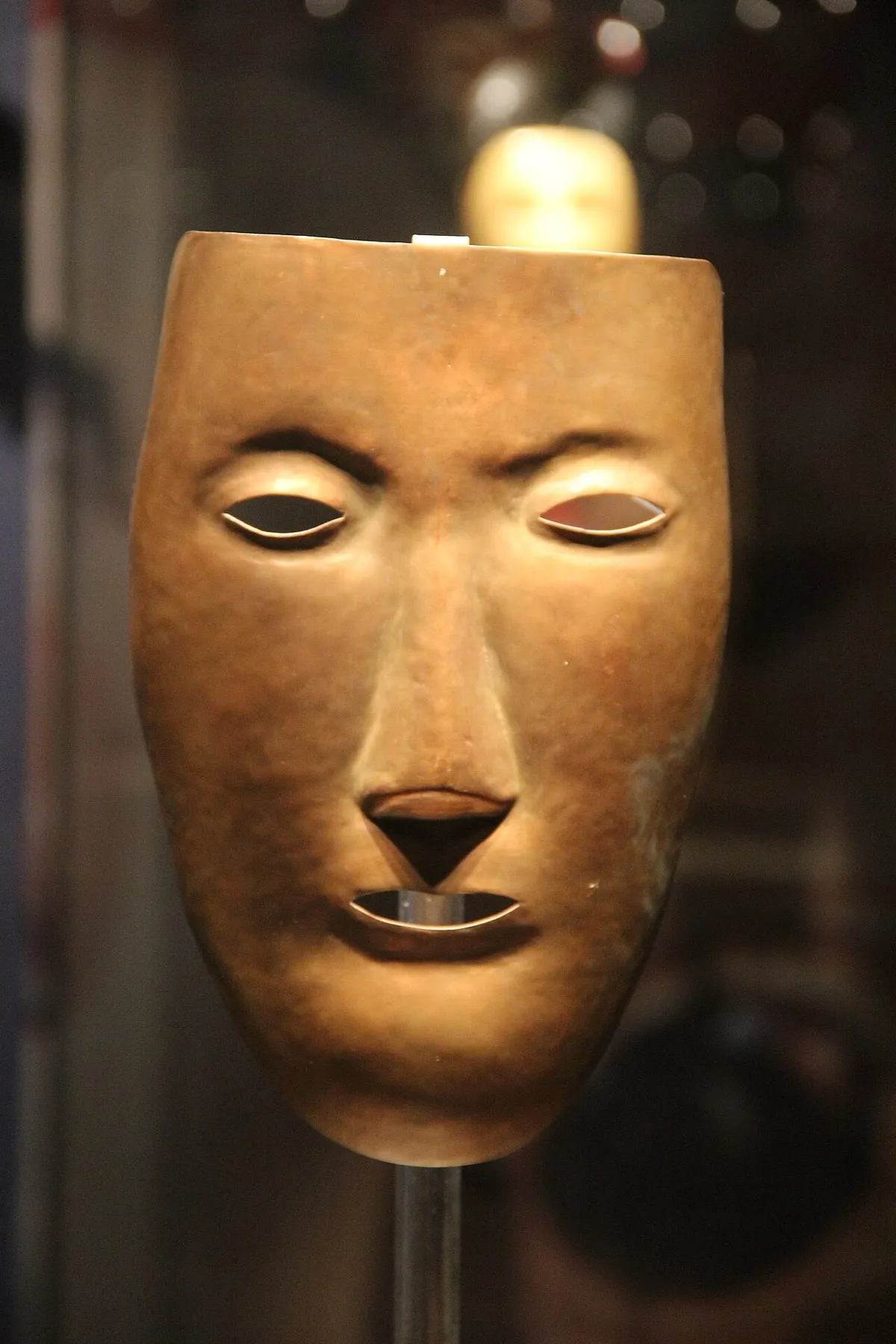
Picture a temple festival in rural Shaanxi Province. A performer bursts into the courtyard wearing a black-and-red official robe, his face hidden behind a ferocious painted mask. He grips a sword and spins in rhythm with thundering drums and firecrackers. Villagers fall silent. They believe that in this exact moment, evil spirits are being driven out.
This is the Dance of Zhong Kui (跳钟馗, Tiao Zhong Kui) — an exorcism ritual that has been performed for at least a thousand years. But it did not emerge from nowhere. Its roots lie in something far older and far grander: Nuo (傩), the most important exorcism ceremony in Chinese history.
For three thousand years, Nuo culture stretched from the royal courts of the Zhou dynasty to the New Year's celebrations of Tang dynasty Chang'an, from the desert caves of Dunhuang to the temple streets of Taiwan. And Zhong Kui — the demon hunter whose name may have evolved from a club-wielding clan — became the ultimate face of this tradition.
What Is Nuo? China's Oldest Exorcism Ritual
The word "Nuo" (pronounced roughly like nwuh) refers to the oldest known system of ritual exorcism in China. Its origins reach back to the Shang dynasty (approximately 1600–1046 BCE), and possibly even earlier.
Clues Etched in Bone
Among the oracle bone inscriptions excavated at the ruins of Yin, the last Shang capital, scholars have found divination records related to Nuo ceremonies. The Shang people lived in deep fear of malevolent spirits. They believed that illness, famine, and military defeat were all caused by invisible demons — and driving those demons away was the central purpose of Nuo.
One particularly striking detail: among the seven surviving Shang clans recorded in later histories was a group called the Zhong Kui Clan (终葵氏). The Zuo Zhuan (Commentary of Zuo), an ancient historical text from the 4th century BCE, explicitly documents this clan's existence. The Qing dynasty scholar Gu Yanwu, in his Rizhi Lu (Record of Daily Knowledge), demonstrated that "Zhong Kui" was actually a phonetic inversion of the word zhui (椎), meaning "club" or "mallet." In other words, the Zhong Kui Clan was literally "the clan that drives out demons with clubs."
This is a remarkable finding. The name Zhong Kui may have originated as the name of a demon-hunting clan, not a person. Over two millennia of linguistic drift, the characters shifted from 终葵 to 钟葵 to 钟馗 — but the core meaning never changed: exorcism.
The Bear-Skinned Exorcist of Zhou
By the Zhou dynasty (approximately 1046–256 BCE), Nuo had evolved into a meticulously orchestrated state ceremony. The official who presided over it was called the Fang Xiang Shi (方相氏), and his costume was designed to terrify:
According to the Zhou Li (Rites of Zhou), one of China's foundational ritual texts, the Fang Xiang Shi wore a full bearskin, a mask fitted with four golden eyes, a black upper garment and red lower garment. He carried a halberd in one hand and a shield in the other, leading over a hundred attendants through the palace halls to hunt down plague demons.
Those four golden eyes deserve attention. A mask with twice the normal number of eyes symbolized supernatural perception — the ability to see invisible demons that ordinary humans could not. When later generations gave Zhong Kui his terrifying "leopard's head and glaring eyes," they were likely continuing this ancient mask tradition.
Confucius Himself Showed Respect
The Analects records a brief but telling moment: when Confucius saw his neighbors performing a Nuo ceremony, he put on his formal court robes and stood respectfully on the eastern steps of his house. For a ritual to make China's most famous philosopher don official attire in reverence, Nuo must have been far more than rustic superstition — it was a ceremony of profound cultural weight.
From Han to Tang: Nuo Becomes a State Spectacle
The Han Dynasty: Hundreds of Children in Procession
By the Han dynasty (202 BCE–220 CE), Nuo ceremonies had grown dramatically in scale. Historical records describe processions of hundreds of boys, their heads wrapped in red cloth, carrying bows made of peach wood and arrows fashioned from thorn branches. They wore bizarre costumes and moved in strange, stomping patterns to drive away evil deities.
The timing was fixed to the end of the twelfth lunar month, the day before the beginning of spring — the liminal moment when the old year turned into the new. The Chinese believed that during this transition, the boundaries between yin and yang grew unstable, and demons could slip through.
The choice of peach wood was deliberate. In ancient Chinese belief, peach possessed innate demon-repelling power — a tradition linked to the myth of the archer Hou Yi, who was said to have been killed by a peach-wood staff. Thorn branches symbolized punishment and the driving out of evil.
Tang Dynasty: The Grand Exorcism of Chang'an
The Tang dynasty (618–907 CE) was the golden age of Nuo. The imperial court held a ceremony called the Great Pursuing Exorcism (追傩大典), which had transcended its religious origins to become the climactic spectacle of the Chang'an New Year.
Court poets left vivid accounts. The exorcism parade marched down the city's main thoroughfare, Zhuque Avenue, led by the Fang Xiang Shi and followed by performers dressed as mythical beasts. Drums shook the earth. The entire city turned out to watch.
And it was during the Tang dynasty that Zhong Kui officially entered the Nuo stage.
The Dunhuang Manuscript That Changed Everything
Among the tens of thousands of manuscripts discovered in the Library Cave at Dunhuang is a document of extraordinary importance: the Chuxi Zhong Kui Qu Nuo Wen (除夕钟馗驱傩文), a text used in New Year's Eve Nuo ceremonies to summon Zhong Kui for exorcism. Written during the Tang dynasty and preserved in the desert for over a millennium, it proves that Zhong Kui was already playing the lead role in Nuo rituals by the Tang era.
This manuscript's significance cannot be overstated. It demonstrates that Zhong Kui was used in rituals before stories about him were invented. The ceremonial Zhong Kui is older than any literary Zhong Kui. The ritual came first; the legends came after.
Imperial Gifts of Zhong Kui Paintings
Complementing the Dunhuang evidence are the thank-you memorials of Tang court officials. The chancellor Zhang Yue wrote a formal Xie Ci Zhong Kui Ji Liri Biao (Memorial Thanking the Emperor for Bestowing a Zhong Kui Painting and a Calendar). The poet-official Liu Yuxi went further, composing two separate memorials of gratitude for Zhong Kui paintings received from the throne.
The emperor distributing Zhong Kui paintings to ministers at year's end was not a personal gesture — it was an established court institution. The paintings were bestowed alongside new calendars, signaling that the imperial government officially recognized Zhong Kui's function as banishing the old, welcoming the new, expelling evil, and inviting fortune — exactly the purpose of Nuo itself.
After the Song Dynasty: From State Ceremony to Folk Performance
The Secularization of Nuo
The Song dynasty (960–1279 CE) marked a watershed in Chinese cultural history. Urban commerce boomed, a middle class emerged, and many solemn religious ceremonies began transforming into popular entertainment. Nuo was no exception.
After the Song, Nuo gradually shed its gravitas as a state ritual and became something closer to a festive folk custom. Historical records describe Song-era New Year's Eve celebrations where people would simply hold up a painting of Zhong Kui and set off firecrackers — the Fang Xiang Shi, the bearskin, the four golden eyes, the hundred attendants, all of those elaborate elements had vanished, replaced by the simplest possible gesture.
On the surface, this looks like decline. But seen differently, it represents Zhong Kui's total absorption of Nuo. Three thousand years of increasingly complex exorcism tradition had been distilled into a single, elegant symbol: Zhong Kui himself.
The Birth of the Dance of Zhong Kui
It was during this period of secularization that the Dance of Zhong Kui emerged as an independent performance form. Scholars trace a three-stage evolution:
- Song dynasty: The dance separated from formal Nuo ceremonies and became a standalone Zhong Kui exorcism performance.
- Ming dynasty: It was absorbed into the Chinese opera tradition, gaining richer storylines and character development.
- Qing dynasty to present: It survived in specific regions as a form of Nuo opera, functioning simultaneously as exorcism ritual and folk art.
The Dance of Zhong Kui Today: A Living Ritual
Today, the Dance of Zhong Kui is practiced primarily in two regions: Huxian County in Shaanxi (the legendary birthplace of Zhong Kui) and the southern areas of Anhui, Minnan (southern Fujian), and Taiwan.
Minnan and Taiwan: Exorcism for the Living
In the folk religion of Minnan and Taiwan, the Dance of Zhong Kui remains a vital, frequently performed ritual. It is called upon in specific situations:
- Sites of accidental death: When someone dies an unnatural death, locals believe a vengeful spirit may linger at the location. A Daoist priest is summoned to perform the Dance of Zhong Kui to purify the site.
- Temple festivals and ghost month ceremonies: During events like the Ghost Festival (Zhongyuan Festival), the dance serves as a protective ritual.
- Moving into a new home: Before settling into a new residence, families invite Zhong Kui to "cleanse the house."
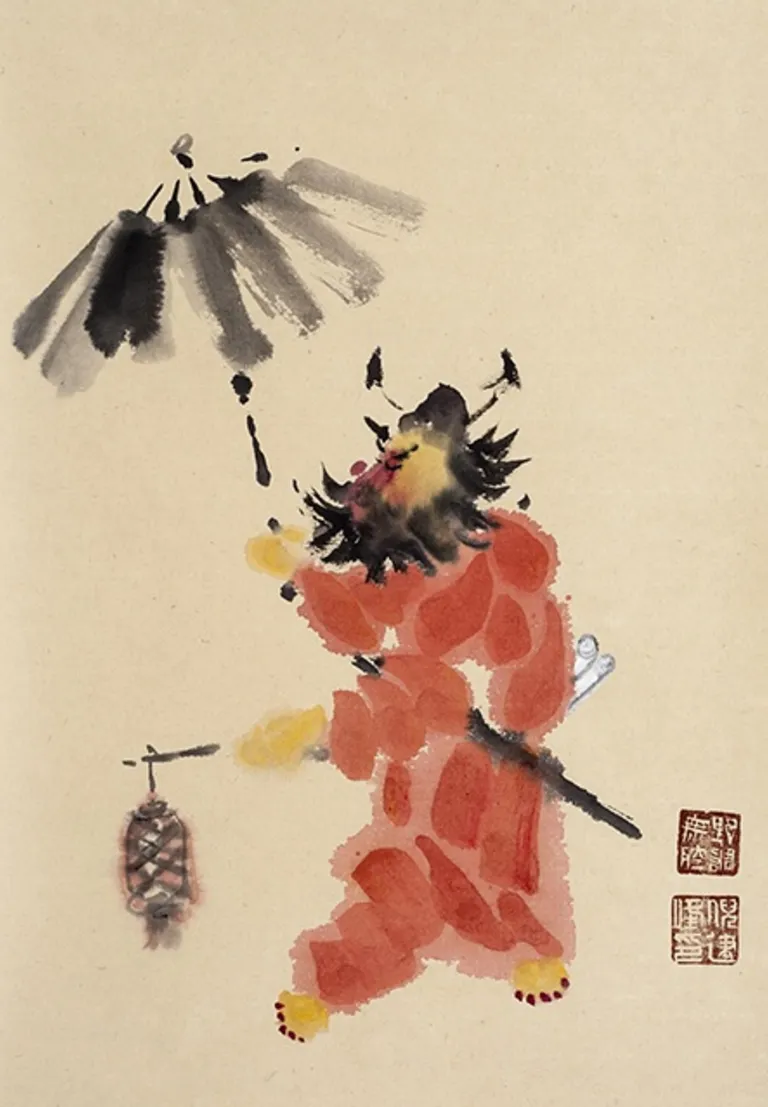
The central performer is a Daoist priest or ritual master dressed as Zhong Kui — flowing black-and-red robe, tangled beard, fierce glare, sword in hand. To the rhythm of gongs and drums, he enacts a choreographed sequence: slashing at invisible demons, stomping to suppress evil, sweeping his gaze across every corner.
In some areas, no human performer is used at all. Instead, a marionette dressed as Zhong Kui is manipulated on strings, its tiny sword cutting through the air. There is something uncanny and beautiful about watching a wooden puppet carry out a ritual that is older than most civilizations.
Huxian County: The Hometown Performance
Huxian County in Shaanxi (now part of Xi'an) is traditionally regarded as Zhong Kui's birthplace, and its Dance of Zhong Kui carries a distinct sense of local pride. Every year during the Dragon Boat Festival and New Year's Eve, local Nuo opera troupes stage large-scale performances that draw tourists, scholars, and filmmakers.
The Huxian version preserves more elements of ancient Nuo: the mask, the rhythmic drumming, the spinning stomps — movements that echo the Zhou Li's description of the Fang Xiang Shi leading his hundred attendants. Three thousand years of history compressed into a single village performance.
Nuo Opera: The Living Fossil of Chinese Theater
Nuo opera (傩戏, Nuo Xi) is the most important living carrier of Nuo culture. In 2006, multiple regional traditions of Nuo opera were inscribed on China's first national intangible cultural heritage list.
What Makes Nuo Opera Unique
Nuo opera evolved from Nuo sacrifices and Nuo dances into a distinctive form of performance that blends religion with art, divine entertainment with human entertainment. It has been passed down through generations in rural China and never fully disappeared.
What sets Nuo opera apart from other theatrical traditions is that it did not begin with scripts. It began with rituals. A single exorcism gesture — swinging a sword — was repeated across centuries until it gradually expanded into a full dramatic sequence: Zhong Kui discovers the demon, pursues it, captures it, and executes it. Religious ceremony spontaneously grew theatrical narrative.
Zhong Kui's Central Role in Nuo Opera
Across the many regional variants of Nuo opera, Zhong Kui is consistently one of the most important characters. He appears in several core repertoire pieces:
- Zhong Kui Catches Ghosts: The foundational drama, depicting the discovery and capture of a malevolent spirit.
- Zhong Kui Marries Off His Sister: The most tender piece in the canon — after his death, Zhong Kui returns with a retinue of ghost soldiers to escort his sister safely to her wedding.
- The Drunken Zhong Kui: A showcase of the character's wild, unrestrained side, adding comic relief.
- Zhong Kui Guards the House: A protective drama performed for new homes or at the turn of the year.
Together, these plays form a complete emotional universe. Catching ghosts is his duty. Marrying off his sister reveals his tenderness. Getting drunk shows his genuine, unguarded personality. Guarding the house is his promise to every household. Through Nuo opera, Zhong Kui ceases to be a cold divine symbol and becomes something more like an old friend.
Where Nuo Opera Survives Today
The major centers of living Nuo opera include:
- Guizhou Province: Dejiang Nuo Hall Opera, Shiqian Puppet Opera
- Jiangxi Province: Nanfeng Nuo Dance, Pingxiang Nuo Mask Carving
- Anhui Province: Guichi Nuo Opera
- Shaanxi Province: Huxian Dance of Zhong Kui
- Fujian and Taiwan: Minnan Dance of Zhong Kui
Each region has its own distinctive style, but Zhong Kui is nearly universal. That fierce, tangled-bearded, sword-wielding figure has become the most recognizable icon in Chinese folk religion — arguably the most successful "brand" in three thousand years of demon-hunting.
Why Zhong Kui? The Logic Behind a Cultural Symbol
The deeper question remains: why Zhong Kui? Nuo culture spanned three millennia and produced countless exorcism deities. Why did this particular figure become the definitive face of Chinese demon-hunting?
The answer may lie in three principles: simplification, personification, and visual power.
Simplification
The journey from the Fang Xiang Shi's bearskin and golden four-eyed mask to the Song dynasty's "just hold up a Zhong Kui painting and light firecrackers" represents a continuous process of reduction. Complex rituals required trained specialists, large crews, and expensive props — sustainable in times of peace, but easily lost during war and migration. A painting of Zhong Kui was the minimal viable product: a single image that could carry the full weight of exorcism belief.
Personification
The Fang Xiang Shi had no name, no backstory, no feelings — it was a mask, a function, a role. Zhong Kui had a name, a biography, a tragic origin, and a righteous vow. People need a god with a personality to form an emotional bond. You will never weep for a four-eyed golden mask, but you might shed a tear for a brilliant scholar denied his rightful place because of his ugliness.
Visual Power
Zhong Kui may be the most visually identifiable deity in the entire Chinese pantheon. Leopard head, glaring eyes, iron-like beard, black robe with red sash, sword in hand — this image was established by the legendary Tang painter Wu Daozi and has remained fundamentally unchanged for over a thousand years. Whether you are a farmer in Shaanxi or a city dweller in Taipei, you know exactly who this is.
Nuo chose Zhong Kui because Zhong Kui was Nuo's perfect interface. Three thousand years of accumulated exorcism belief needed a symbol that was simple, striking, memorable, and easy to传播 — and Zhong Kui fulfilled every requirement.
References:
- Zhou Li (Rites of Zhou), "Xia Guan: Fang Xiang Shi"
- Analects (Lunyu), "Xiang Dang": Confucius observing the Nuo ritual
- Zuo Zhuan (Commentary of Zuo), Duke Ding Year Four — record of the Zhong Kui clan
- Gu Yanwu, Rizhi Lu (Record of Daily Knowledge) — phonetic analysis of Zhong Kui as zhui (club)
- Dunhuang manuscript: Chuxi Zhong Kui Qu Nuo Wen — Tang dynasty ceremonial text
- Zhang Yue, Xie Ci Zhong Kui Ji Liri Biao (Memorial Thanking the Emperor for a Zhong Kui Painting and Calendar)
- Liu Yuxi, Wei Li Zhongcheng Xie Zhong Kui Liri Biao
- Liu Yuxi, Wei Huainan Du Xianggong Xie Zhong Kui Liri Biao
- Zhang Bing & Zhang Yuzhou, "The Development and Evolution of the Zhong Kui Story as Seen from the Dunhuang Manuscript Chuxi Zhong Kui Qu Nuo Wen," Dunhuang Yanjiu (Dunhuang Research), Issue 1, 2008
- Ruan Yuan, Guangling Shishi — record of hanging Zhong Kui paintings at the Dragon Boat Festival
- Fuchad Dun Chong, Yanjing Suishi Ji (Record of Yearly Customs in Beijing)
- Shi Xuan, Jiujing Yishi (Remnants of the Old Capital) — Ming palace New Year's Eve display of Zhong Kui images
- Kang Baocheng, The Origins of Nuo Opera Art, Guangdong Higher Education Press, 2011
- Qu Liuyi & Qian Fu, Introduction to Eastern Nuo Culture, Shanxi Education Publishing House, 2006