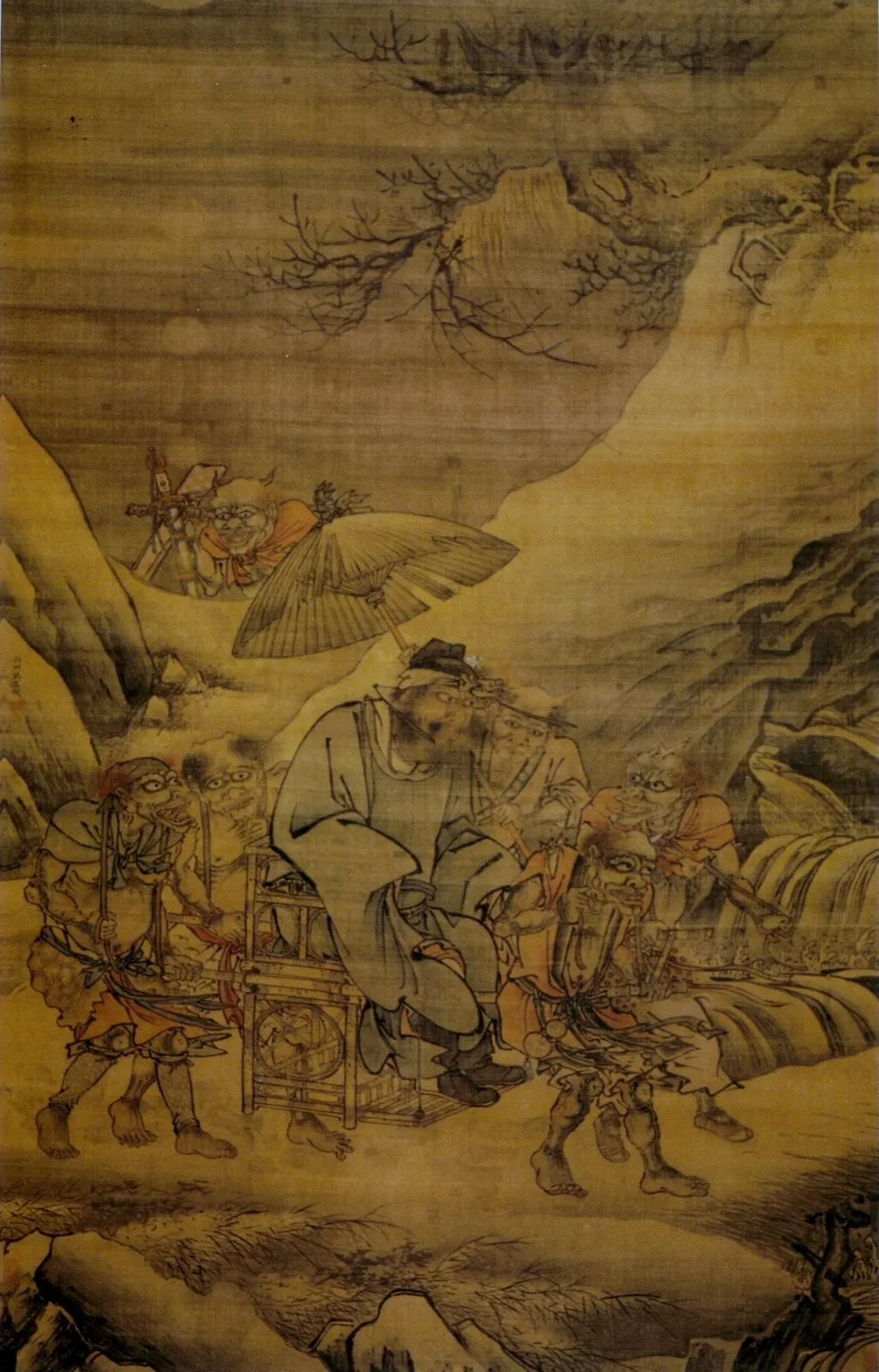
Zhong Kui is arguably the most iconic demon hunter in all of Chinese mythology. With his fierce glaring eyes, wild bristling beard, flowing blue robes, and a demon-slaying sword in hand, he has guarded the doorways of Chinese homes for well over a thousand years. But where does the name "Zhong Kui" actually come from? Was he a real historical figure, or did he emerge from something far stranger — a ritual object, a mushroom, an emperor's fever dream?
The answer is more layered than you might expect. Over the centuries, Zhong Kui's identity has been shaped and reshaped again and again: from a pre-Qin exorcism tool, to a Tang dynasty court painting tradition, to a tragic scholar immortalized in Ming and Qing novels. Scholars have identified at least four distinct origin theories, each backed by classical texts.
This article walks through all four theories, compares their documentary evidence, and reconstructs the full journey of how Zhong Kui went from a blunt wooden club to the King of Ghosts.
1. The Zhong Kui Wand: How a Bludgeon Became a God
The ritual implement theory is the most widely accepted explanation among scholars. It was first laid out by Gu Yanwu (1613–1682), one of the great intellectuals of the Ming-Qing transition, in his encyclopedic work Record of Daily Knowledge (Rizhi Lu). His argument was strikingly simple:
"Zhong Kui is nothing more than a phonetic transformation of the word zhongkui (终葵)."
Gu Yanwu traced "zhongkui" back to a cone-shaped ritual implement used in ancient exorcism ceremonies. The name of this object was later adopted as a personal name, valued for its apotropaic power. He pointed to a passage in the Zuo Zhuan (Commentary of Zuo), under the fourth year of Duke Ding, which records that among the seven clans descended from the Shang dynasty survivors was one called the Zhongkui Clan (终葵氏).
From a linguistic standpoint, "zhongkui" is actually a fanqie — a traditional Chinese spelling-out device — for the word zhui (椎), meaning "mallet" or "club." You take the initial consonant of zhong and the final of kui, and the result is zhui. In other words, the Zhongkui Clan was likely a lineage whose hereditary trade involved wielding clubs to drive away evil spirits.
Over the centuries, "zhongkui" became a byword for supernatural protection. The written characters themselves shifted gradually — from 终葵 to 钟葵 and finally to 钟馗. A name that once denoted a demon-bashing club was, through generations of retelling, ultimately attached to a snarling, heavily bearded deity.
Zhong Kui's visual lineage goes back even further, to the ancient Nuo rituals (傩祭) of early China. Nuo was the oldest known form of Chinese exorcism ceremony. The ritual master wore a grotesque, frightening mask and wielded sacred objects to chase away malicious spirits. Zhong Kui's trademark ferocious visage descends directly from the aesthetics of those Nuo masks.
2. Emperor Xuanzong's Dream: The Most Famous Origin Story
Of all the legends surrounding Zhong Kui, the story of Tang Emperor Xuanzong dreaming of Zhong Kui is by far the best known. It serves as the narrative foundation for virtually every Zhong Kui tale that followed.
The Dream Pool Essays: The Earliest Written Record
The oldest surviving textual reference to Zhong Kui appears in the Dream Pool Essays (Mengxi Bitan), written by the Northern Song polymath Shen Kuo (1031–1095). Shen Kuo described a painting attributed to Wu Daozi, the legendary Tang dynasty painter known as the "Sage of Painting." Attached to the scroll was a colophon from the Tang period that told the following story:
During the Kaiyuan era, Emperor Xuanzong returned to the palace after military exercises at Mount Li and fell gravely ill with malaria. For nearly a month, no physician or shaman could cure him. Then one night, the emperor dreamed of two ghosts — one large, one small. The smaller ghost wore crimson trousers, had one shoe on and one bare foot, and carried a lacquered fan. He had stolen the imperial consort's perfume sachet and the emperor's jade flute, and was sprinting around the palace halls.
The larger ghost wore a cap and blue robes, with one arm bared. He seized the small ghost, gouged out its eyes, tore it apart, and devoured it on the spot. When the emperor asked who he was, the large ghost replied: "I am Zhong Kui, a military examination candidate who failed to win appointment. I have sworn to rid Your Majesty's realm of all evil spirits."
The emperor woke from the dream — and his malaria had vanished, his body stronger than before. He immediately summoned Wu Daozi and asked him to paint the figure from the dream. Wu Daozi set brush to silk as though he could actually see the apparition before him. When he presented the finished work, the emperor stared at it in amazement and said: "You and I shared the same dream — how could the resemblance be this perfect?"
One crucial detail: In Shen Kuo's version, Zhong Kui describes himself as a failed military examination candidate, but there is no mention whatsoever of suicide.
The Lost Tang Anecdotes: The Story Takes Its Classic Shape
By the Ming dynasty, the scholar Chen Yaowen compiled the Tianzhong Ji (Records of the Heavenly Center), in which he quoted a now-lost text called the Tang Yishi (Unofficial Histories of the Tang). This version added several critical elements that completed the classic Zhong Kui narrative:
- The small ghost was given a name — Xuhao (虚耗), meaning "the one who drains fortune and squanders prosperity," a personification of bad luck and loss.
- Zhong Kui's identity was fleshed out: a man from Zhongnan Mountain who sat for the military examinations during the Wude era of Emperor Gaozu (the founding Tang emperor). After failing to pass, he smashed his head against the palace steps in shame and died.
- A new detail was added about imperial grace: after Zhong Kui's death, Emperor Gaozu posthumously granted him a green robe and ordered a proper burial. In gratitude, Zhong Kui swore to exterminate every demon in the Tang empire.
The key difference between the two versions is significant. In the Dream Pool Essays, Zhong Kui is simply a failed military candidate. In the Tang Yishi, the added backstory of suicide and imperial burial explains why Zhong Kui operates in the spirit world — he himself is a ghost who died in grievance, which gives him the power to fight other ghosts on their own turf.
Hard Evidence from Tang Dynasty Court Life
The Zhong Kui legend was not pure invention. There is solid documentary proof that Tang dynasty courts practiced a ritual of distributing Zhong Kui paintings:
- Zhang Yue (667–730), a prominent minister under Emperor Xuanzong, wrote a formal "Memorial of Gratitude for the Bestowal of a Zhong Kui Painting and a Calendar," recording his receipt of both a Zhong Kui portrait and a New Year almanac from the throne.
- The mid-Tang poet Liu Yuxi (772–842) composed two such memorial tables — one on behalf of a military commissioner and another for a duke — proving that the court of Emperor Dezong was still distributing Zhong Kui paintings as part of its year-end exorcism rituals.
- Among the Dunhuang manuscripts discovered in the twentieth century, a Tang-era text titled "Zhong Kui's Exorcism Prayer for New Year's Eve" confirms that Zhong Kui had already become the central figure in the Nuo ceremony conducted on the last night of the year.
These documents establish that by the time of Emperor Xuanzong at the latest, Zhong Kui was already recognized as an exorcism deity across both court and commoner culture. The imperial practice of gifting Zhong Kui portraits to officials at year's end had become an institutionalized ritual.
3. The Tragic Scholar Who Failed the Imperial Exam
The failed scholar theory gives Zhong Kui's backstory its most deeply human dimension. In this telling, he is not some abstract spirit that materialized from nowhere — he was a real person treated unjustly, whose suffering transcended death.
The Demon-Slaying Chronicle: A Story Set in the Reign of Emperor Dezong
In The Demon-Slaying Chronicle (Zhan Gui Zhuan), a novel written by Liu Zhang during the Kangxi era (circa 1703), Zhong Kui's story is placed during the reign of Tang Emperor Dezong. The protagonist is a brilliant scholar of terrifying ugliness. He places at the top of the imperial examination rankings, only to have the emperor strip him of the Zhuangyuan (first scholar) title solely because of his grotesque appearance. Humiliated and enraged, Zhong Kui dashes his brains out on the palace steps.
The novel also features historical figures such as the powerful chancellor Lu Qi and the literary giant Han Yu, who served as vice minister of personnel.
Debunked by Historians
Scholars have thoroughly dismantled this version of events. The chronological problems are fatal:
- Lu Qi died in 785 CE, when Han Yu was just seventeen years old
- Han Yu did not pass his own jinshi examination until 792 CE
- The two men could never have served in court simultaneously
- The novel's detailed descriptions of Zhong Kui reading fortune-telling signs by the roadside are clearly literary invention
Yet even though the "failed scholar" version fails as history, its influence on Zhong Kui's popular image has been enormous. The story of a brilliant mind rejected for his face, who is then elevated to become the greatest demon hunter in the cosmos, resonated powerfully with ordinary people. It satisfied a deep hunger for cosmic justice, and it transformed Zhong Kui from an abstract exorcism symbol into a flesh-and-blood tragic hero.
4. The Mushroom Theory: Li Shizhen's Curious Alternative
Of the four origin theories, the mushroom theory is by far the most obscure. It comes from Li Shizhen's Compendium of Materia Medica (Bencao Gangmu), the towering pharmacological encyclopedia of the Ming dynasty:
Li Shizhen cited the ancient Erya dictionary, which recorded "Zhong Kui" as the name of a type of fungus. He connected this to a commentary on the Artificers' Record (Kaogong Ji) that identified "zhongkui" as an awl or spike. Since the mushroom resembled an awl in shape, and the awl resembled the mushroom, they shared the same name. In Li Shizhen's telling, creative storytellers later fabricated the tale of an unappointed scholar who could devour demons, and through repeated retelling, the fiction hardened into accepted tradition — all built on a simple linguistic confusion.
This theory has never gained wide acceptance in academic circles, but it offers a valuable insight: Zhong Kui's origins likely do not trace back to a single source. Instead, multiple homophones — a ritual implement, a species of fungus, a personal name — may have cross-contaminated one another over centuries, layering meanings on top of each other until they coalesced into a single mythological figure.
5. A Thousand-Year Timeline of Transformation
Piecing together all four theories, the evolution of Zhong Kui's image traces a clear chronological arc:
Pre-Qin Period — "Zhongkui" exists as the name of a cone-shaped exorcism implement. The Zhongkui Clan is recorded among the seven Shang-descended lineages. Nuo exorcism rituals, the ancestor of Zhong Kui's demon-chasing role, are already taking shape.
Southern and Northern Dynasties — "Zhong Kui" is in use as a personal name. The sister of the famed Southern Song general Zong Que was named Zhong Kui. The Northern Wei produced a man named Li Zhongkui. The Sui dynasty had military commanders named Qiao Zhongkui and Yang Zhongkui. Shen Kuo himself noted these names and concluded that "the name Zhong Kui has been around for a very long time — it did not originate in the Kaiyuan era."
Tang Dynasty (The Turning Point) — Zhong Kui completes the transition from object to deity. The dream of Emperor Xuanzong enters the record. Wu Daozi's painting (according to tradition) fixes the visual iconography. The court institutionalizes the distribution of Zhong Kui paintings at year's end. Dunhuang manuscripts confirm Zhong Kui's role in Nuo ceremonies. Zhong Kui is now officially the God of Exorcism.
Song Dynasty — Shen Kuo's Dream Pool Essays documents the Zhong Kui painting tradition. In 1072 CE, Emperor Shenzong orders woodblock-printed Zhong Kui portraits to be distributed to senior ministers. Zhong Kui imagery spreads widely among the common people and becomes a staple of New Year decoration.
Yuan and Ming Dynasties — The legend expands through drama, folklore, and popular art. The failed scholar narrative begins to standardize. Zhong Kui receives the honorific title "Holy Lord Who Bestows Blessings and Guards the Home." The Complete Story of Tang's Zhong Kui is published, laying groundwork for later novels.
Qing Dynasty — The New Year print tradition carries Zhong Kui's image into millions of households. Liu Zhang's Demon-Slaying Chronicle and the anonymous Ghost-Pacifying Chronicle fix Zhong Kui's literary persona. Zhong Kui becomes permanently associated with the Dragon Boat Festival as the signature figure of fifth-month exorcism. Regional variations multiply — different locales develop their own "Zhong Kui Dance" traditions.
Modern Era — Academic research blossoms, spurred by the 1978 Dunhuang manuscript discoveries. Film, television, and gaming continually reinvent Zhong Kui — from mobile game characters to big-budget fantasy films. Active Zhong Kui worship persists in Shaanxi, the Jianghuai region, southern Fujian, Taiwan, and beyond.
6. Conclusion: A Cultural Symbol Built in Layers
The question of Zhong Kui's origins cannot be answered with a single clean story. Each of the four theories illuminates a different facet of the figure:
- The ritual implement theory reveals Zhong Kui's deep roots in ancient exorcism practice
- The emperor's dream theory captures the literary imagination that gave Zhong Kui his classic narrative
- The failed scholar theory channels the common people's yearning for justice against arbitrary power
- The mushroom theory reminds us that language itself — homophones and misreadings — can birth mythology
Zhong Kui was not "invented" in a single moment. He is a cultural construct shaped over vast stretches of time by Nuo ritual implements, imperial painting traditions, folktales, literary fiction, and Daoist theology working in concert. His name may have started with a demon-bashing club. His story may have begun with an emperor's fever dream. His face may be a composite of a thousand painters' imaginations. But it is precisely this layered accumulation that has made Zhong Kui one of the most enduring and vital deities in Chinese folk religion.
From a wooden bludgeon to the King of Ghosts — Zhong Kui has traveled two thousand years. His journey is not over yet.
References:
- Shen Kuo, Dream Pool Essays (Mengxi Bitan), Supplement, Vol. 3, Miscellaneous Records
- Gu Yanwu, Record of Daily Knowledge (Rizhi Lu), Section 7: Zhongkui
- Li Shizhen, Compendium of Materia Medica (Bencao Gangmu), Chapter on Zhong Kui
- Liu Zhang, The Demon-Slaying Chronicle (Zhan Gui Zhuan), Kangxi era
- Chen Yaowen, Records of the Heavenly Center (Tianzhong Ji), quoting the Tang Yishi
- Zhang Yue, "Memorial of Gratitude for the Bestowal of a Zhong Kui Painting and a Calendar"
- Liu Yuxi, "Memorial of Gratitude for Zhong Kui Painting and Calendar" (two versions)
- Dunhuang Manuscript: "Zhong Kui's Exorcism Prayer for New Year's Eve"
- Zheng Zunren, Studies on Zhong Kui, Showwei Publishing, 2004
- Liu Xiaofen and Zhong Wenshan, Mythological and Literary Analysis of Zhong Kui, Lingnan University, 2009