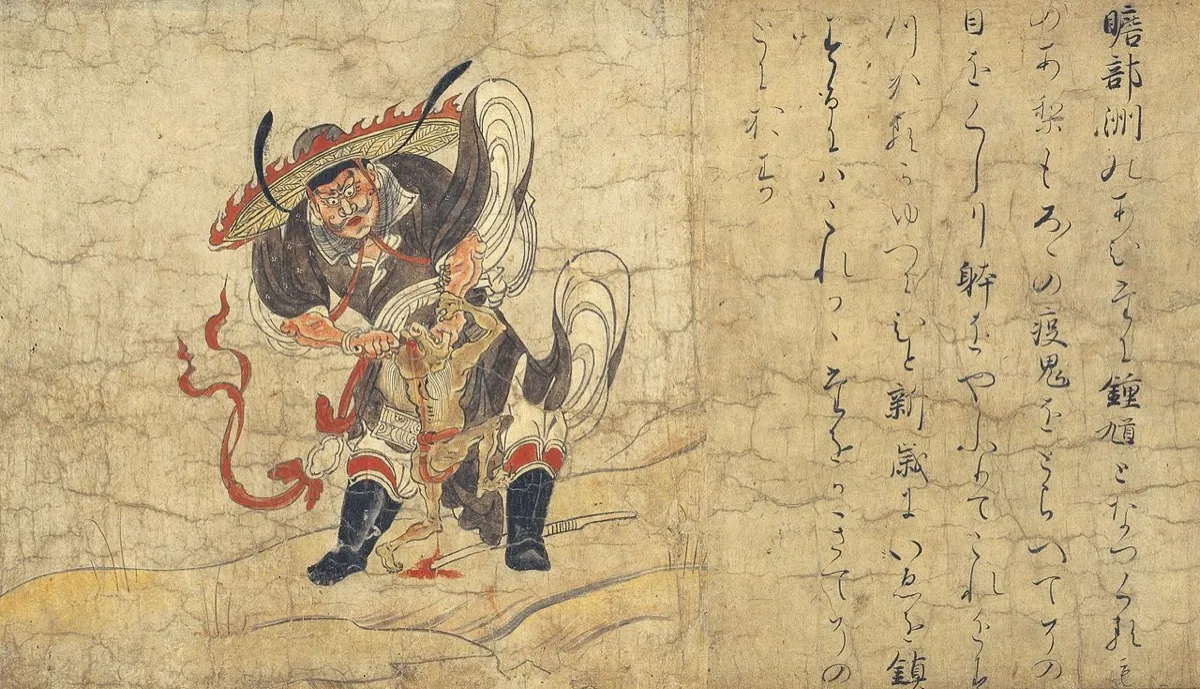
If Liu Zhang's Zhan Gui Zhuan (Slaying Ghosts) is a satirical masterwork that uses demons as allegories for human vice, then Ping Gui Zhuan (Subjugating Ghosts) — attributed to the mysterious "Daoist of the Clouds on the Eastern Mountain" — is its twin and its echo. Both novels cast Zhong Kui as a demon-quelling hero, both skewer the corruptions of Qing-dynasty society, and both are routinely published together under the umbrella title Zhong Kui Zhuan. Yet the differences between them run far deeper than their shared premise might suggest.
The Enigmatic Author: Who Was the Daoist of the Eastern Mountain?
A Pen Name and Its Clues
Ping Gui Zhuan was completed during the Qianlong reign (1736–1795), decades after Zhan Gui Zhuan appeared around 1703. Its author hid behind the sobriquet "Dongshan Yunzhong Daoren" — roughly, "the Daoist dwelling among the clouds on the Eastern Mountain." Each element of this pen name carries literary resonance: "Eastern Mountain" hints at a hermit's retreat, "among the clouds" signals detachment from the mundane world, and "Daoist" firmly anchors the persona in China's mystical tradition.
Scholars have proposed several theories about the author's true identity. Some suggest a connection to Liu Zhang himself — the thematic overlap between the two novels is striking enough to raise the possibility that one writer produced both under different names at different stages of life. Others argue for a separate author who was directly inspired by Liu Zhang's work. Zheng Zunren's monograph Zhong Kui Yanjiu (Studies on Zhong Kui, Xiwei Information, 2004) subjects both texts to detailed stylistic comparison and concludes that the prose styles diverge too sharply to come from the same hand.
A Different Era, A Different Target
The decades separating the two novels matter. Zhan Gui Zhuan emerged in the late Kangxi period, a time of relative stability when bureaucratic rot was just beginning to surface. Ping Gui Zhuan appeared during the Qianlong era, when the cracks in the facade of imperial prosperity had widened considerably. This shift in historical mood reshaped each book's satirical focus:
- Zhan Gui Zhuan targets personal moral failings — lust, greed, hypocrisy, and vanity
- Ping Gui Zhuan takes on structural and institutional corruption — the dark machinery of officialdom itself
From "Demon-Quelling Deity" to "Grand Marshal of Ghost Subjugation"
Why the New Title Matters
One of the most telling differences between the two novels is Zhong Kui's celestial appointment:
- In Zhan Gui Zhuan, he receives the title "Qumo Dashen" — Great Deity of Demon Expulsion
- In Ping Gui Zhuan, he is named "Pinggui Da Yuanshuai" — Grand Marshal of Ghost Subjugation
The shift from "deity" to "marshal" is anything but cosmetic. A "deity" banishes demons through sacred authority and supernatural might — Zhong Kui operates as a lone divine enforcer. A "grand marshal," by contrast, commands armies. The character "ping" (平) carries the weight of a military campaign, a large-scale pacification effort requiring strategy, coordination, and the deployment of forces across vast territories.
This reimagining reveals how Qing-era literati gradually reconceived Zhong Kui. Liu Zhang's version is a solitary crusader for justice. The "Daoist of the Eastern Mountain" recasts him as a field commander who must rally allies, manage resources, and wage a sustained war against the forces of chaos.
The Architecture of Sixteen Chapters
Ping Gui Zhuan spans eight fascicles and sixteen chapters — six more than Zhan Gui Zhuan's ten. The additional room allowed the author to build a substantially more complex narrative:
- A vaster cosmology: The realms of the living, the dead, and the heavens interact more frequently and with greater narrative consequence
- A larger cast: Beyond Zhong Kui himself, the novel introduces a wider array of companions, adversaries, and supernatural beings
- A broader campaign: Zhong Kui's ghost-subjugating journey cuts across more regions, encounters more diverse threats, and weaves through more dramatic set pieces
Unfortunately, the original chapter titles have not survived intact in extant editions, so scholars reconstruct the overarching plot primarily through plot summaries and comparative textual analysis.
Head-to-Head: How Ping Gui Zhuan Compares to Zhan Gui Zhuan
A Structural Comparison
| Dimension | Zhan Gui Zhuan | Ping Gui Zhuan |
|---|---|---|
| Author | Liu Zhang (attributed) | Daoist of the Eastern Mountain |
| Date | Kangxi era, c. 1703 | Qianlong era |
| Length | 10 chapters | 8 fascicles, 16 chapters |
| Zhong Kui's title | Great Deity of Demon Expulsion | Grand Marshal of Ghost Subjugation |
| Narrative mode | Satirical allegory foremost | Richer plot, fuller characterization |
| Academic standing | Celebrated as a satire of human nature | Slightly lower literary reputation but stronger storytelling |
| Core device | Each demon = one human weakness | Greater emphasis on plot momentum and character depth |
What Both Novels Achieved Together
Despite their differences, both works served the same pivotal function in the evolution of Zhong Kui's mythos: they transformed him from a passive spirit who appears in dreams into a proactive hero who takes the fight to evil.
In Tang and Song dynasty lore, Zhong Kui is largely reactive. Emperor Xuanzong dreams of him, then commissions his portrait and grants him a title. He waits to be summoned. But in Zhan Gui Zhuan and Ping Gui Zhuan, Zhong Kui becomes a figure of agency — someone who strategizes, grows angry, devises clever plans, and adapts his tactics to each new adversary. As Liu Xiaofen and Zhong Wenshan argue in their 2009 study Zhong Kui Shenhua Ji Wenxue Fenxi (Analyzing the Zhong Kui Myth and Its Literature), it was precisely the popularity of these two novels that established the narrative template for virtually every Zhong Kui story that followed.
Editions, Print History, and the Combined Tradition
Standalone Editions
The earliest known edition of Ping Gui Zhuan dates to the fiftieth year of the Qianlong reign (1785), printed from the blocks of the Wuyun Lou workshop in Fengcheng. Later notable editions include:
- 1980, Changjiang Literature and Art Publishing House — a typeset edition held in the Peking University Library
- 1984, People's Literature Publishing House — included in the Chinese Novel Historical Materials Series under the collection Guben Pinghua Xiaoshuo Ji (Anthology of Classic Pinghua Fiction)
- 1990, Liaoshen Publishing — collected in the Huangdan Qi Shu (Books of the Bizarre) volume of the Chinese Supernatural Fiction Series
- Shanghai Classics Publishing House — included in the Guben Xiaoshuo Jicheng (Comprehensive Collection of Classic Fiction)
The Combined Edition: Zhong Kui Zhuan
The most consequential edition arrived in 1980, when Changjiang Literature and Art Publishing House issued Zhan Gui Zhuan and Ping Gui Zhuan bound together as a single volume titled Zhong Kui Zhuan, credited to "Yanxia Sanren and Yunzhong Daoren." This combined edition became:
- The most readily available version for general readers
- The standard base text for academic research
- The primary gateway through which new audiences discover both works
The very existence of this combined tradition speaks volumes. Publishers and readers alike came to see the two novels as an organic whole — each illuminating what the other lacks.
Reassessing Ping Gui Zhuan's Literary Merit
What the Novel Contributes Uniquely
For decades, Ping Gui Zhuan has lived in the shadow of its companion piece. Critics have generally praised Liu Zhang's satire as sharper and more elegant, and his one-demon-one-vice allegorical structure as more intellectually satisfying. But Ping Gui Zhuan offers contributions that no other work in the Zhong Kui canon can replace:
- Narrative completeness — The sixteen chapters give characters room to breathe. Relationships develop. Plot threads converge and resolve. The result is a more immersive reading experience.
- Breadth of social critique — By moving beyond individual moral failings to indict the structures that produce them, the novel achieves a wider critical lens.
- Enrichment of the Zhong Kui persona — The "Grand Marshal" framing adds a military dimension that rippled outward into later opera, visual art, and eventually film and television.
Why Both Novels Should Be Read Together
Zhang Bing's 500 Zhong Ming Qing Xiaoshuo Bolan (A Reader's Guide to 500 Ming and Qing Novels, Shanghai Dictionary Publishing House, 2005) presents the two works side by side, implying a complementary relationship rather than a competitive one. Zhan Gui Zhuan supplies the sharp satirical core. Ping Gui Zhuan provides the richer narrative shell. Only together do they represent the full scope of Qing-dynasty Zhong Kui fiction.
From Page to Cultural Icon: The Novel's Lasting Legacy
How Two Novels Reshaped Zhong Kui's Image
The combined influence of Zhan Gui Zhuan and Ping Gui Zhuan rippled across three major cultural domains:
In theater, the colorful demons and dramatic battle scenes gave playwrights a ready-made repertoire. The beloved Peking Opera episode "Five Ghosts Harass Zhong Kui" and similar regional opera staples trace their lineage directly to material first developed in these novels.
In visual art, the detailed physical descriptions of ghosts and demons gave painters a standardized visual vocabulary. From Qing-era New Year's prints to contemporary ink-wash masterworks, the converging image of Zhong Kui — his fierce glare, his sword, his entourage of spirits — owes much of its consistency to the fact that these two novels effectively "canonicalized" his appearance.
In folk religion, the sheer popularity of the books reinforced Zhong Kui's standing as a universal protector. Whether you called him the "Great Deity of Demon Expulsion" or the "Grand Marshal of Ghost Subjugation" made little difference to ordinary people. What mattered was that Zhong Kui could handle any ghost, any demon, any evil — a spiritual superhero for the common household.
Ping Gui Zhuan may lack the lapidary precision of Zhan Gui Zhuan, but its very existence proves a truth about great mythological figures: they never stop evolving. From a phantom glimpsed in a Tang emperor's dream to a Qing-dynasty grand marshal commanding celestial armies, Zhong Kui has been reinvented with every retelling — and the process shows no sign of stopping.