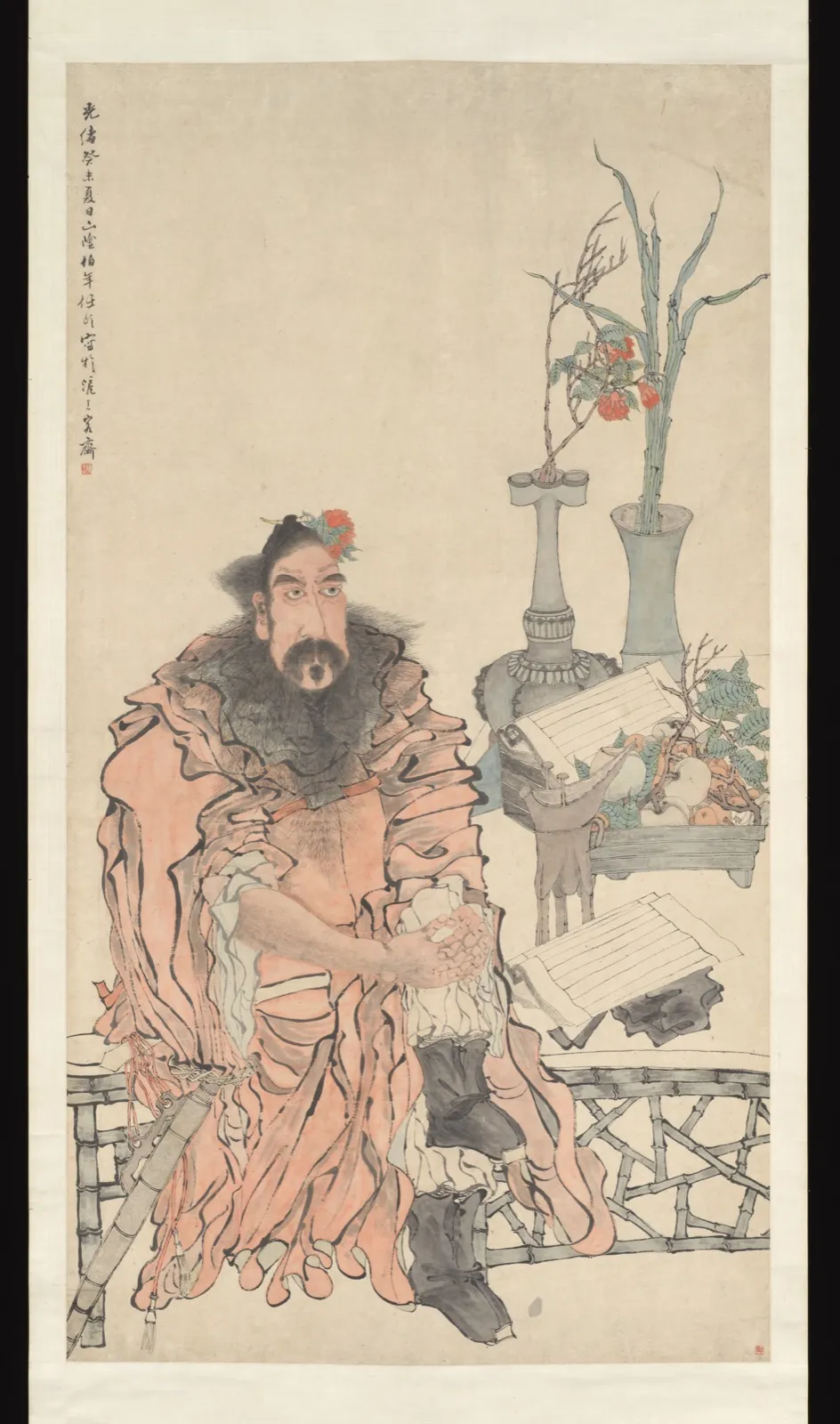
Of all the stories woven around Zhong Kui — the fierce, bat-winged ghost catcher whose portrait hangs over doorways across East Asia — one episode strikes deeper than the rest: a brilliant scholar, denied the honors he had earned, smashes his head against the stone steps of the imperial palace and dies on the spot. His crime? A face too horrifying for the emperor to bear.
That single act of despair transformed Zhong Kui from an abstract exorcism symbol into someone generations of frustrated scholars could see themselves in. His rage, his sense of injustice, his absolute refusal to accept a world that valued appearances over ability — these emotions resonated across a thousand years of Chinese literary tradition.
But did it actually happen? The answer is more complicated — and more revealing — than a simple yes or no.
Two Versions of a Single Tragedy
Zhong Kui's "scholar suicide" is not one story but two, set in completely different eras of the Tang Dynasty and preserved in different texts.
Version One: The Military Exam (Tang Yishi)
The older version survives in the Ming dynasty encyclopedia Records of the Celestial Center (Tianzhong Ji), which quotes a now-lost text called the Anecdotal History of Tang (Tang Yishi). Here the story unfolds during the Wude reign of Emperor Gaozu (618–626 CE), the very first years of the Tang Dynasty.
In this telling, Zhong Kui is a man from Zhongnan Mountain who enters the military examination — not the prestigious civil-service track. He proves himself the strongest and most skilled candidate, but his grotesque appearance costs him the appointment. Humiliated beyond endurance, he throws himself against the palace steps. Emperor Gaozu, moved by the young man's resolve, orders him buried with honor in a green court robe. After death, Zhong Kui becomes a spirit-protector, swearing to rid the empire of demons as repayment for the emperor's kindness.
Years later, Emperor Xuanzong falls gravely ill with malaria and dreams of a large, fearsome figure devouring a mischief-making ghost called Xuhao ("Empty Consumption"). He wakes cured and commissions the legendary painter Wu Daozi to capture the vision on silk — the origin of the iconic "Emperor Minghuang Dreams of Zhong Kui" painting tradition.
Key detail: The Tang Yishi version identifies Zhong Kui as a "candidate who failed the military exam" — a warrior, not a man of letters.
Version Two: The Civil Exam (Chronicle of Demon Slaying)
The Qing dynasty novelist Liu Zhang rewrote the story entirely in his Chronicle of Demon Slaying (Zhan Gui Zhuan), completed around 1703. He shifted the timeline roughly 150 years forward to the reign of Emperor Dezong (780–805 CE) and changed Zhong Kui from a military candidate into a civil-service scholar — a man of dazzling intellect and literary brilliance.
In this version, Zhong Kui tops the written examination and should be named Zhuangyuan (first-place laureate). But when he is brought before the emperor for the final audience, Dezong is so startled by his terrifying visage that he refuses the appointment on the spot. The scholar's despair turns to fury, and he brains himself on the palace staircase then and there.
Two real historical figures appear in supporting roles: the scheming chancellor Lu Qi, who whispers that an ugly man cannot represent the dynasty, and the imperial official Han Yu — later revered as the greatest prose stylist of his age — who steps forward to defend Zhong Kui's right to serve.
How the Two Versions Compare
| Element | Tang Yishi Version | Chronicle of Demon Slaying |
|---|---|---|
| Era | Gaozu's Wude reign (618–626) | Dezong's reign (780–805) |
| Exam type | Military | Civil (jinshi) |
| Zhong Kui's identity | Warrior candidate | Literary scholar |
| Reason for rejection | Ugly appearance | Emperor dismayed by his face |
| Method of death | Headbutts palace steps | Headbutts palace steps |
| Aftermath | Emperor Gaozu grants green burial robe | Posthumously appointed Demon-Slaying Deity |
| Historical figures | None | Lu Qi, Han Yu |
Strip away the details and only one element survives in both: Zhong Kui, denied a earned honor because of his face, kills himself on the palace steps. Everything else — the when, the how, the who — is contested ground.
Lu Qi Meets Han Yu: A Historical Impossibility
Liu Zhang's decision to set his novel during Dezong's reign and populate it with named historical figures was a clever piece of world-building — but it also provided the very evidence that exposes his version as fiction.
Lu Qi: The Most Hated Chancellor of the Tang Dynasty
Lu Qi (d. 785 CE) served as grand chancellor during the early years of Dezong's reign. Historical records describe him as physically repulsive — his complexion had a bluish tint — yet unlike Zhong Kui, he succeeded in climbing to the highest offices. Once there, he ruled through intimidation, purging rivals and imposing crushing taxes. The great calligrapher-general Yan Zhenqing was among those he hounded to death.
The irony is inescapable: Lu Qi himself was a victim of appearance-based prejudice who, instead of dying in protest, chose to wield power against anyone who had ever judged him.
Han Yu: The Greatest Prose Master of the Tang
Han Yu (768–824 CE) is one of the towering figures of Chinese literary history — later canonized as the leading voice among the "Eight Great Prose Masters of Tang and Song." His campaign to revive classical, plain-spoken prose reshaped Chinese writing for a thousand years.
His own path through the examination system was famously agonizing. He sat for the jinshi exam multiple times before finally passing in 792 CE, and then spent years fighting through the bureaucratic selection process before receiving a real posting.
The Timeline That Breaks the Story
Here is the problem:
- Lu Qi died in 785 CE, when Han Yu was roughly seventeen years old.
- Han Yu passed the jinshi exam in 792 CE — by which point Lu Qi had been dead for seven years.
- When Lu Qi sat on the imperial council, Han Yu was still a teenager preparing for his first exam.
The two men never served in government at the same time. The scene of Chancellor Lu Qi denouncing Zhong Kui while Vice-Minister Han Yu rises to defend him is, in historical terms, impossible.
This chronological collision is the strongest piece of evidence that the "Dezong-era jinshi scholar" version of Zhong Kui's death is Liu Zhang's literary invention — a powerful piece of fiction, not a recovered historical memory.
The Street-Fortune-Teller Clue
Scholars have noted a second giveaway. The Chronicle of Demon Slaying includes elaborate, vividly drawn scenes of Zhong Kui reading fortunes and interpreting characters at a roadside stall in the capital. The level of everyday detail — the sights, the chatter, the rhythm of street commerce — reads far more like a Qing-dynasty author drawing on his own urban surroundings than like a faithful reconstruction of Tang life.
The academic consensus is clear: Liu Zhang's "jinshi scholar" version is a work of creative fiction, not history.
Appearance-Based Discrimination in Tang China
Yet if the story is fiction, the social wound it addresses was entirely real. Judging a person's worth by their looks was not a casual prejudice in Tang China — it was written into the law.
The Four Criteria: Body, Speech, Calligraphy, Judgment
The Tang civil-service evaluation system operated on four pillars known as "Body, Speech, Calligraphy, and Judgment" (shen, yan, shu, pan):
- Body (shen): Physical presence and attractiveness. Candidates with deformities, disfiguring scars, or simply an ugly face could be eliminated at this stage.
- Speech (yan): Eloquence and clarity of expression.
- Calligraphy (shu): Beauty and skill in brushwork.
- Judgment (pan): Logical reasoning and legal analysis.
Notice what comes first. Even before a candidate opened his mouth or unrolled his exam paper, inspectors assessed his body. The system included a formal rule: those deemed "repulsive in appearance" could be barred from office altogether.
Real Victims of the Beauty Standard
Zhong Kui's plight was not as unique as it sounds. History records several confirmed cases:
- Fang Gan, a celebrated Tang poet with a cleft lip, was repeatedly denied official appointment despite his literary gifts. He never passed the selection and became known by the bitter nickname "Master Mended-Lip."
- Wen Tingyun, the brilliant lyric poet who helped define the huajian (flower-pattern) school of ci poetry, was haunted throughout his career by his looks. Contemporaries called him "Wen Zhong Kui" — Wen the Zhong Kui — because, like the demon hunter, he was monstrously talented and monstrously ugly.
That last detail is more than a footnote. The fact that Wen Tingyun's nickname folded him into the Zhong Kui legend suggests something intriguing: the scholar-suicide story may have grown, at least in part, from collective memory of real, disfigured talents who were crushed by the examination system.
From Social Reality to Mythic Archetype
Appearance-based discrimination was not an abstract grievance in Tang China — it was a lived catastrophe for anyone born with the wrong face. When Liu Zhang recast Zhong Kui as a brilliant scholar destroyed by his looks, he was channeling a very real pain into mythological form.
Zhong Kui's rage belongs to every person judged on sight. His suicide belongs to every soul driven to the edge by an unfair system. And his posthumous apotheosis into a demon-slaying god speaks to one of the deepest convictions in Chinese culture: what the living world denies you, the cosmos will repay.
Why the Story Shifted from Warrior to Scholar
One of the most revealing changes between the two versions is Zhong Kui's identity: why did Liu Zhang turn a military candidate into a literary one?
Military Exams Carried Little Prestige
The Tang military examination, established in 702 CE under Empress Wu Zetian, tested archery, horsemanship, lance work, and physical strength alongside basic strategic theory. It was a practical pathway, but it ranked far below the civil-service exam in social standing. Tang culture valued the brush over the sword; a military graduate could never rival the prestige of a jinshi laureate.
Casting Zhong Kui as a failed military candidate made him an unlucky warrior, but not a tragic one. Military exam failures were common and unremarkable.
Civil Exams Carried Mythic Weight
The jinshi examination, by contrast, was the great arena of hopes and heartbreak. Thousands of scholars converged on Chang'an each exam cycle; the typical pass rate hovered around one or two percent. Among those who failed were some of the finest minds in Chinese history — Du Fu sat the exam twice and never passed; Meng Jiao succeeded only after repeated attempts, at the age of forty-six.
By turning Zhong Kui into a jinshi candidate, Liu Zhang plugged him into the most emotionally charged narrative in Chinese literary culture: the genius destroyed by circumstance. From Qu Yuan drowning himself in the Miluo River to the generations of poets who wrote heartbreaking verses about exam failure, this was a wound every educated reader understood instantly.
Liu Zhang's Calculated Improvements
Every change Liu Zhang made served the story's emotional power:
- A scholar-hero resonates more than a warrior-hero — his audience was literate, exam-scarred, and ready to feel Zhong Kui's pain as their own.
- The Dezong era is more dramatic — this was the Tang after the An Lushan Rebellion, a period of corruption and moral crisis that made institutional injustice feel more plausible.
- Lu Qi as villain elevates the stakes — prejudice becomes conspiracy when a notorious chancellor backs it.
- Han Yu as defender lends credibility — anchoring the tale to a real cultural hero makes it feel true even when it isn't.
Historically indefensible? Absolutely. Narratively brilliant? Without question.
Death on the Palace Steps: The Tradition of Protest by Self-Destruction
Zhong Kui does not simply "commit suicide." He smashes his skull against the stone stairs of the imperial palace — an act steeped in a specifically Chinese political tradition: death remonstrance (sijian).
What Is Death Remonstrance?
In the Chinese political-philosophical tradition, a loyal minister who could not change his ruler's mind through reasoned argument was permitted — even expected — to stake his life on the objection. To die protesting an unjust decision was the highest form of loyalty: it forced the ruler to confront the consequences of his error in the most visceral way possible.
The most venerated examples span centuries:
- Bi Gan of the Shang Dynasty, who spoke truth to the tyrant Zhou and was carved open so the king could inspect his heart.
- Wu Zixu of Wu, ordered to kill himself after warning his king against a disastrous alliance — he asked that his eyes be hung on the city gate so he could watch the enemy army arrive.
- Qu Yuan of Chu, who walked into the Miluo River with a stone after his political reforms were rejected and his king refused to hear him.
Zhong Kui's headlong rush at the palace steps follows this lineage exactly. His death is not surrender — it is an argument made with his body. The staircase is the physical symbol of imperial power; by crushing his skull there, in front of the emperor who wronged him, Zhong Kui forces that power to witness what it has done.
The Logic of Posthumous Apotheosis
Chinese culture routinely repays those who died in righteous protest with supernatural promotion. Bi Gan became the god of literature. Qu Yuan received an eternal festival. Guan Yu, the betrayed Three Kingdoms general, rose to become Guan Di, the God of War.
Zhong Kui follows the same arc:
- A righteous person suffers injustice (rejected for his face).
- He protests through self-destruction (headbutts the steps).
- The cosmos corrects the imbalance (he is elevated to godhood).
- From his new position of supernatural authority, he protects others (hunting demons and evil spirits).
This four-beat structure — injustice, protest, elevation, guardianship — is the fundamental pattern of compensatory justice in Chinese myth. It tells the marginalized and the powerless: the world may be unfair, but the universe is not.
A Death That Still Speaks
Whether history or invention, Zhong Kui's scholar-suicide has become inseparable from Chinese culture. Its echoes surface everywhere:
In Literature
Pu Songling's Strange Tales from a Chinese Studio is full of examination-failed scholars who find strange justice among ghosts and fox spirits — a direct inheritance of Zhong Kui's arc. Wu Jingzi's The Scholars turns the examination system itself into a gallery of absurdity and pain.
On Stage
Kunqu opera's Zhong Kui Marries Off His Sister presents the demon hunter in elaborate, grotesque makeup that turns ugliness itself into a form of power — a visual rebuke to anyone who judges by appearance.
In the Present Day
In an era of lookism and curated online personas, Zhong Kui's story has never felt more current. A man rejected for his face becomes the most fearsome protector of the innocent — a reminder that true strength has never lived on the surface.
Further Reading:
- Liu Zhang, Chronicle of Demon Slaying (Zhan Gui Zhuan, c. 1703), modern edition by Changjiang Literature and Art Publishing House, 1980
- Chen Yaowen, Records of the Celestial Center (Tianzhong Ji), quoting the lost Anecdotal History of Tang (Tang Yishi)
- Zheng Zunren, A Study of Zhong Kui (Zhong Kui Yanjiu), Xiwei Information, 2004
- Liu Xiaofen and Zhong Wenshan, Mythological and Literary Analysis of Zhong Kui, Lingnan University, 2009
- Wang Yixing, A Study of Chronicle of Demon Slaying in the Context of Chinese Satirical Fiction, Sichuan University Press, 2019
- Qi Yukun and Chen Huiqin, History of Chinese Satirical Fiction, Liaoning People's Publishing House, 1993
- Zhang Bing and Zhang Yuzhou, "The Development and Evolution of Zhong Kui Stories as Seen from the Dunhuang Manuscript 'New Year's Eve Zhong Kui Exorcism Text,'" Dunhuang Research, Issue 1, 2008
- Hu Yimin, History of Qing Dynasty Fiction, Hefei University of Technology Press, 2013