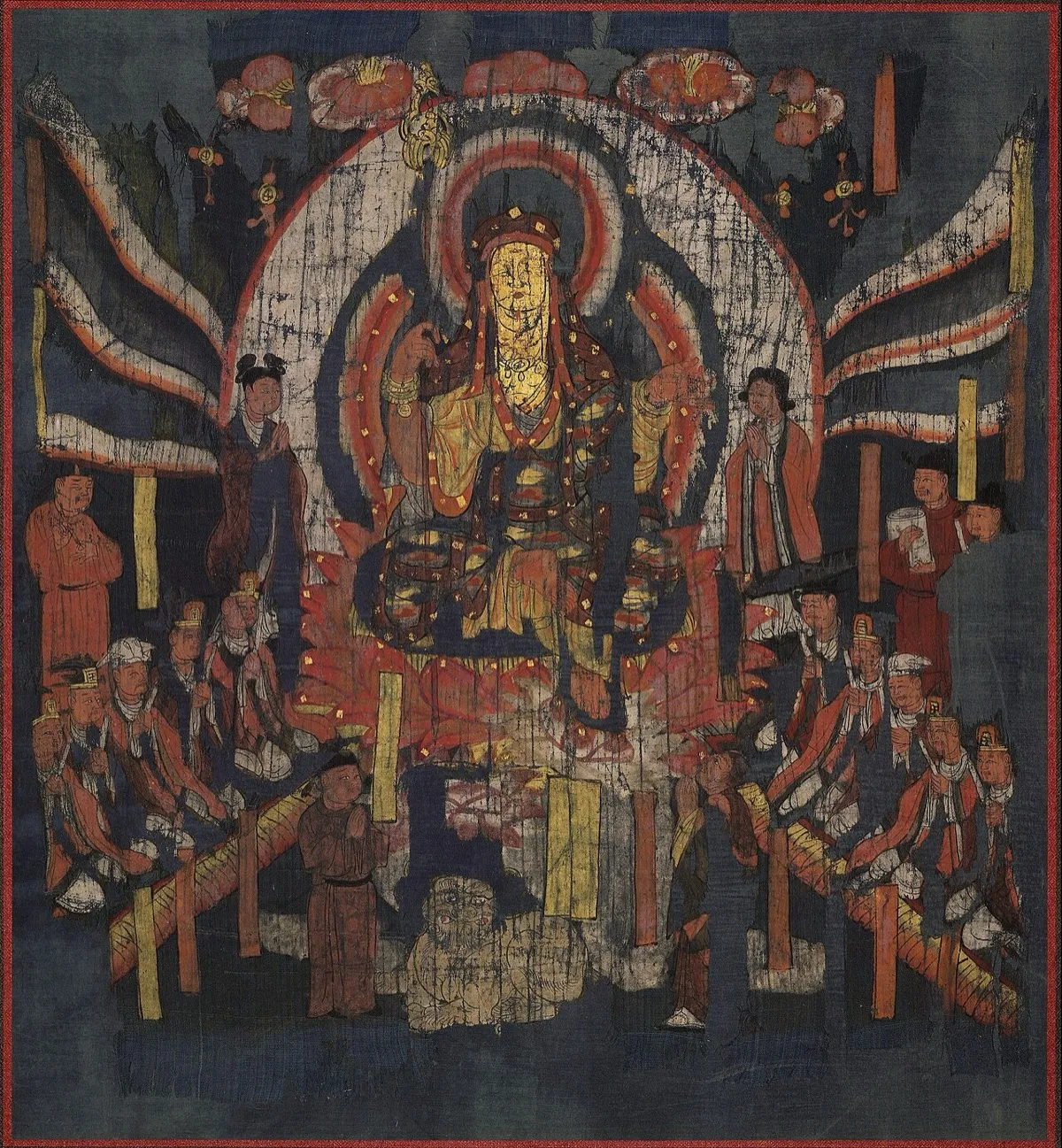
During the golden age of the Tang Dynasty, Emperor Xuanzong returned from military maneuvers at Mount Li and fell gravely ill. Malaria racked his body for weeks. His court physicians and shamans exhausted every remedy, but nothing worked. Then, one midnight, two demons invaded his dreams — a thieving imp and a towering giant who devoured it whole.
That single nightmare gave birth to one of the most enduring figures in Chinese spiritual life: Zhong Kui, the Demon Hunter. For over thirteen centuries, his image has guarded doorways across China. His legend has inspired paintings, plays, novels, and films. And it all traces back to one fevered night in an imperial palace.
The Earliest Written Record: Shen Kuo's Dream Pool Essays
The oldest surviving account of this dream appears not in a Tang Dynasty text, but in the writings of Song Dynasty polymath Shen Kuo (1031–1095). In his Dream Pool Essays (Mengxi Bitan), Shen Kuo describes examining a painting attributed to the legendary Tang artist Wu Daozi, along with a manuscript note attached to the scroll. He copied the text verbatim — not as a storyteller spinning a tale, but as a meticulous scholar preserving a historical artifact.
The Emperor Falls Ill After Mount Li
According to the manuscript note Shen Kuo transcribed, Emperor Xuanzong held grand military exercises at Mount Li during the Kaiyuan era (713–741 CE). Upon returning to the palace, he fell ill with a persistent fever that lingered for nearly a month. Court shamans and imperial physicians tried every technique at their disposal, yet the emperor's condition refused to improve.
Two Demons Appear: The Thief and the Giant
Then, one night, the emperor dreamed of two demons — one large, one small.
The smaller demon was a grotesque figure. He wore crimson shorts, one foot bare and the other shod, with the extra shoe dangling from his waist. He carried an oversized paper fan tucked into his belt. His mischief was bold and specific: he stole the emperor's jade flute and the purple silk sachet belonging to the emperor's beloved consort, Yang Guifei — then ran circles around the throne room with his loot.
These stolen objects carried heavy symbolic weight. The jade flute represented imperial authority and the harmony of celestial music. The sachet embodied the emperor's most intimate bond. A demon making off with both was more than petty theft — it was an omen of something precious slipping away.
The larger demon cut an entirely different figure. He wore a cap and flowing blue robes, one arm bared, both feet wrapped in leather. This was not the garb of a warrior or a monster. Blue robes, in Tang Dynasty dress codes, marked officials of the sixth rank or below — low-ranking bureaucrats. The giant looked less like a fearsome spirit and more like a minor civil servant, albeit a ferociously determined one.
His response to the thieving imp was swift and brutal. He seized the small demon, gouged out its eyes, tore its body apart, and swallowed it whole. No hesitation, no theatrics — just the cold efficiency of a creature whose sole purpose was exterminating evil.
Zhong Kui Reveals Himself
The stunned emperor managed a single question: "Who are you?"
The giant demon bowed and answered with formal court etiquette. He called himself Zhong Kui, a candidate who had failed the imperial martial examinations. He swore an oath to rid the empire of all demons and evil spirits on the emperor's behalf.
Three details in this self-introduction are worth noting. First, Zhong Kui addressed the emperor as "your servant" — he considered himself a loyal subject, not a rival power. Second, he specified that he had failed the martial, not literary, examinations, a nuance that later retellings often blurred. Third, his demon-hunting mission was framed as an act of fealty to the throne, not a personal vendetta.
Wu Daozi Paints the Vision From Memory
When the emperor awoke, his fever had broken entirely. He felt stronger than he had in weeks. Wasting no time, he summoned the court painter Wu Daozi and described the dream in vivid detail, ordering him to capture the scene on silk.
According to the account, Wu Daozi accepted the commission and completed the painting almost immediately, as though he could see the dream himself. When the emperor examined the finished work, he stared in astonishment and exclaimed that Wu Daozi must have shared his exact dream — the likeness was uncanny.
Shen Kuo's transcription ends here. He offers no follow-up about rewards or imperial decrees. He was simply doing what scholars do: preserving what he found.
Shen Kuo's Footnote: A Name Older Than the Dream
Importantly, Shen Kuo appended his own commentary. He noted that the name "Zhong Kui" predated the Kaiyuan era by centuries. Historical records mentioned figures named Li Zhongkui during the Northern Wei dynasty, the generals Qiao Zhongkui and Yang Zhongkui during the Sui dynasty, and even the sister of the celebrated Liu Song general Zong Que bore the name. Shen Kuo's conclusion was measured: the name "Zhong Kui" was already in wide use as a personal name long before Emperor Xuanzong's famous dream.
This footnote is a crucial reminder. However the legend crystallized, its central character drew on naming traditions and possibly folk beliefs that were already ancient by the Tang era.
The Expanded Version: Tales of the Tang Dynasty (Tang Yishi)
By the Ming Dynasty, the story had grown richer. The scholar Chen Yaowen included a version attributed to a now-lost text called Tales of the Tang Dynasty (Tang Yishi) in his massive encyclopedia Celestial Records (Tianzhong Ji). This retelling added three pivotal details that would define the Zhong Kui legend for generations.
Addition One: The Thief Gets a Name — Xuhao, the Demon of Depletion
In this expanded version, the small demon introduces himself as Xuhao. The name itself is a curse. "Xu" means to steal from emptiness — to take what isn't there. "Hao" means to drain, to squander, to turn good fortune into disaster. Xuhao wasn't just a petty ghost. He was the personification of waste and loss.
A later text, The Complete Tale of Zhong Kui of the Tang Dynasty (Tang Zhong Kui Quan Zhuan), spelled out the symbolism explicitly: the demon stole wealth from thin air and turned joyful occasions into sorrow. When Xuhao made off with Yang Guifei's sachet and the emperor's flute, he wasn't simply taking objects — he was draining the Tang Dynasty of its greatest treasures, its love and its art. Read against the backdrop of the An Lushan Rebellion that would later devastate the empire, this detail carries an unmistakable undertone of national anxiety.
Addition Two: Suicide and the Gift of a Burial Robe
The Tang Yishi version introduces Zhong Kui's backstory in full. He was a scholar from Zhongnan Mountain who traveled to the capital during the Wude era (618–626 CE) to sit for the martial examinations. He performed brilliantly but was denied the degree — reportedly because his appearance was considered too grotesque. Humiliated and enraged, he dashed his head against the palace steps and died.
Emperor Gaozu, the Tang founding emperor, was moved by this tragedy. He ordered that Zhong Kui be buried in the green robe of a minor official — a posthumous recognition of merit that the scholar had never received in life. It was this act of grace that bound Zhong Kui's spirit to the Tang Dynasty. He vowed to spend eternity hunting demons on the empire's behalf.
The narrative structure here is classic Chinese folk religion. A talented individual is wronged by the establishment, suffers a tragic death, and is then elevated to divine status. The pattern repeats across Chinese history — Qu Yuan, the patriotic poet who drowned himself; Guan Yu, the general deified as the God of War; Yue Fei, the loyal minister betrayed and executed. Zhong Kui fits cleanly into a tradition that transforms systemic injustice into sacred power.
Addition Three: The Emperor Wakes in a Cold Sweat
The Tang Yishi adds visceral physical detail. Emperor Xuanzong jolted awake drenched in cold sweat — and his malaria vanished. In traditional Chinese medicine, a sudden sweat signaled that the pathogenic force had been expelled from the body. The dream battle between Zhong Kui and Xuhao was not merely symbolic; it was the mechanism of healing. The emperor's illness left his body through the nightmare itself.
The text also amplifies the description of Wu Daozi's painting. Rather than simply calling the result lifelike, it suggests that Wu Daozi painted as though he had personally witnessed Zhong Kui — implying that the artist might have entered a trance state, channeling the demon hunter's spirit directly onto silk.
Wu Daozi: The Brush That Forged a God
One figure in the Zhong Kui origin story deserves far more attention than he usually receives: the painter Wu Daozi. If Emperor Xuanzong's dream gave the legend its narrative, Wu Daozi's brush gave it its face. His painting was the template from which every subsequent depiction of Zhong Kui descended.
From Humble Origins to Sage of the Brush
Wu Daozi (c. 685–758) was born into poverty in Yuzhou, modern-day Henan Province. He began his career as an itinerant folk painter before his extraordinary talent attracted powerful patrons. Historical records indicate that he studied calligraphy under Zhang Xu — known as the "Sage of Cursive Script" — and the poet He Zhizhang, though it was painting where his genius truly erupted.
His break came through a legendary event. The general Pei Min commissioned a painting, and what followed became one of the most celebrated artistic spectacles in Chinese history. Pei Min performed a sword dance, Zhang Xu wrote wild cursive calligraphy, and Wu Daozi painted — all three working simultaneously before a massive audience. Contemporaries dubbed their combined performance the "Three Perfections."
When Emperor Xuanzong learned of Wu Daozi's gifts, he brought him into the imperial court and appointed him to a series of official positions. For the rest of his life, Wu Daozi served as a palace painter, his brush reserved for the empire's most important commissions.
The Hell Scroll That Changed Lives
Wu Daozi's most renowned work before the Zhong Kui commission was his Hell transformation mural (Di Yu Bian Xiang Tu) at Jingyun Temple in Chang'an. According to historical accounts, the depiction of infernal torments was so harrowing that butchers and fishermen who saw it abandoned their professions, terrified of the karmic consequences.
This was the man Emperor Xuanzong chose to paint a demon hunter. The emperor did not want a beautiful painting. He wanted a weapon — an image so powerful that spirits themselves would cower before it.
Reconstructing the Lost Masterpiece
Wu Daozi's original Zhong Kui painting has been lost to history. No authenticated work by his hand survives. But later copies and written descriptions allow us to reconstruct its essential features:
- A face bristling with a wild beard, eyes glaring wide, terrifying yet commanding
- Blue robes — the garment of a low-ranking Tang official
- A cap and one bared arm
- One hand seizing a demon, the other raised as if in the act of consumption
- Feet wrapped in leather, suggesting long marches and endless campaigns
This image remained remarkably stable for over a thousand years. Every Chinese New Year print, every temple mural, every folk painting of Zhong Kui traces its visual DNA back to Wu Daozi's lost original. A single brushstroke session in an imperial studio effectively designed the face of a god.
The Imperial Distribution System: How the Court Made Zhong Kui a National Icon
A dream alone, no matter how vivid, would not have launched a nationwide cult. What transformed Zhong Kui from a one-time apparition into a permanent fixture of Chinese spiritual life was an institutional practice: the imperial court's tradition of distributing Zhong Kui paintings at year's end.
Zhang Yue: The First Minister to Give Thanks
Zhang Yue (667–730), who served as grand councilor under Emperor Xuanzong, wrote a formal memorial titled "Expression of Gratitude for the Bestowal of a Zhong Kui Painting and a Calendar." The document records a year-end ritual in which the emperor presented ministers with a Zhong Kui image alongside the official calendar for the coming year. Zhang Yue's text makes clear that the painting was understood as a protective talisman — a spiritual shield against malevolent forces for the new year.
Liu Yuxi: Witness Across Decades
The mid-Tang poet and official Liu Yuxi (772–842) authored two separate memorials of thanks: one on behalf of Military Commissioner Li, another for Councillor Du of Huainan. These two documents, written years apart, prove that the practice of gifting Zhong Kui paintings continued from Emperor Xuanzong's reign through that of Emperor Dezong — a span of roughly five decades. This was not a personal whim of one ruler. It was formal court protocol.
The Dunhuang Manuscript: Proof From the Empire's Edge
Among the thousands of manuscripts discovered in the Dunhuang caves in the early twentieth century is a Tang Dynasty text titled "Incantation for the New Year's Eve Exorcism by Zhong Kui." This document describes Zhong Kui's role as the lead figure in the Nuo exorcism ceremonies performed on New Year's Eve.
Dunhuang sat at the far northwestern frontier of the Tang Empire, more than a thousand miles from Chang'an. The fact that Zhong Kui had been integrated into local exorcism rituals at such a remote outpost means his cult had penetrated deep into the provinces. He was no longer an imperial curiosity — he was a national phenomenon.
The Significance of the System
Taken together, these sources reveal a clear transmission path for Tang Dynasty Zhong Kui worship:
- Imperial origin: The emperor commissioned Wu Daozi's painting and ordered woodblock copies distributed across the realm
- Institutional support: Year-end distribution of Zhong Kui images became standard court practice
- Elite endorsement: Memorials by prominent officials like Zhang Yue and Liu Yuxi conferred cultural legitimacy
- Grassroots adoption: The Dunhuang manuscript demonstrates that the belief had reached common people at the empire's margins
This was not a folk belief that bubbled up from below. It was a cultural movement driven from the top down — a dream, a painting, a ritual, and a remote frontier manuscript forming four links in an unbroken chain of evidence. By the end of the Tang Dynasty, Zhong Kui had completed the journey from apparition to deity.
Reading Deeper: What the Dream Really Means
Why did the Zhong Kui legend crystallize during the Tang Dynasty? Why Emperor Xuanzong, of all rulers? Definitive answers may be impossible, but the story rewards close reading.
A Prophecy in Reverse: The Shadow of the An Lushan Rebellion
The dream is set during the Kaiyuan era — the apex of Tang power and prosperity. Yet the story's imagery reads like a premonition of collapse. A demon steals the symbols of imperial pleasure and romantic love. The emperor lies stricken, beyond the help of healers. Only supernatural intervention can save him. If you replace "malaria" with "rebellion" and "demon" with "An Lushan," the allegory sharpens into focus.
Some scholars argue that the Zhong Kui legend crystallized as a retrospective narrative — a way for survivors of the An Lushan Rebellion (755–763) to process the trauma of watching the greatest empire on earth tear itself apart. The nightmare was not just one man's fever dream. It was a culture's collective memory of catastrophe, dressed in the language of demons and dreams.
The Outsider as Savior
Zhong Kui's identity is carefully constructed to subvert expectations. He is a failed examination candidate — a man rejected by the very system that was supposed to reward talent. His grotesque appearance was the reason for his rejection. He is, by every measure of Tang society, a marginal figure: gifted but unrecognized, loyal but unwanted.
Yet this outcast becomes the emperor's savior. The narrative taps into one of the deepest currents in Chinese folk psychology: the belief that true worth lies beyond surface appearances, and that the people society discards may be precisely the ones it needs most. A demon hunter who was himself hunted by prejudice. A guardian forged by injustice.
The Universal Nightmare
At its simplest level, the Zhong Kui legend endures because everyone has had nightmares. If an emperor — the most powerful man in the known world — could be tormented by demons in his sleep, what hope did ordinary people have? The answer was Zhong Kui: a guardian who asked nothing in return, required no temple or elaborate ritual, and could be invoked simply by hanging his image on a door or above a bed. Low barriers to entry. High perceived efficacy. This was the formula that carried Zhong Kui from an imperial bedroom to every household in China.
From One Dream to a Thousand Years
Emperor Xuanzong's nightmare ended when he opened his eyes. But Zhong Kui's story was just beginning.
After the Tang Dynasty, imperial distribution of Zhong Kui paintings transitioned into a thriving folk art tradition. During the Song Dynasty, Emperor Shenzong ordered woodblock-printed Zhong Kui images distributed to his ministers. By the Ming era, Chen Yaowen's encyclopedia preserved the narrative in its most recognizable form. The Qing Dynasty saw Liu Zhang's novel Chronicle of Demon Slaying (Zhan Gui Zhuan) recast Zhong Kui as an uncompromising avatar of justice.
Today, Zhong Kui appears in films, television series, video games, and commercial art across East Asia. His visual design evolves with each generation, but the core figure — the blue-robed giant with the wild beard, snatching demons in his fists — remains instantly recognizable.
It all began with a sick emperor, a fever dream, and a painter who worked as though possessed. But as a Tang poet might have observed: the things we see in dreams are sometimes more real than anything we encounter awake.
Sources and Further Reading:
- Shen Kuo, Dream Pool Essays (Mengxi Bitan), Supplementary Discourses, Vol. 3
- Chen Yaowen, Celestial Records (Tianzhong Ji), quoting Tales of the Tang Dynasty (Tang Yishi)
- Zhang Yue, "Expression of Gratitude for the Bestowal of a Zhong Kui Painting and a Calendar"
- Liu Yuxi, "Gratitude for Zhong Kui Painting and Calendar on Behalf of Military Commissioner Li" and "Gratitude for Zhong Kui Painting and Calendar on Behalf of Councillor Du of Huainan"
- Dunhuang Manuscript: "Incantation for the New Year's Eve Exorcism by Zhong Kui"
- Zhang Bing and Zhang Yuzhou, "The Development and Evolution of the Zhong Kui Story as Seen in the Dunhuang Manuscript 'New Year's Eve Exorcism by Zhong Kui,'" Dunhuang Research, No. 1, 2008
- Zhang Yanyuan, Records of Famous Paintings Across Dynasties (Lidai Minghua Ji)
- Liu Xiaofen and Zhong Wenshan, Mythological and Literary Analysis of Zhong Kui, Lingnan University, 2009
- Wu Jiamin, Shu Zhiling, and Yan Shuli, Folk Beliefs in Zhong Kui and His Mythological Literary Image, Lingnan University, 2011