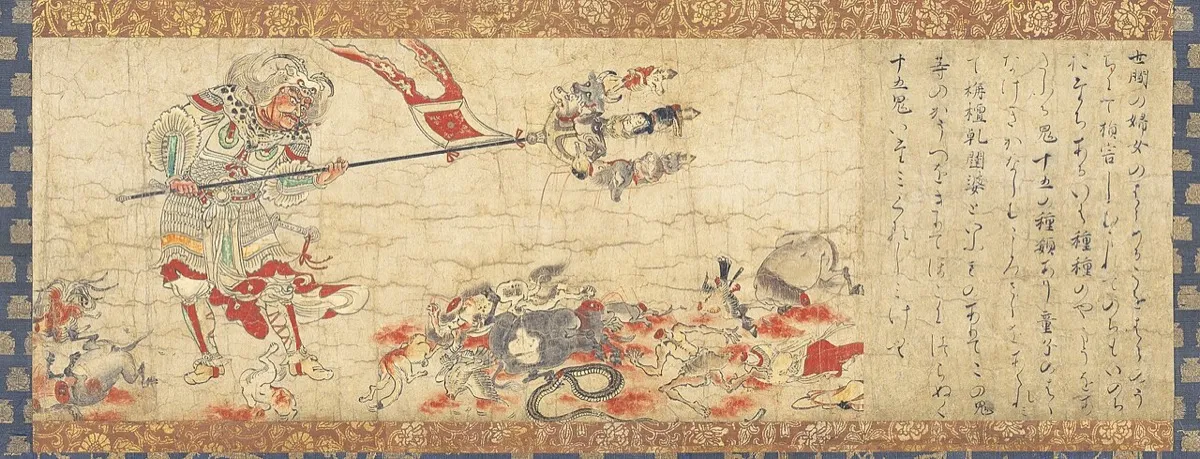
English Wikipedia introduces Zhong Kui in a single, almost abrupt sentence: "Zhong Kui is a Taoist deity in Chinese mythology." Brief as that definition is, it highlights a crucial truth. Of all the institutions that shaped Zhong Kui over the centuries, Taoism (also spelled Daoism) was the last — and by far the most consequential — to claim him. It was formal Taoist canonization that transformed a beloved folk ghost-hunter into a fully credentialed deity, complete with an official title, codified rituals, and temple worship.
But why would Taoism embrace a ghost who had died by suicide? And what exactly does his Daoist title — "Holy Lord Who Bestows Blessings and Guards the Home" — really signify?
Taoism's Open-Source Pantheon
An Ever-Expanding Divine Roster
Unlike religions that maintain a closed canon of sacred figures, Taoism operates more like an open-source project. Its pantheon grows continuously. Any deity with deep roots in popular worship can be formally adopted, given an official title, and woven into the liturgical system. Guan Yu (the God of War), Mazu (Goddess of the Sea), Cheng Huang (City Gods), and Tudigong (Earth Gods) all began as local folk cults before Taoism granted them institutional legitimacy.
Zhong Kui followed this exact trajectory:
- Grassroots devotion — During the Tang Dynasty, an emperor commissioned his portrait, and ordinary families began hanging his image for protection.
- Literary reinforcement — Song, Ming, and Qing writers expanded his legend in collections like Shen Kuo's Dream Pool Essays (Mengxi Bitan) and the popular novel Quelling the Demons (Zhen Gui Zhuan).
- Ritual performance — Nuo opera and "Zhong Kui Dances" dramatized his exorcisms on village stages.
- Formal Taoist canonization — By the Song-Yuan era, Taoist orders enrolled him in the divine hierarchy under the title "Holy Lord Who Bestows Blessings and Guards the Home" (赐福镇宅圣君, Ci Fu Zhen Zhai Sheng Jun).
The journey from step one to step four spanned five to eight centuries — slow, but once it gathered momentum, unstoppable. When a god's popular foundation runs deep enough, Taoist adoption becomes almost inevitable.
The Army of 80,000 Demons: Zhong Kui's Place in the Daoist Power Structure
Wikipedia mentions a telling detail: "Zhong Kui is able to command 80,000 demons to do his bidding." In Taoist magical systems, a deity's rank is often measured by the number of spirit soldiers they can mobilize. Eighty thousand is a formidable figure — it places Zhong Kui far above run-of-the-mill exorcism generals in the invisible bureaucracy of the Chinese underworld.
Consider the hierarchy:
- A typical City God commands a few hundred to a few thousand spirit troops
- Each of the Five Commissioners of Plague controls roughly ten thousand
- Zhong Kui commands 80,000 demon soldiers
- Only Yanluo Wang (King of Hell) theoretically commands all underworld forces
This military scale turns Zhong Kui from a lone-wolf hero into a strategic commander. When a Taoist priest invokes him during a home-protection ritual, it is not simply a matter of asking one god to chase away a ghost. The priest is mobilizing an otherworldly army of 80,000 to secure an entire household.
The Specialized Divisions of the Demon Army
In the granular workings of Daoist practice, Zhong Kui's 80,000 troops are not a disorganized mob. Over centuries of ritual refinement, Taoist priests categorized them into functional units — a kind of supernatural operations manual:
- Reconnaissance unit — Identifies the type and origin of malevolent spirits infesting a space
- Arrest squad — Captures hostile ghosts and demons
- Escort detail — Transports captured entities to the underworld for judgment
- Garrison force — Establishes and maintains protective barriers around a purified location
This division of labor is not ancient doctrine so much as practical knowledge accumulated by generations of Taoist practitioners. But it underscores an important point: invoking Zhong Kui in ritual is not a simple plea for divine intervention. It is a coordinated deployment of spiritual forces, as tactically sophisticated as any military campaign.
Decoding the Title: "Holy Lord Who Bestows Blessings and Guards the Home"
During the Song and Yuan dynasties, Taoism formally granted Zhong Kui the title Ci Fu Zhen Zhai Sheng Jun — roughly, "Holy Lord Who Bestows Blessings and Guards the Home." Every word in this six-character honorific carries precise theological weight.
"Bestowing Blessings": From Defense to Abundance
The earliest version of Zhong Kui had one job: drive out ghosts. But the Taoist title places "bestowing blessings" before "guarding the home." This sequence is deliberate. It signals an upgrade from passive defense to active benediction — Zhong Kui does not merely expel evil; he ushers in good fortune.
This reflects a core Daoist principle sometimes expressed as "support the upright and eliminate the perverse" (扶正祛邪, fu zheng qu xie): true protection means more than neutralizing threats. It means cultivating positive energy. Zhong Kui, under his Taoist mandate, handles both sides of that equation.
"Guarding the Home": From Personal Shield to Spatial Sanctuary
The word "home" (宅, zhai) broadens Zhong Kui's protective reach from individuals to entire living spaces. In Daoist geomancy, a "home" is not just walls and a roof. It encompasses the land's energy channels, the building's orientation, and the intangible atmosphere pervading the site.
When Zhong Kui "guards the home," he secures the feng shui matrix itself — the invisible terrain that shapes a household's fortunes. This is why Taoist home-protection rituals are commonly performed when moving into a new house, opening a business, or sensing that something in a space feels fundamentally wrong. The need is not for a personal guardian but for a spatial lockdown.
"Holy Lord": Admission to the Highest Ranks
Within the Taoist divine hierarchy, "Holy Lord" (圣君, sheng jun) is a prestigious rank — significantly above "General" or "Envoy." It places Zhong Kui on roughly the same level as Guan Yu, who is venerated as "Holy Emperor Guan" (关圣帝君, Guan Sheng Di Jun).
The title marks Zhong Kui's transition from a folk phenomenon — powerful but unofficial — to a recognized officer in the Taoist celestial bureaucracy. He now holds a formal commission with defined responsibilities, answerable to the cosmic chain of command.
The Home-Protection Ritual: How Taoist Priests Deploy Zhong Kui
Taoism's adoption of Zhong Kui finds its most concrete expression in ritual practice — specifically, the Zhong Kui Home-Protection Ceremony (镇宅科仪, zhen zhai ke yi).
The Ritual Step by Step
A standard ceremony typically unfolds in six stages:
- Setting up the altar — A ritual platform is assembled in the client's home, with a Zhong Kui statue or painting as the focal point.
- Purifying the space — The priest chants incantations and rings ceremonial bells to clear interfering energies from the ritual area.
- Invoking the deity — By reciting the Zhong Kui Bao Gao (a formal invocation prayer), the priest summons Zhong Kui to descend upon the space.
- Exorcism — The priest mirrors Zhong Kui's own actions: brandishing a sword, stomping fiercely, glaring with righteous fury — all to drive out whatever malevolent forces have taken up residence.
- Sealing the perimeter — Protective talismans are placed at critical points: doorways, windows, corners, and any spot considered spiritually vulnerable.
- Sending off the deity — The priest thanks Zhong Kui and ceremonially escorts him back to the spirit realm.
The full ritual usually takes one to two hours and requires a trained Taoist priest. In some regions, it is combined with a "Zhong Kui Dance" (跳钟馗) — the priest simultaneously performs the ritual and acts out Zhong Kui's exorcism, blurring the line between liturgy and theater.
The Invocation Prayer (Bao Gao)
While the exact wording of the Bao Gao varies across Taoist lineages, the core elements remain consistent:
- Praise for Zhong Kui's identity and origins — a scholar from Zhongnan Mountain, a great vanquisher of demons
- Request for his arrival — leading his 80,000 demon soldiers
- Specification of what needs to be expelled — plague spirits, hostile ghosts, yin energy, miasma
- Petition for blessings — peace in the home, prosperity for the family
The recitation of the Bao Gao is the ceremony's linchpin. Taoist doctrine holds that only the correct invocation can reach Zhong Kui — think of it as dialing a celestial phone number. The Bao Gao is his direct line.
Talismans and the Zhong Kui Image
When the ritual concludes, the priest leaves behind two layers of spiritual protection:
- Talismans (符, fu) — Yellow paper inscribed with red cinnabar ink, affixed to doorways and key locations. These function as encoded spiritual software, programmed to repel malign influences.
- A Zhong Kui painting or print — Hung in the main hall or over the front door, serving as a visible, permanent reminder of his protective presence.
Together, these two elements form the "hardware system" of Taoist home protection: the talisman is the code running in the background; the painting is the interface that residents and visitors can see.
Why Taoism Chose Zhong Kui
The question remains: Taoism has countless exorcism deities to choose from. What made Zhong Kui the ideal candidate for "Holy Lord of the Home"?
Advantages No Other Deity Could Match
A unique dual citizenship. Zhong Kui himself transitioned from ghost to god. He understands mortal suffering — because he was wronged by the human world — and he understands the laws of the spirit realm — because he once belonged to it. This liminal identity makes him the most effective enforcer and mediator between yin and yang.
Unmistakable visual identity. Leopard-like head, glaring round eyes, iron-wire whiskers, crimson official robes, and a drawn sword — Zhong Kui's appearance has remained essentially unchanged for over a thousand years. That visual consistency means every worshipper in a ritual instantly recognizes him. No explanation needed.
A rich narrative universe. Unlike the generic "General So-and-So" or "Envoy of Such-and-Such," Zhong Kui comes with a full biography: his brilliance, his humiliation, his suicide, his deification, his demon-hunting career, even the poignant story of marrying off his sister. These stories give worshippers something to connect with emotionally, not just functionally.
Multifunctional range. Zhong Kui does far more than catch ghosts. He repels plague, sanctifies homes, bestows blessings, protects children, and purifies spaces. One deity covers most of what a household needs, eliminating the trouble of invoking multiple gods for different problems.
Taoism's Pragmatic Genius
Beneath all the theology, Taoism's adoption of Zhong Kui reflects a deeply pragmatic institutional strategy: canonize whichever deity the people already worship most fervently. Rather than promoting an unfamiliar god from the top down, Taoism certifies a god who is already thriving from the bottom up.
Zhong Kui is arguably the strategy's greatest success story. He arrived with a millennium of grassroots devotion behind him. Taoism simply added its institutional seal — transforming a folk hero into a celestial official. The faithful did not need to change their habits at all; they only needed to know that the Zhong Kui they had always revered now carried Taoism's official endorsement.
Zhong Kui in Living Taoist Practice Today
Far from fading into historical obscurity, Zhong Kui remains one of the most frequently invoked deities in contemporary Taoist home-protection rituals.
Taiwan: A Living Laboratory of Daoist Zhong Kui Worship
Taiwan is arguably where Zhong Kui's Taoist ritual tradition is most vibrant today. Both the Zhengyi (Orthodox Unity) order in the north and the Lingbao (Numinous Treasure) order in the south maintain unbroken lineages of Zhong Kui home-protection ceremonies. From housewarmings to business openings, from sensing bad energy in a home to purification after a funeral, Zhong Kui rituals play a practical role in everyday Taiwanese life.
Mainland China: A Gradual Revival
Since China's reform and opening-up policies of the 1980s, Taoist activity has steadily recovered — and Zhong Kui worship along with it. Daoist temples in Shaanxi's Zhouzhi County (reputed to be Zhong Kui's birthplace), as well as in Anhui, Jiangsu, and Fujian, enshrine Zhong Kui and hold regular home-protection ceremonies. The scale is modest compared to Guan Yu or Mazu temples, but Zhong Kui devotion endures.
The Chinese Diaspora: Gods Who Travelled Overseas
Chinese communities in Malaysia, Singapore, and Indonesia have carried their Taoist Zhong Kui traditions across oceans. The Zhongnan Ancient Temple (终南古庙, Zhong Nan Gu Miao) in Batu Pahat, Malaysia, stands as a major overseas outpost of Daoist Zhong Kui worship — proof that when people migrate, their protective deities migrate with them, rituals and all.
Further Reading:
- Richard Von Glahn, The Sinister Way: The Divine and the Demonic in Chinese Religious Culture, University of California Press, 2004
- "Zhong Kui" entry, English Wikipedia — Taoist deity classification, 80,000 demon soldiers, Five Demons technique
- Relevant Zhong Kui ritual texts in the Daoist Canon (道藏, Dao Zang)
- Kang Baocheng, Origins of Nuo Theatre Art (傩戏艺术源流), Guangdong Higher Education Press, 2011
- Qu Liuyi and Qian Fu, Introduction to Eastern Nuo Culture (东方傩文化概论), Shanxi Education Press, 2006
- Jiang Shuhui, "Research on Zhong Kui Worship in Taiwan: Temples Built During the Qing Dynasty," Journal of East Asian Sinology, 2025 Special Issue
- Wu Jiamin, Shu Zhiling, and Yan Shuli, Zhong Kui Folk Beliefs and Their Mythological-Literary Image, Lingnan University, 2011